 Barbs are a small, resilient, and slightly feisty aquarium fish beloved by many aquarists. They thrive in algae-free middle and lower layers of water, are undemanding about water composition, and can live in an aquarium for 3-4 years. These ideal fish, especially for beginner aquarists, come in many varieties, varying in size, body shape, and coloration.
Content
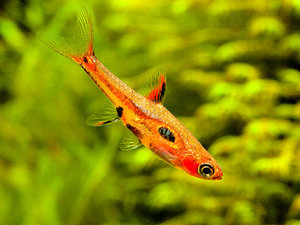
Cherry barb
Small fish growing up to 4 cm in length, They are completely non-aggressive and are the quietest inhabitants of the aquarium.In the wild, this fish species inhabits slow-moving and stagnant waters on the island of Sri Lanka.
Cherry barbs are distinguished by:
 elongated body;
- with a curved back of greenish-brown color;
- yellow or raspberry-red sides;
- dark brown stripe along the entire body;
- a striking red stripe on the upper part of the iris;
- multi-colored fins, which can be either yellowish-transparent or deep red in color;
- short antennae near the lower jaw.
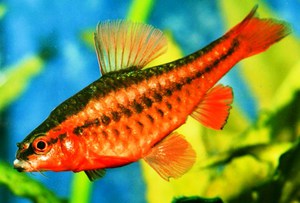 elongated body;
Females of this species of fish are much larger than males and very modestly coloredTheir abdomen is a light yellow-cream color, while in males it is bright red.
Male cherry barbs constantly compete with each other for females, while they do not cause damage to each otherThese schooling fish are best kept in groups in a community tank with other small, peaceful fish.
Fire barb
A fish from the waters of northeastern India loves slow-flowing rivers and stagnant watersIn the wild, they can grow up to 15 cm in length, but in artificial reservoirs they grow only up to 8 cm.
Fire barbs are distinguished by:
- oval, elongated, flattened on the sides body;
- bright colors;
- a dark spot on the front of the tail, which has a golden border;
- greenish-olive back;
- belly and sides with a fiery sheen.
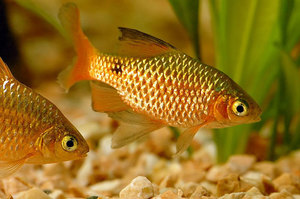 oval, elongated, flattened on the sides body;
Peaceful and unpretentious schooling fish lead an active lifestyle and coexist well in the same aquarium with fish of various species. The exception is sedentary inhabitants of artificial ponds.
Females are larger than males, less colorful, and less slender. Their fins are colorless, and their bodies range from bronze to silvery-brown. Males are distinguished by their fiery-colored sides and abdomen. and an olive-green back. Their fins have a copper tint.
This species reaches sexual maturity at eight months. For successful breeding, one female and two males should be separated from the school for two weeks and fed live food.
Barbus Sumatran
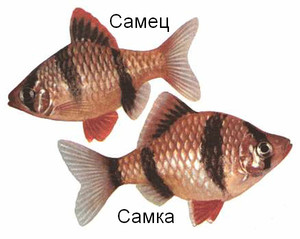
For this fish's unbearable character Many aquarists call it the "striped robber"She loves to run around the aquarium and pester other fish.
Externally, you can distinguish the Sumatranus by the following characteristics:
- laterally flattened oval body;
- wedge-shaped head;
- wide black stripes running across a silvery-yellow background, of which there must be four;
- whitish belly and dark back;
- black dorsal fin with a red border, the top of which is transparent;
- red pelvic fins;
- the remaining fins are reddish or colorless.
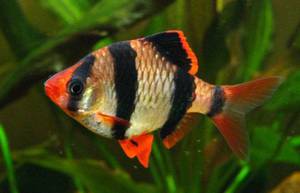 wedge-shaped head;
Males are slimmer and smaller than females, with redder fins and a brighter head. Females are distinguished by a plumper abdomen.
Sumatran barbs grow up to 5 cm, have a good appetite, and can eat almost any food. Since these gregarious the fish are moderately aggressiveThey can coexist in the same aquarium with many fish. They are often housed with other barb species, cardinalfish, spotted catfish, platies, neons, swordtails, gouramis, dinios, and pearl gouramis.
Black barb
This fish, native to the vegetated waters of Sri Lanka, was brought to Russia in 1954. These peaceful, schooling, and very active fish have:
- a laterally compressed, elongated black body;
- reddish snout;
- terminal mouth without antennae;
- yellowish-gray color with three or four transverse silver stripes;
- length up to 7 cm.
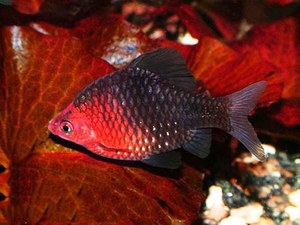 a laterally compressed, elongated black body;
During the spawning period The male's front part becomes crimson, while the back part becomes greenish or deep black. The stripes on his body virtually disappear. In females, on the other hand, the stripes become more clearly visible.
This type of fish needs to be fed not only with dry and live food, but also plants in the form of algae and scalded dandelion leaves, spinach, and lettuce. Otherwise, the black barb will start eating the aquarium plants.
These active fish can be kept in schools of 6-7 individuals in a single pond. They get along well with various fish species. It is not recommended to house them exclusively with long-finned aquarium inhabitants.
Barbus Denisoni
A fish of the carp family found in the waters of the Manimala River, which is found in southern India. This fish species got its name from the former governor of Madras, Sir Thomas Denison.
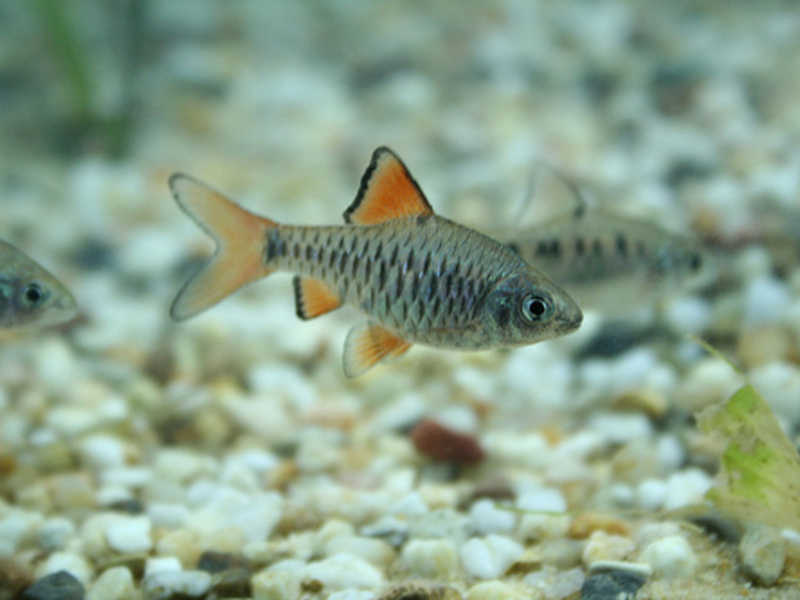
Barbus Denisoni has:
- lanceolate and oblong body shape;
- silvery color with a golden hue or vice versa;
- one black stripe down the middle of the body;
- a bright red stripe from the nose to the dorsal fin;
- olive-colored back, on which is located a fin with one red ray;
- On the caudal fin, which has a fork shape, there are small stripes of yellow and black.
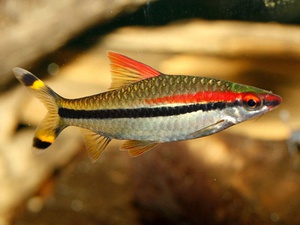 lanceolate and oblong body shape;
It's virtually impossible to distinguish a female Denisoni from a male. Only closer to spawning does the female's abdomen become fuller. The maximum size of both males and females reaches 9-11 cm.
This fish species is more demanding in terms of maintenance, so it is mainly bred by experienced aquarists. Schooling fish live in groups of at least 7 individuals in home ponds of at least two hundred liters in sizeIt's essential to create conditions close to natural conditions for them and stock the aquarium with hardy plant species. The water should be free of inorganic compounds.
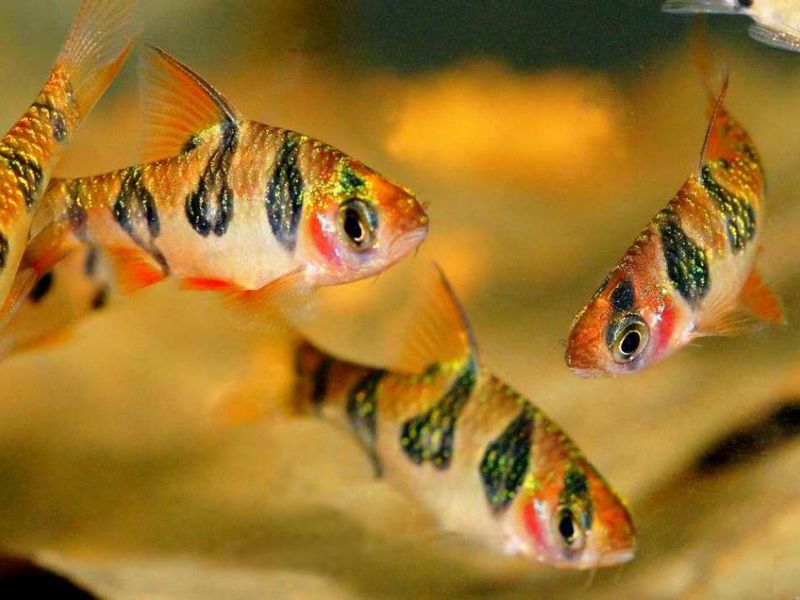
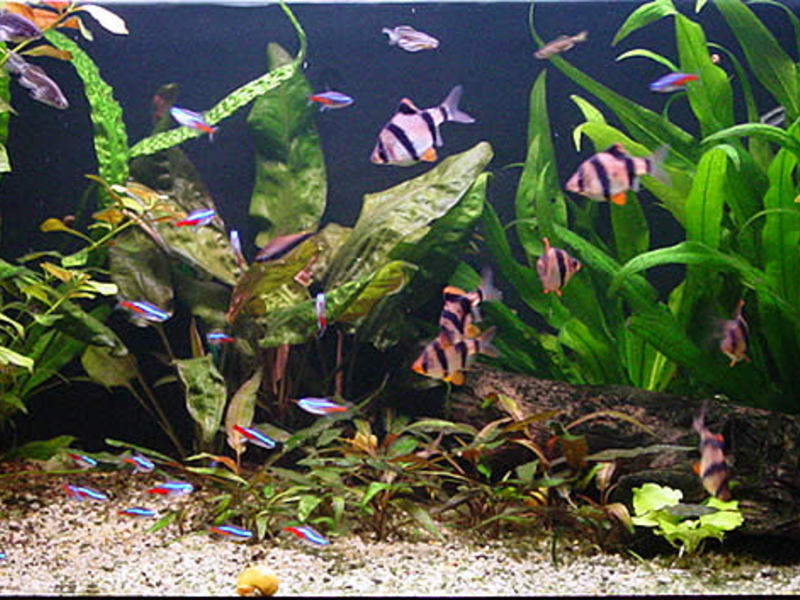
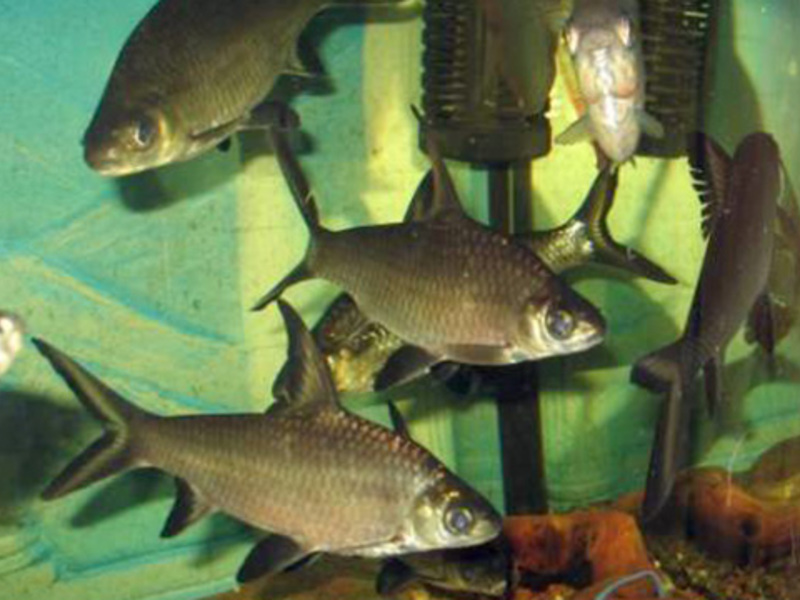
Denisoni not picky eaters, so you can feed them a variety of organic matter, including plants, crustaceans, insects, and various worms. A varied diet will make them more colorful and healthy.
Barbus the Mutant
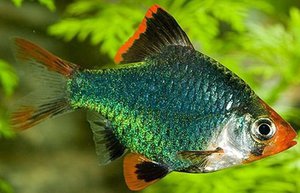
This species of barb has the most unusual coloring. The combination of dark green or dark blue with orange and black fins is very beautiful and unusual. Furthermore, the Mutant is distinguished by:
- arched back profile;
- a pair of antennae;
- 7 cm long;
- transverse intermittent black stripes.
 arched back profile;
These aquarium fish need a school, so they should be housed in groups of at least six individuals. Mutants can live with many fish species, but since they are prone to ripping off the fins of their fellow fish, it's best not to keep long-finned fish with them.
Barbus the Clown
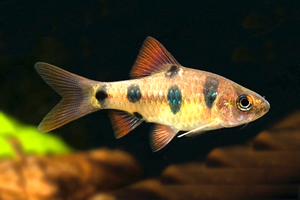
Quite large fish can grow up to 15 cm in length, so they should be kept in fairly large tanks. Clownfish are distinguished by:
- original paint;
- elongated body;
- red or reddish-brown back;
- black and blue spots on the sides;
- with red fins.
 original paint;
Males are more brightly colored and smaller in size than females. Clowns can live in pairs or flocks.During the spawning period, males and females should be kept separately for two weeks. This species spawns several times in the spring and summer, so they can produce up to two hundred eggs during this period.
Clownfish are omnivorous, but in order for the plants in the aquarium to maintain their original appearance and grow, their diet must include plant foods.
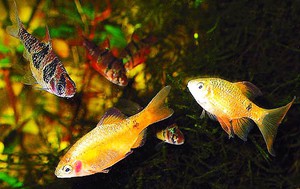
Barbus Lineatus
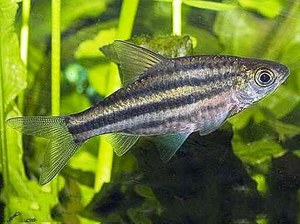
In the wild, this fish species lives in the waters of the islands of Kalimantan, Sumatra, and the Malacca Peninsula. These 8–10 cm fish have:
- elongated body shape;
- golden yellow color;
- four black and blue stripes that run along the entire body;
- transparent colorless fins;
- slightly rounded caudal fin of golden-yellow color;
- high black and yellow dorsal fin;
- terminal mouth;
- pale blue lower jaw.
 elongated body shape;
Small males have bright pink dorsal fins and a reddish tint to their bodies. Females have a duller coloration, a fuller abdomen, and a curved dorsal profile.
Into a home pond It is recommended to house 7-8 individuals of Linear barbs, where they will befriend other inhabitants. These very active fish love dense vegetation and prefer to live in the lower layers of the aquarium. Their movement should be unobstructed, and the lighting should be diffused and subdued.
Green barb
In the wild, this fish species inhabits streams and rivers in southern China, Malaysia, and Hong Kong. This schooling, peaceful, but shy fish has the following characteristics:
- a long, low green body;
- curved back line;
- terminal mouth;
- one pair of small antennae;
- golden shine;
- whitish abdomen;
- reddish or olive with yellow back;
- vertical green-gold stripes on the sides;
- dark spot at the base of the caudal fin.
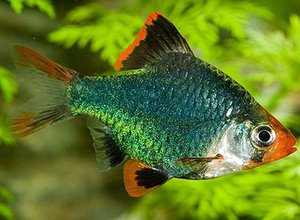 a long, low green body;
The fish's body is covered in a mesh-like pattern created by scales with a dark border. The green barb reaches 7 cm in length.It is undemanding in terms of care and food. In an aquarium, it lives up to 5–6 years.
Shark Barb
A representative of the carp family lives in the waters of Malaysia, Cambodia, and Thailand, the islands of Kalimantan and Sumatra. This fish species was introduced to Russia in the late 1970s. Although shark barbs reach 35 cm in length in the wild, aquarium fish grow to only 20 cm. Their appearance is distinctive:
- silvery-gray large body;
- body flattened on both sides;
- large mouth and eyes;
- large scales with a mirror effect;
- colorless pectoral fins;
- yellow dorsal and caudal fins with a black border.
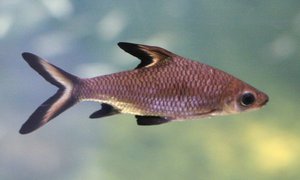 silvery-gray large body;
Since the shark barb is a very active fish, an aquarium with a volume of 150-200 liters is required for itIf the pond is too small for it, the fish will stop growing. Furthermore, it is recommended to cover the tank with glass, as this fish is a very agile jumper.
Shark barbs have a weak digestive system, so they should only be fed specific foods. Fry are fed rotifers or brine shrimp, gradually transitioning to larger foods. Feeding them bloodworms is not recommended.
Scarlet barb
This unpretentious species of aquarium fish reaches 6 cm in length and gets along well with any inhabitants of artificial reservoirsTheir appearance differs:
- slightly flattened body on the sides;
- silvery-brown color;
- dark spots on the scales, which are arranged in such a way that a beautiful pattern is formed;
- a bright scarlet longitudinal stripe along the sides of the body in males;
- large single black spots on the tail body and behind the head in young males and females;
- transparent yellowish fins;
- black markings on the anal and dorsal fins.
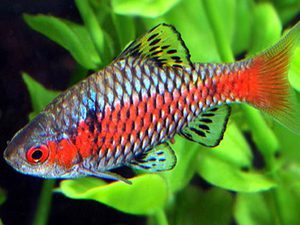 slightly flattened body on the sides;
A tank for scarlet barbs should be long. For a pair of individuals, 10–20 liters is sufficient. The water should be settled, and the bottom should be covered with dark substrate.
Scarlet barbs can be fed any food. You should give dry food and white bread., but it's preferable to include live food in their diet. This could include cyclops, daphnia, rotifers, tubifex, or bloodworms. A strong and resilient aquarium fish can live for about 3-4 years in an artificial pond.
A stunning spectacle can be created in an aquarium by placing Sumatran barbs, Mutants, Clowns and Albinos together. Since these the fish are quite unpretentiousCreating suitable conditions for them won't be difficult. And with the right diet and care, they will delight aquarists with their beauty for at least five years.