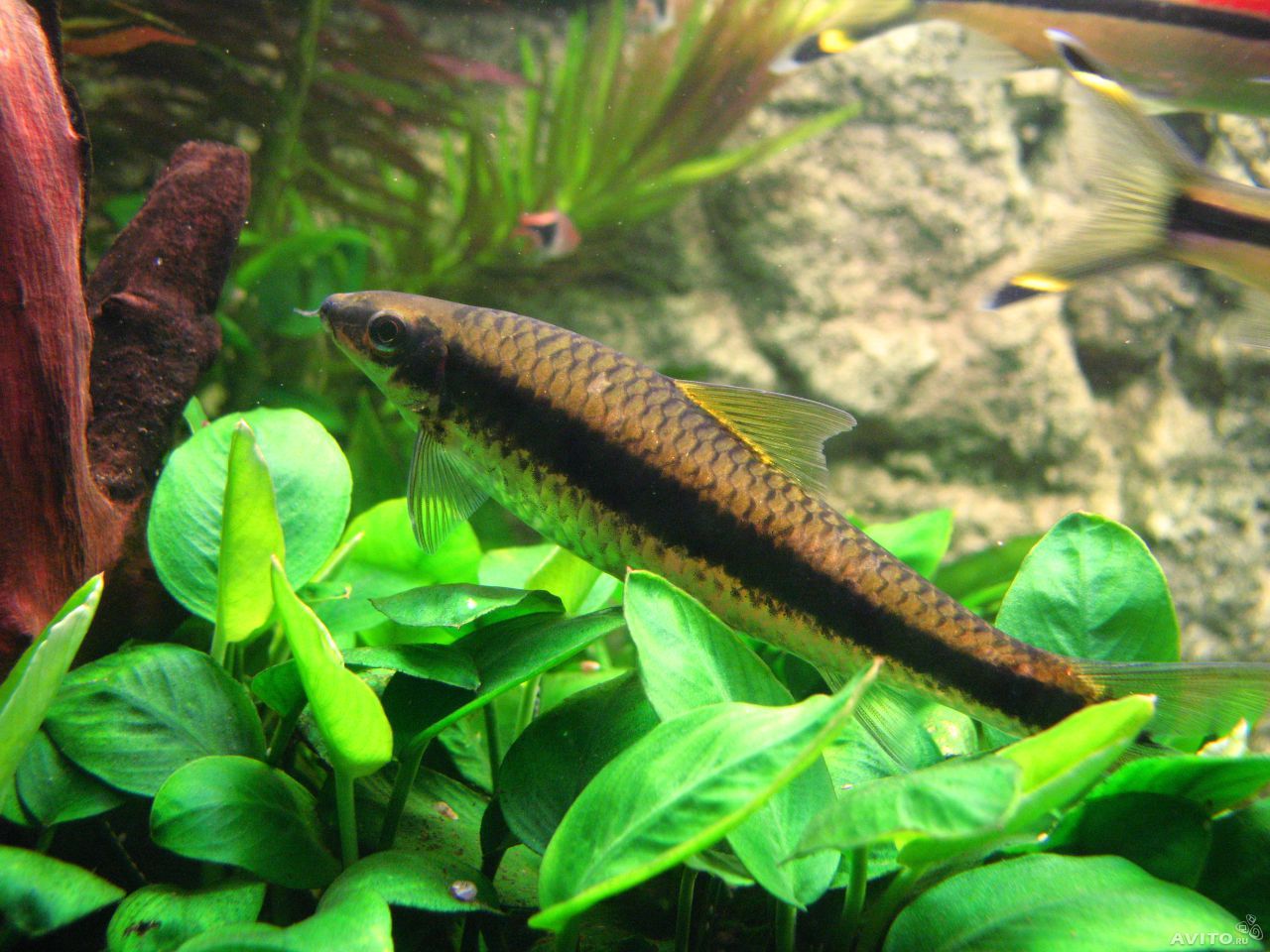
 Decided to get a fish aquarium but don't know where to start? In that case, consider danios—they're easy to care for and maintain, and even beginner aquarists can handle them.
Danios are tiny members of the carp family, with a striking and attractive appearance thanks to their vibrant colors. They are also very active and playful, making it a joy to watch a school of frolicking danios. These fish are undemanding and get along well with other aquatic species.
Content
Description of the appearance of Danio fish
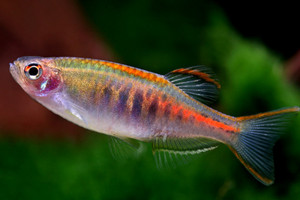 Danios are native to Southeast Asia, where they inhabit flooded rice fields and small, calm bodies of water. They arrived in Europe only in the early 20th century, and in Russia no more than 50 years ago.
These are small aquarium fish with a body about 6 cm longTheir bodies are elongated and narrow. Their heads are small, and their upturned snout allows them to feed at the surface of the water. Two pairs of thin barbels near the mouth serve as tactile organs. Their fins are small and usually transparent.
There are many species of zebrafish, but they all have one thing in common - the presence of horizontal stripesThat's why they're nicknamed "lady stockings." These fish look especially striking under bright light—their stripes shimmer beautifully.
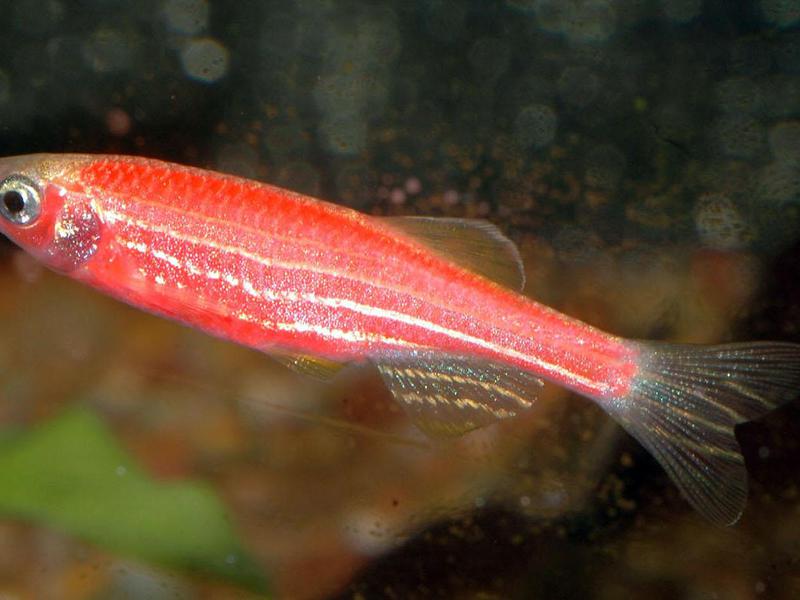
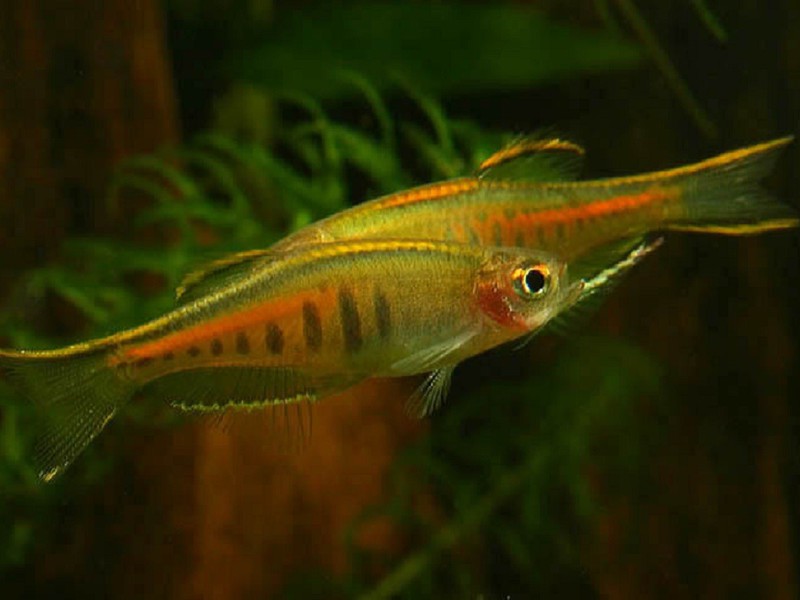
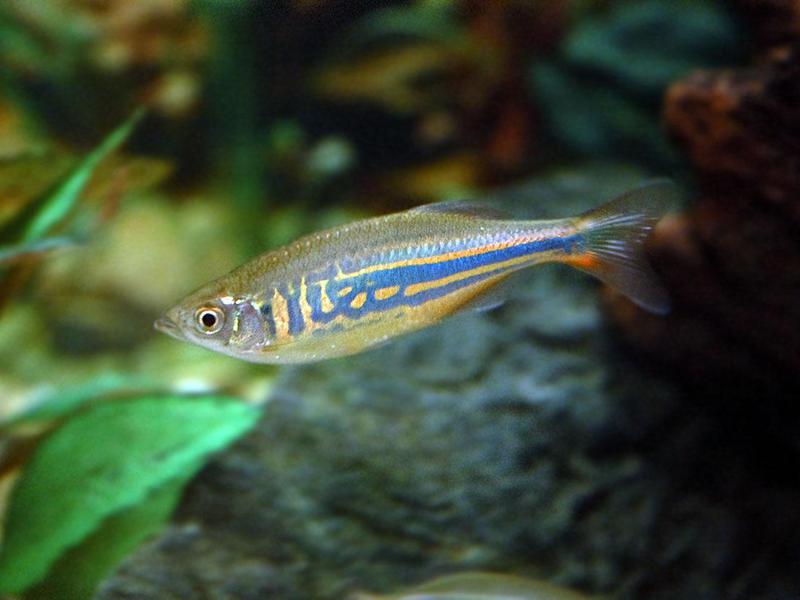
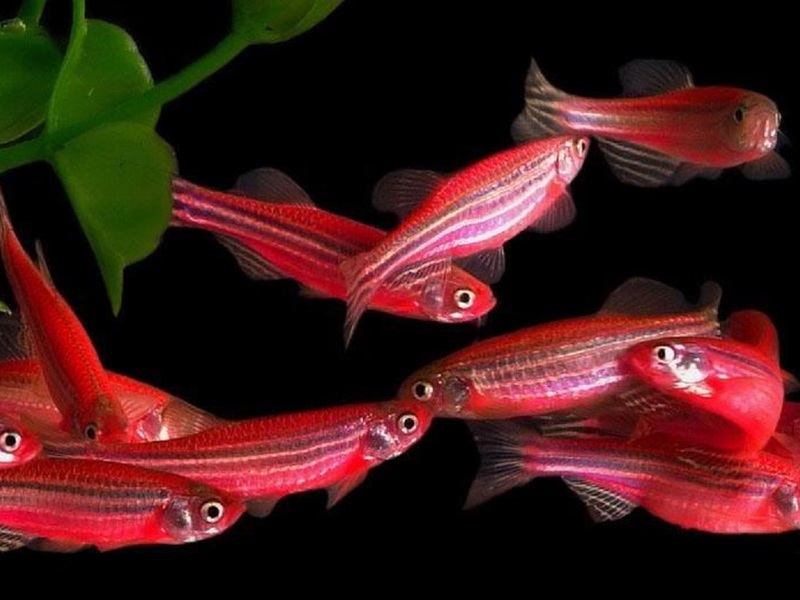
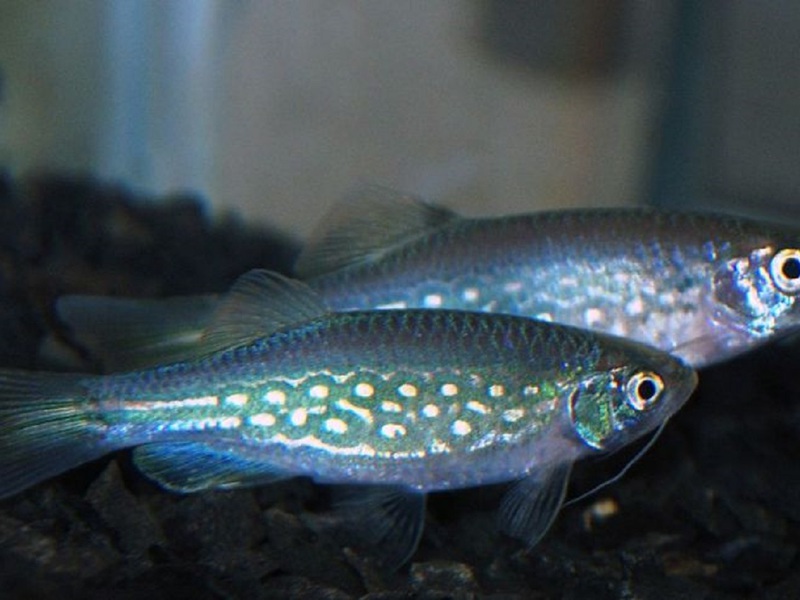
The most common types are:
- Danio rerio.
- Danio pink.
- Danio Dangila.
- Firefly danio.
- Malabar danio.
Pink danio
Pink Danio or Pearl — one of the most beautiful species of danio. These small fish reach a body length of 6 cm. Their bodies, compressed laterally, are gray-olive in color. The sides have a silvery or greenish-gray sheen, depending on the lighting.
Along the sides of the body runs reddish stripe with a blue borderBut with age, the stripe fades, and the fish lose this characteristic. The anal fin is reddish, and the dorsal and caudal fins are greenish.
Pink danios can decorate any aquarium, and they look especially beautiful with the right lighting.
Male pink danios can be recognized by their smaller size than females. They also have a cherry-colored spot in the middle of their caudal fin and brighter coloring The latter feature is easy to explain: pregnant females are slower, and their pale coloring helps them hide in the undergrowth and remain unnoticed by predators.
Danio rerio
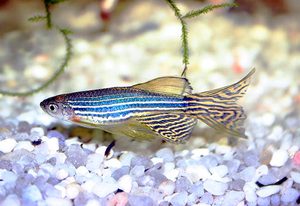 The most popular species in the aquarium hobby is the Danio rerio. These fish have a graceful body, reaching up to 5 cm in length. A distinctive feature of the Danio rerio is the alternating stripes running along its entire body. yellow and black and blue colors. The stripes also cover the caudal and anal fins.
Female danio rerio are larger than males, they have round and large abdomen, especially when they are carrying eggs. Males have a more graceful build. Females' coloring is not as intense as that of males, and their body stripes are not as clearly defined.
Only adult fish can be distinguished by sex, as juveniles differ little from each other. Due to their small size, a young female can be mistaken for an adult male.
Aquarium maintenance conditions
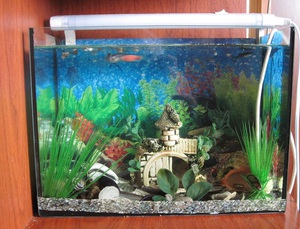 Danios are active, restless, and known for their jumping ability. Therefore, an aquarium with these fish needs to be provide a lidTo prevent pets from hitting the lid when jumping, leave 3-4 cm of free space between it and the surface of the water in the aquarium.
These fish prefer a schooling lifestyle. Therefore, for a home aquarium, it's best to purchase 6-8 individuals at once to ensure they don't become stressed and stay active.
Males constantly chase and harass each other. This behavior doesn't necessarily mean the fish are aggressive toward their peers. It's a manifestation of activity and a typical way for danios to live in a school.
Danios are small and love to frolic, so they will need a container volume from 50 liters and larger. An oval, elongated shape is best—it allows the fish to move easily and confidently. The bottom can be lined with small stones or gravel. It's helpful to provide small hiding spots—the fish will feel comfortable having a place to hide.
Vegetation should be present, but it should not be thickTo ensure the school has ample space to swim freely in a well-lit area, it's best to plant plants along the sides and back of the aquarium, leaving a clear space in the middle for the fish to feed.
Care instructions
 Danios adapt well to a wide range of temperatures, from 18 to 30°C. However, it's best not to test your pets' endurance and provide them with a temperature about 18-24 °C - this way they will be less susceptible to diseases.
These tiny creatures love good lighting, so if you don't have any special equipment, you should find a well-lit place to place the aquarium.
Danios swim in the upper and middle layers of the water, where oxygen is usually sufficient. Therefore, additional aeration of the aquarium is not required.
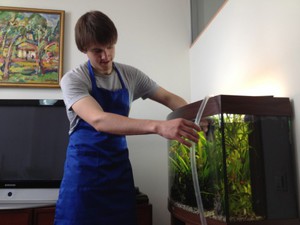
Optimal water parameters in an aquarium: water hardness dH 3-15° and acidity pH 6-7.5. It is important to remember weekly water changes: a quarter of the water in the container is replaced with clean water, which has been left to settle for several days.
In their natural habitat, danios feed on zooplankton, plant seeds that have fallen into the water, insects, and their larvae. As pets, they are unpretentious: they happily eat any food. food - live and dryAnd their favorite treats are bloodworms, Artemia, and tubifex.
The food should be in small pieces, otherwise the pets won't be able to swallow it. They won't pick up food from the bottom, as they primarily feed from the surface of the water.
Compatibility with other fish and possible diseases
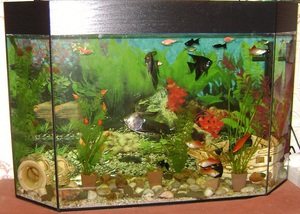 Danios will enhance any aquarium, including community aquariums. Their peaceful nature allows them to be kept with other small, peaceful inhabitants of home mini-tanks. They get along well with neons, swordtails, gouramis, and other fish.
Snails, ampullaria, and shrimp can also be tankmates for danios. However, danios should not be kept with aggressive fish and some species of veiltail fish.
Despite their unpretentiousness and adaptability, these fish are susceptible to certain diseases. One of them is curvature of the spineIt most often appears after a fright: the fish's eyes bulge, its gills spread out to the sides, and its scales stand on end.
The outcome is tragic: after a while, the fish dies. A disease called dropsy also occurs. Its symptoms include raised scales, a swollen abdomen, and bulging eyes. The disease leads to the death of aquatic inhabitants.
Breeding Features
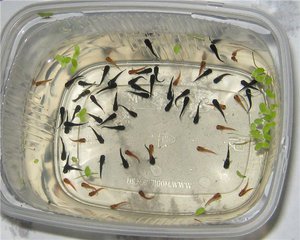 Breeding danios isn't particularly difficult: spawning is simple, the fry are numerous, and they grow quickly. They reach sexual maturity at 7-8 months of age. The best fish are selected for spawning. strong and active individuals.
Before breeding, males and females are placed in separate aquariums of at least 10 liters capacity with a temperature of at least 20°C. Here, the males are actively fed live food for several days. During this time, the female's abdomen should become noticeably rounded, indicating her readiness to spawn.
For spawning you need to prepare separate spawning aquariumHere's what you need for this:
- A suitable container with a volume of 3-12 liters is selected.
- Plants, moss, or a protective net are placed on the bottom of the spawning tank to prevent the parents from eating the eggs.
- The aquarium is filled with clean, settled water.
- The water level in the container should be 5-10 cm so that the fish have 3-4 cm of free space above the vegetation lining the bottom.
- The temperature in the aquarium is created a couple of degrees higher than what the fish are used to in order to stimulate spawning.
The breeders (usually a female and 2-3 males) are released into the spawning tank in the evening to allow the fish to get used to their new surroundings. The vessel is placed on a well-lit windowsill.
Spawning typically begins early in the morning at the first rays of the sun and lasts one to two hours. A female can lay 50-400 eggs, the number depending on her size and state of preparation. After spawning parents are being moved away back into the community tank so they don't eat the future offspring.
If the temperature in the spawning tank is maintained at 23-26°C, the fry will hatch as early as the third day. At lower temperatures, their appearance can be expected in 7-10 daysThe first few days the fry hang on the glass and plants, and then begin to swim.
During the first few days after hatching, the fry are fed live dust or infusoriaThen, gradually, the food for them is enlarged and transferred to a more spacious container.
Breeding danios is a simple process, and with the right approach, even beginners can get offspring from these charming fish.