 Aquariums with a variety of inhabitants are in high demand. These pets require little maintenance, and observing them is a joy. Fish rightfully take the cake in this regard. Besides being a beautiful addition to the aquarium, they delight with their appearance. However, caring for them can be challenging.
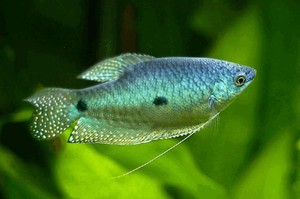
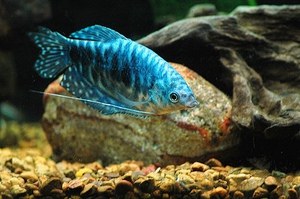
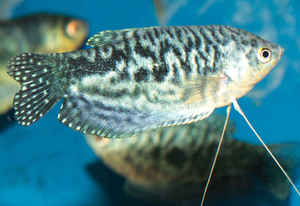
There's a rule: the more beautiful the fish, the more demanding its care. But, for example, the marbled gourami has a unique shape and beautiful coloring. They're well-suited for beginners, require little care, and breed easily.
Where does fish care begin?
Keeping any fish starts with something simple: choosing an aquarium. Marble gouramis are best populate in small flocks, five or seven fish each. An aquarium of at least 50 liters (12 gallons) is sufficient for them. Adults will require a larger home—an aquarium of at least 80 liters (27 gallons). It's important to leave a good layer of air space. To achieve this, leave at least 8 centimeters (3.1 inches) of space between the lid and the water surface. It's important to ensure there are no temperature fluctuations. Otherwise, the gourami will become ill from gulping cold air.
Keeping your fish depends on the water quality. Each region has its own specific drinking water sources, so pay close attention to your water quality. Experienced gourami breeders recommend keeping the temperature between 23-28 degrees Celsius. The pH can be a maximum of 8, and water hardness - no more than 35.
A filter is an essential component of any fish care. Its job is to oxygenate the water by regulating currents of varying strength. For gourami, powerful filters are not recommended; minimal settings are sufficient. Replace some of the water weekly. Unlike other species, the marbled gourami does not require mandatory aeration.
Gourami care also includes lighting. Morning sun is best, while artificial overhead lighting is best in the evening. The marbled color looks best on dark substrate. Granite chips, coarse sand, and small pebbles are best for this purpose.
What should the aquarium ultimately contain?
 Lamp;
Lamp;- Priming;
- Plants;
- Shelters;
- Filter;
- Thermometer optional;
 Lamp;
Lamp;Feeding the fish: the main points
Proper feeding is an essential part of any pet's care. The marbled gourami is no exception. Experienced breeders claim that these fish will eat all types of food. Therefore, you can safely combine them. For example, among live ones, you might prefer bloodworm, tubifex, coryza or brine shrimpThe main criterion is the size of the pieces. Since gouramis have small mouths, large pieces can get stuck in their throats and cause problems. Scraped meat can be given as a treat (it should be frozen first to remove any parasites).
Marbled gourami will also enjoy dry food, such as gammarus or cyclops. These are sold in pet stores in two forms: flakes and granules. In the summer, you can harvest greens, such as dandelion leaves. Just make sure to collect the plant outside the city, away from busy roads. Lettuce leaves are also a good choice. Marbled gourami can also eat oatmeal and bread crumbs.
The only rule of feeding is variety. It wouldn't hurt maintain a balance of nutrients in the diet. Marbled gourami easily tolerate fasting for two weeks. However, this shouldn't be done too often, as pets can die or become ill. Keeping gourami is notable for a fun fact: these fish have excellent hunting skills and easily catch insects. This makes them excellent parasite fighters in aquariums. For example, hydra planaria can be introduced into the water with live food. Marbled gourami pets will also enjoy small snails.
Marbled gourami and other species: compatibility
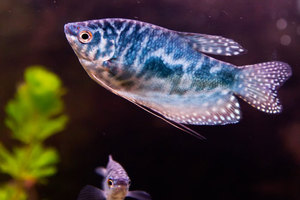 Many beginning aquarium fish keepers wonder: can marbled gourami be kept with other species? A definite no to smaller fish, as they may be perceived as food. Incidentally, species such as swordtails and barbs can terrorize gourami by tugging at their filiform fins. Therefore, it's best to keep marbled gourami in a separate aquarium.
Reproduction: Do it wisely
It is worth talking separately about breeding gourami. Various types of plants are often used to decorate an aquarium. They are best plant in small groups, leaving room for the pets to swim. They are most often placed near the back wall of the aquarium. Be sure to provide floating plants separately. They are needed so that the male can build a nest and spawn.
The marbled male differs little from the marbled female. Specifically, he has a more pointed and elongated dorsal fin. Individuals are typically ready to breed at eight months, though experienced breeders consider a year to be the optimal age. For spawning, it's best to set up a separate aquarium with a capacity of at least 30 liters to ensure the fry are not harmed. The water should be warm, preferably around 28 degrees Celsius.
It's also best to separate the male and female. Before breeding, it's best to keep the gourami separately and feed them exclusively live food for two weeks. It's easy to tell when a female gourami is ready: the full belly of the calf is visibleAfter this, the marbled male and female are placed in the spawning tank. During this time, the male begins building a nest using foam, saliva, and plants. This takes a maximum of two days. Beforehand, ensure you provide a hiding place for the female, as the male may become aggressive during this short period.
The pair's upbringing then becomes very interesting. The mating ritual begins. During it, the male spreads his fins gracefully and dances, displaying himself in all his glory. If he succeeds in attracting the female, mating begins. The female settles near the nest, and the male helps her squeeze out the eggs, fertilizing them at the same time. A total of just under a thousand fry are produced. In reality, most of them will not survive. After the mating, the male deposits the eggs in the nest and chases the female away, so it's best to separate her.
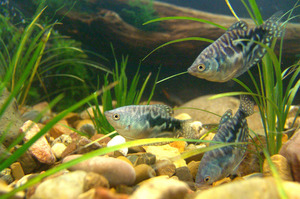 Interesting fact: male gourami care for their young themselves. The eggs will hatch in about three days, and it's best to remove the male at this stage. Otherwise, he'll injure or eat the fry. Microdoses of worms or bloodworms are used as food. Remove any leftover food promptly, otherwise the aquarium will become dirty. will cause mass death of fryUnlike adult gourami, juveniles require aeration because their labyrinth organ is not yet fully developed. Monitor the size of the fry and separate them into different aquariums promptly.
Overall, caring for gouramis isn't all that difficult. And their exotic appearance will surely attract any connoisseur of beauty. So, what makes gouramis so special?
- Colorful painting;
- Low maintenance;
- Simple propagation;
- Unpretentiousness to conditions;
As you can see, these fish are ideal pets for a home aquarium.