 For beginner aquarists, it's advisable to choose easy-to-care-for fish. This will allow them to learn how to properly care for their fish at first. If the results are positive, then it's time to introduce other species that require more experience and knowledge.
One of the most common species is the gourami. It's easy to care for, and its friendly nature will always brighten the mood of everyone in the house.
Description of Gourami and its photo
The list of the most common aquarium fish The gourami is a fish that has long gained popularity due to its low maintenance requirements, attractive appearance, and friendly nature. Experienced aquarists also call it a lazy fish.
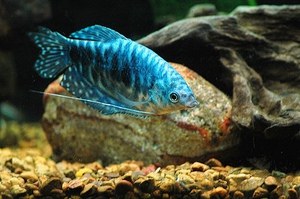
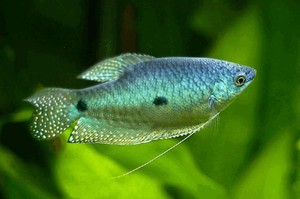
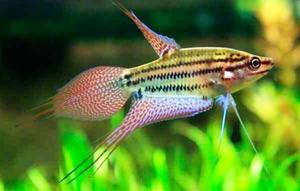
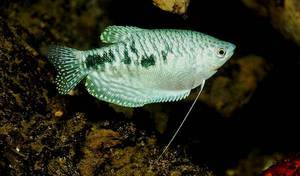 The photo clearly shows that Gourami is distinguished by its pectoral fins They have long whiskers. They resemble thin arms in appearance. They serve as the fish's sense of touch. This is why these fish are also called thread-bearing gourami.
Gourami belong to the genus of tropical freshwater A member of the macropod family. In the wild, they are found primarily in Southeast Asia, where they thrive in still, slow-moving waters. Gourami vary in shape and color depending on their habitat.
Gourami fish didn't arrive on the European mainland immediately. Spotted gourami were the first to be brought to Europe. Since then, modern breeders have succeeded in developing many species with different color patterns.
As you can see in the photo, these beautiful and unusual fish They have an elongated, oval-shaped body. Aquarium species most often have a body length of up to 4.5–10 cm. There are specimens that grow up to 15 and even 35 cm. The latter are considered true record-breakers.
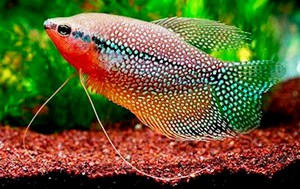 The fish's body is flattened on the sides with filiform pectoral fins. A continuous lower fin extends almost to the tail. can you tell a female from a maleMales have a pointed, elongated dorsal and anal fin, while females have rounded, short fins. Gourami always have spots and stripes on their bodies, and their natural color is traditionally light silver. Gourami can come in a variety of colors, but the brighter the color, the healthier they are.
In captivity, this aquarium fish is believed to live for 5–7 years, but sometimes this species can live up to 12 years. Much of its lifespan will depend on the conditions it is kept in.
During the process of evolution, the Gourami developed a labyrinth. It is additional respiratory organ to the gillsThe labyrinth is located in the cavity above the gills and consists of extremely thin bony plates. The plates are covered with a mucous membrane and are permeated with a network of vessels. This organ begins to develop only 2–3 weeks after the fry hatch from the egg.
Types of Gourami
There are many species of these beautiful and active aquarium fish. The following species are considered the most popular among aquarists:
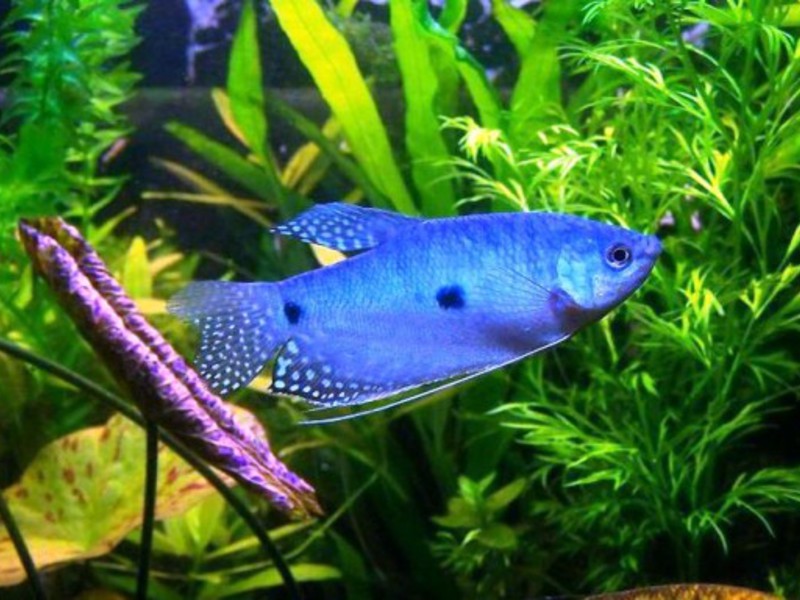
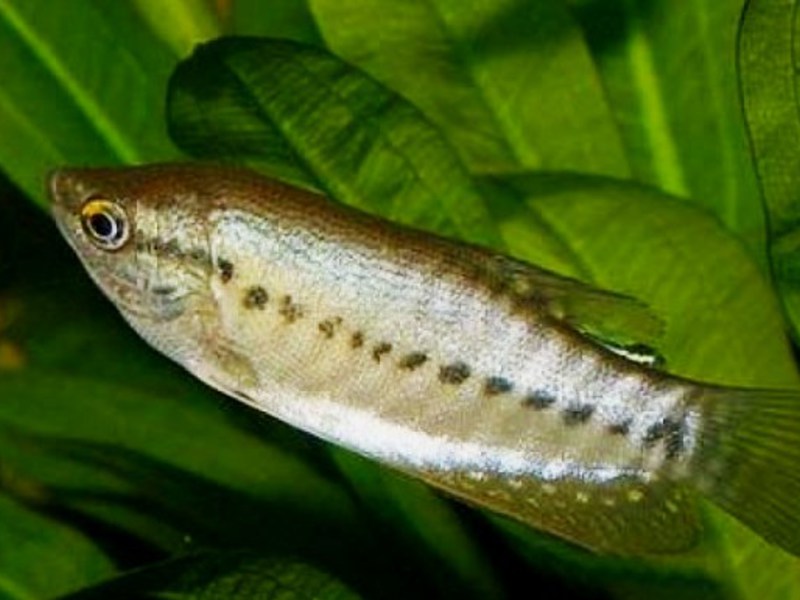
 Spotted (common) These bluish or golden-colored fish have barely noticeable spots on their bodies. Darker, almost black spots are located on their sides and tail. They can grow to a maximum length of 13 cm. They are very friendly and peaceful, so they almost always get along with other aquarium inhabitants. They are considered the progenitors of the marbled species.
- Marble — They were bred through selective breeding. They grow up to 12 cm and are distinguished by irregularly shaped black spots located on the rear of their bodies.
- Pearl — are distinguished by their silvery-purple coloring and reach a length of 11 cm. The spots on the fish's body resemble pearls, hence their name. A dark stripe runs along the entire body.
- Grumbling — were named for the sounds they make, which resemble the cooing of a pigeon.
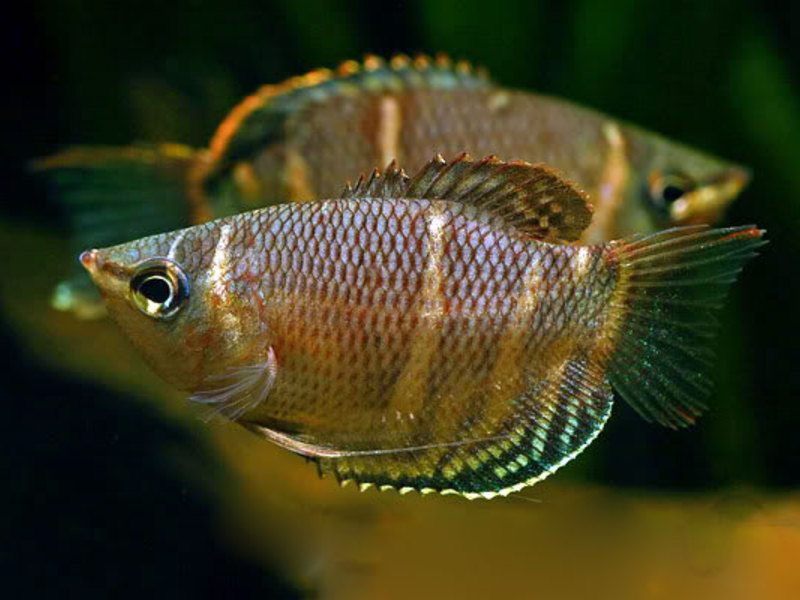
- Honey Gourami — can grow up to 7 cm in length. Their color resembles honey, but turns red during spawning season. These fish are very calm, but extremely shy.
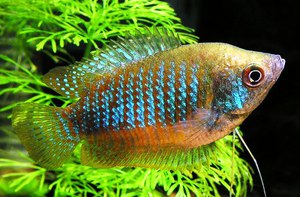
- Golden (solar) — are distinguished by their yellow-orange body color. Barely visible stripes reach a maximum length of 8 cm. Red and yellow speckles adorn the fins, and the tail has a dark edge.
- Blue gourami — are distinguished by the fact that they do not have stripes on their bodies.
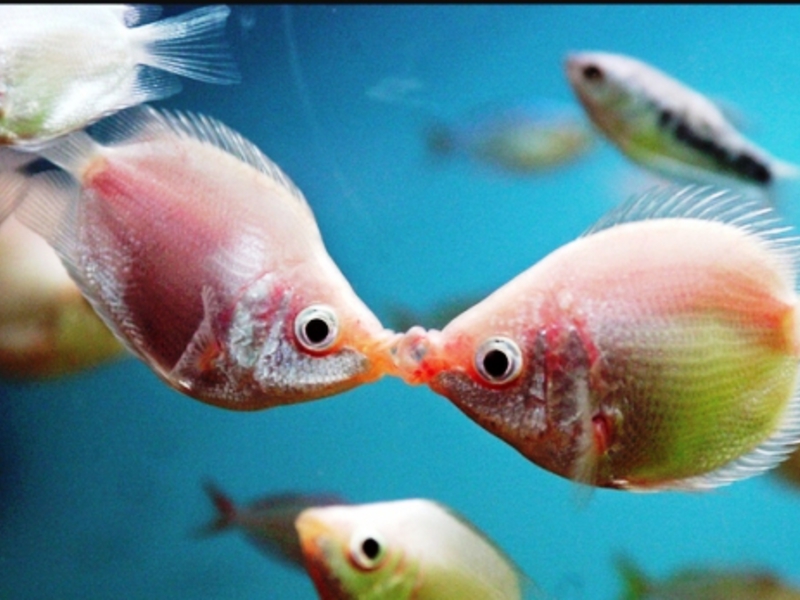
- Kissing (pink) — have a distinctive feature: thick lips. They have a row of teeth. The fish often touch each other with their mouths, hence their name.
- Flying (tiger) — an unusual species with a wing-like growth on its body. Their appearance is very unusual.
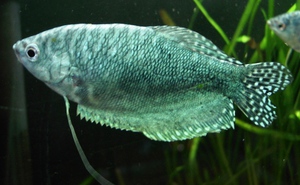 Spotted (common) These bluish or golden-colored fish have barely noticeable spots on their bodies. Darker, almost black spots are located on their sides and tail. They can grow to a maximum length of 13 cm. They are very friendly and peaceful, so they almost always get along with other aquarium inhabitants. They are considered the progenitors of the marbled species.
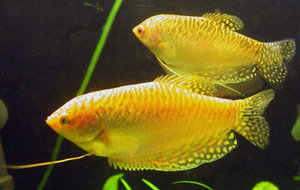 Blue gourami — are distinguished by the fact that they do not have stripes on their bodies.
Most The largest species is the brown (snake-like) gourami, as the fish can grow up to 20 cm in length. Its coloring resembles that of the spotted gourami, but with a sharper snout. The body is generally silvery, but with a broken stripe of dark spots running along it. Dark lines run transversely across the entire body. Young snake gourami are distinguished by their uniform coloring.
Gourami Reproduction
 At the age of 9–12 months, fish reach sexual maturity. The breeding process of Gourami This is quite unusual, and it occurs differently in many species. Males are more vibrantly colored at this time, allowing them to be seen in all their glory.
For spawning it is necessary Prepare a special 20-30 liter container with soft, clean water. Place floating plants in it. To make the spawning tank more comfortable and speed up the breeding process, the water in it should be approximately 5% OFrom above. It is imperative to place more live food in it.
The spawning process occurs in stages:
- First, the male builds a nest from pieces of algae and his own foam;
- he constantly shows off in front of the female and after building the nest, he begins to invite her to spawn, nudging her with his nose;
- when the female is ready to spawn, she swims to the nest and spawns up to 2,000 eggs over it;
- The male's task is to pick up the fallen eggs and attach them to a permanent location.
The male continues to care for the eggs and the nest. After a couple of days, the fry hatch, and when they reach 10 days of age, the adults should be moved to another tank. They may harm or eat the fry. After 2-3 weeks, the adult gourami are ready to breed again.
Care Features
For the fish It was comfortable to be in the aquarium, it is necessary to create conditions in it that are as close as possible to the natural habitat:
- an aquarium with a volume of at least 20 liters and a water level of no more than 35 cm;
- clean water with frequent replacement of 1/4 of the total volume and a temperature of 26–28 OWITH;
- good lighting;
- decorative elements and aquarium plants;
- bright light for 12 hours daily.
 an aquarium with a volume of at least 20 liters and a water level of no more than 35 cm;
These fish are very active and can leap high above the water. A protective cover with air holes is recommended for the aquarium.
Gourami are considered easy to maintain and attractive in appearanceThey are fascinating to observe. They will enhance any aquarium, as they always look bright and beautiful. Even beginner aquarists can handle their care and maintenance.