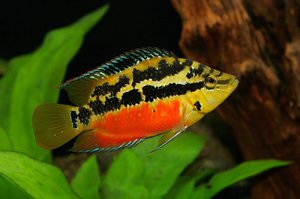
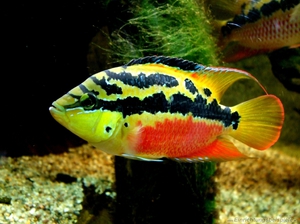
 The beautiful Salvini cichlid became popular among aquarists towards the end of the last century. Its reddish, fruit-colored side earned it the nickname "mango cichlid." Its bright and colorful coloring makes this fish very attractive. However, it has a rather aggressive nature, requiring careful consideration when keeping it in captivity.
Appearance and behavior
In the wild, Salvini cichlids inhabit the strong and weak currents of Guatemala, Honduras, southern Mexico, and Central America. These predatory fish feed on invertebrates, insects, and fish, which they hunt in the open spaces of tributaries and rivers.
In a confined space Cichlasomas grow to a maximum of 16 cm, making them quite suitable for aquarium keeping. The fish are distinguished by their appearance:
- elongated oval body;
- sharp muzzle;
- large head with large eyes;
- with thick lips.
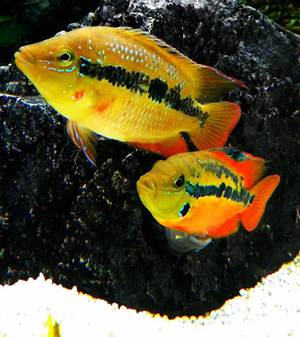
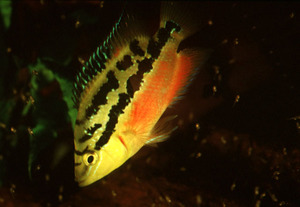
This predator's coloring is quite unusual. It can range from lemon or canary yellow to olive green. The belly is orange or reddish. Bright blue spots are scattered across the body and fins. Two black stripes with a blue tint appear to be painted along the entire body. The upper stripe consists of irregular outlines, while the lower stripe is solid. This coloring makes the cichlid's beauty simply mesmerizing.
It would seem that every aquatic enthusiast should keep such a vibrant fish in their aquarium. However, professionals know that breeding cichlids requires great careWhile the predator is peaceful under normal conditions, during spawning and mating season, males are extremely aggressive. Any other individuals encountered during this time are terrorized and beaten to death.
Differences between males and females
It's fairly easy to tell the sexes apart. The male is much larger and has a fatty bump on his forehead. The female has additional black spots:
- paired spots resemble additional eyes and are located below the midline on the gill covers;
- a single spot is located in the middle of the dorsal fin.
Cichlasoma salvini: care and feeding
 To keep a pair of fish, a 200-liter aquarium is sufficient, but if they are to be kept with individuals of another species, the tank should have a capacity of at least 400 liters. The water is filled slightly alkaline or neutral, with a hardness of 5-20 dH and a temperature of 24°C to 26°C. Predators are very demanding regarding temperature, so if necessary, the pond is equipped with a heater.
Almost any substrate is suitable for the cichlid salvini. Small pebbles or granite chips should be added to a depth of 8 centimeters. This is necessary to allow for the planting of plants with strong rhizomes and tough leaves.
Fish prefer areas sheltered from external light by a rock or driftwood. Therefore, even delicate algae, such as Echinodorus, can be planted in open areas. Elodiya, Vallisneria, Myriophyllum, and Cryptocorynes are also suitable for a cichlid aquarium. Elodiya grows quickly, so using it in an artificial pond eliminates the need for various artificial flora.
It's not recommended to provide strong lighting for a Salvini cichlid aquarium, as the fish don't like bright light. To prevent the fish from constantly hiding in a shelter, a small amount of light is sufficient. fluorescent lamps at 0.3 W/l.
Rocks and driftwood are essential in the aquarium. To create hidden areas and additional hiding spots, some driftwood should be positioned vertically.
The artificial pond must be equipped with good filtration, as cichlids naturally thrive in crystal-clear water. A quarter of the tank's volume will need to be replaced every week.
Feeding
As true predators, cichlids prefers food of animal originThey can be fed:
- frozen or live bloodworms;
- earthworms;
- cricket larvae;
- sometimes corethra and tubifex;
- chopped frozen seafood;
- young shrimp or live small fish;
- dry food for cichlid fish.
It is recommended to include natural food in the diet add plant foods in the form of scalded lettuce or spinach leaves. You can even feed predators oatmeal.
Compatibility with other fish
Predators consider small fish as food, so they should not be kept with species like guppies and neons in the same aquarium. Cichlasomas can live side by side with:
 Other cichlid species. In this case, fights between males are inevitable, so the artificial pond should be spacious enough and equipped with various hiding places.
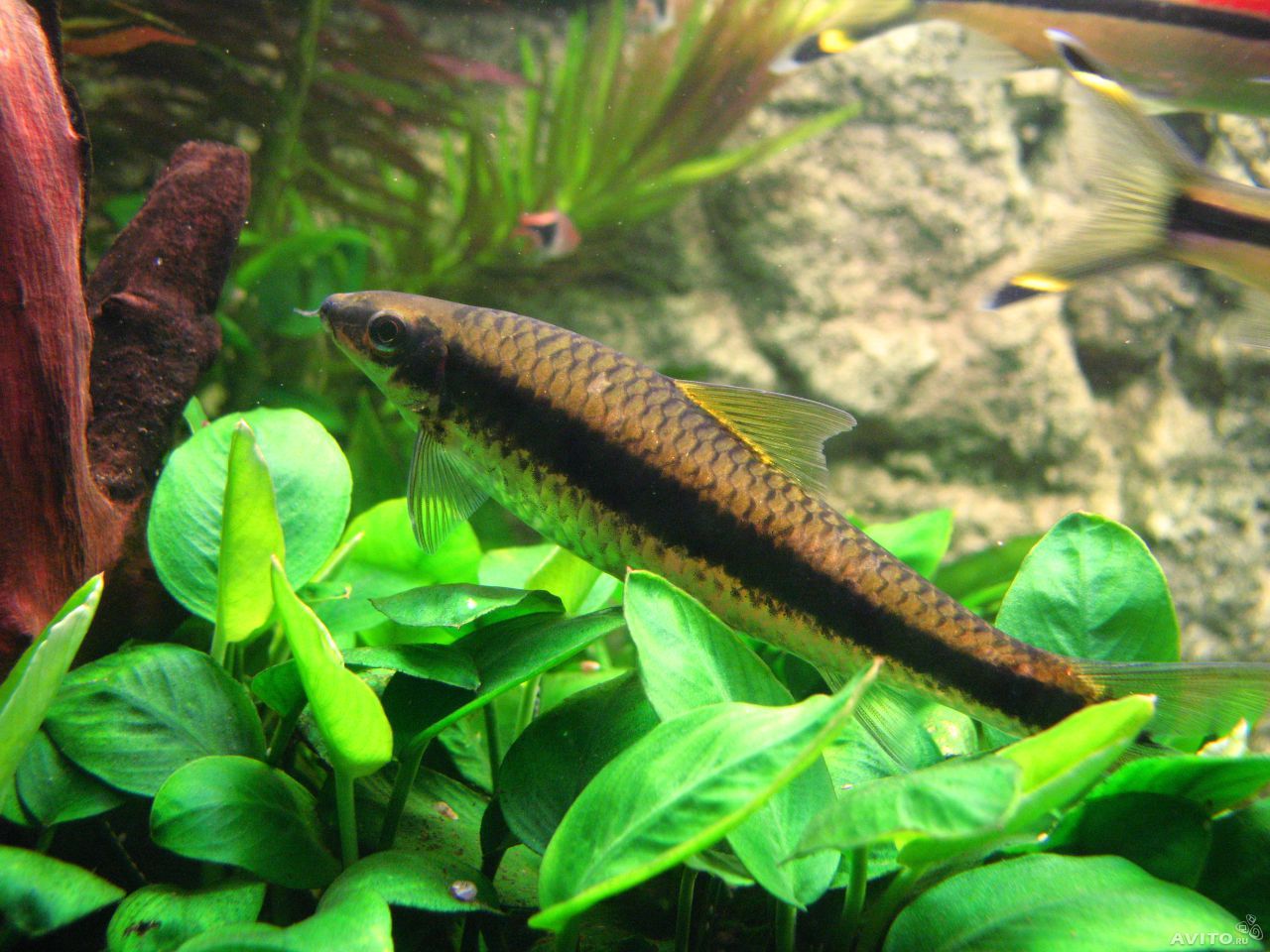
- Interbranch catfishes, or tarakatums, are generally considered predators. Predators ignore unrelated species of large fish. Furthermore, catfish are stress-resistant and combative representatives of other families.
- You can keep just one pair, without adding any other fish. However, there's a chance that the male may kill the female during a spat. In this case, as soon as a "family conflict" occurs, the aquarium can be divided into two halves using glass or mesh.
 Other cichlid species. In this case, fights between males are inevitable, so the artificial pond should be spacious enough and equipped with various hiding places.
If a cichlazoan living with neighbors becomes aggressive and attacks other fish, it should be kept away for a while (until it calms down) transplant into a separate pond.
Breeding
 Salvini cichlamosas reach sexual maturity at a size of 12-13 cm. These fish choose their mates independently, so it is recommended to purchase either a group of juveniles or an established pair. Choosing a mate for this species is not recommended, as the male may simply kill a female he doesn't like.
"Married" couple immediately begins to dominateIn this case, the male attacks other males, and his partner attacks females. Therefore, it's best to separate the pair immediately.
When properly maintained, cichlids spawn without any stimulation, at intervals of several weeks. Stimulation involves raising the aquarium's water temperature by 3-4 degrees Celsius and simultaneously changing up to two volumes of water per week.
Cichlamosas lay their eggs on a vertical or inclined surface. This can be a large rock, a grotto, or a ceramic pot. The area containing the eggs must be covered. Cichlamosas lay 500 to 600 eggs at a time.
The male guards the surrounding area, while the female removes dead eggs and fans the surviving ones with her fins. To ensure the survival of the eggs, the water temperature during their development should be maintained within 26C.
After about three days, the larvae hatch, and the female transfers them to a previously dug hole. There, under the protection of their parents, they develop for another five days. Once the fry reach 4-5 mm, they begin to swim and feed independently. They can be fed chopped tubifex, daphnia, or brine shrimp. In a spacious aquarium planted with plenty of algae, the fry can feed themselves on small crustaceans and protozoa found in the weeds.
For your little Salvini they take care of it for quite a long timeThey gather them into schools and take them out for walks, while aggressively guarding the fry from other inhabitants of the reservoir. Therefore, during spawning, it is best to isolate the male, female, and offspring from their neighbors.
A very beautiful member of the cichlid family, the Cichlamosa salvinii is rarely seen behind aquarium glass due to its aggressive nature. However, if you do decide to keep this beautiful predator, you'll be able to admire not only its magnificent coloring but also witness its struggle for survival in your pond. You'll definitely never be bored with this fish.