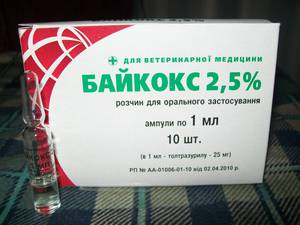
 Anyone who keeps birds probably knows that they are often susceptible to various infectious diseases. For this reason, they are given special medications that act as a preventative measure against these diseases. One of the most effective is Baycox. You'll learn about its specific uses below.
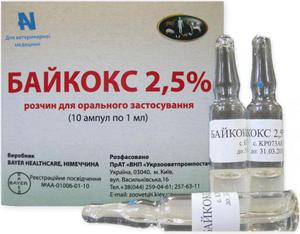
Baycox is an effective remedy for the treatment of coccidiosis in different species of poultry:
- chickens;
- broilers;
- geese;
- turkeys;
- ducks;
- quails;
- pigeons and others.
The drug's key component, toltrazuril, destroys pathogens at any stage of development. Using Baycox does not weaken the immune system or reduce the ability to resist coccidiosis. It can be used alone or in combination with other medications.
Instructions for use of the drug and dosage
Baycox is prescribed for birds with increased levels of coccidia in the litter, which constitutes from 10 to 20 thousand/g for prevention and clinical manifestations of the disease.
The medicine should be taken with water. The dosage is as follows:
- 7 mg of medicine is required per kilogram of bird weight;
- per 100 kg – 28 ml of 2.5% solution.
One ml of Baycox solution is used per liter of water; this volume is sufficient to administer to the bird for two days. Alternatively, the solution can be diluted to 3 ml per liter, but the dosage will be different. This solution is administered for two days, eight hours at a time. If the disease is severe, the medication is repeated after five days.
Solution with Baycox can be stored for up to 48 hours, then it should not be given to birds. Also, the solution should be stirred well if sediment appears.
Recommendations for taking Baycox vary slightly depending on the bird it is prescribed for and its age.
Using Baycox for chickens
When raising chickens, you need to protect them from infectious diseases.
Starting from two weeks, the chicks susceptible to such diseases:
- impaired digestion;
- developmental delay and weakness;
- oxygen deficiency;
- viruses;
- coccidiosis.
Baycox can be given to chicks for coccidiosis along with other medications with similar effects. However, it must be prepared with water; 1 ml of the product is required per liter of liquid.
Baycox for goslings
 Goslings are susceptible to infectious diseases from the first days of life, which, if left untreated, can lead to their death. Their immune system is weak, and their body is not yet capable of resisting. However, unlike chickens, goslings are more resilient and have higher survival rate.
Goslings need to be monitored and their development addressed. From two weeks of age, coccidiosis and other infections should be prevented. Add a Baycox solution to the water. Apply 1 ml of a 2.5% solution per liter of water. Administer throughout the day.
Application for turkey poults
When breeding turkeys, you need to have them with you from the first days of their life such medications:
- growth and development accelerators;
- antifungal drugs;
- antibiotics;
- probiotics;
- vitamin and mineral complexes;
- Baycox.
Turkeys with coccidiosis have a poor appetite, are very weak, and have liquid feces containing blood impurities.
Baycox for other chicks
The rules for using Baycox for other types of chicks are the same. During this time, they should be given supplements to strengthen their immune system. Don't forget to give them vitamin supplements to promote their growth and development.
Baycox is diluted in water, 1 ml of the product is added to a liter of water.
Use of Baycox for adult birds
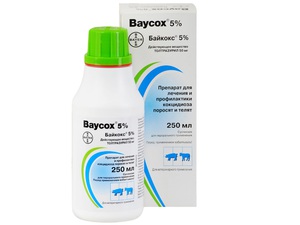 Baycox should be administered to broiler chickens when coccidia levels in the litter reach 10,000 to 20,000/g. The recommended dosage is 1 ml per liter, administered over 24 hours. For preventative purposes, the solution is diluted in water and given to the birds for 1-2 days, depending on the chosen dosage.
Similar dosage instructions are available for other birds – adult turkeys, ducks, and others.
Side effects and contraindications
If you take Baycox strictly according to the instructions, there will be no side effects. It is well tolerated and does not cause allergies. belong to hazard class 4, and even if the dosage is 10 times higher than the norm, it will not be life-threatening and will not cause side effects even in chicks.
However, it is not advisable to give the drug to laying hens, except in extreme cases, and only if the eggs will not be used as food.
Poultry slaughter is permitted only after at least one week of treatment with the drug. If slaughter occurs earlier, the meat is suitable only for feeding other animals or for producing meat and bone meal.
Analogues of the drug
Baycox has the following analogues:
 Cocciprodin (Ukraine) is a similar active substance, more affordable;
- Solikox (Ukraine) – treats all types of coccidia not only in birds but also in other animals. It is considered more effective than Baycox;
- Amprolin – 300 VP (Holland) – prevents the occurrence of coccidiosis in birds, rabbits and lambs, eliminates the clinical manifestations of the disease.
- has a Ukrainian analogue Amprolinum 22%, which contains slightly less active substance;
- Amprolinvest 12.5% is an oral solution given to birds with drinking water. It is also available in powder form;
- Diacox 0.2% is a relatively new medication. It is administered orally with food, either individually or in groups.
 Cocciprodin (Ukraine) is a similar active substance, more affordable;
The last drug are prescribed to birds as follows:
- broilers - from the first day of the bird's life until the end of fattening at a rate of 1 mg per kilogram of finished feed;
- chickens, goslings, ducklings and small pheasants - from 1 day to 16 weeks, 1 mg per kilogram of feed is prescribed;
- turkeys – from birth to 14 weeks – the dosage is similar.
This drug is also prescribed not only to birds, but also to kids, calves, lambs and rabbits based on a dosage of 1 mg per kilogram of weight once according to indications. repeat after three weeks.
As you can see, Baycox and its analogs are very effective medications for the treatment of coccidiosis, as well as for prevention, starting from the first day of a bird's life. Even if the chick is completely healthy, this medication should be kept in a special first aid kit for the bird.