 Poultry farmers often raise broilers on their own plots to produce tasty and nutritious meat. This is a profitable venture, as broilers have a high growth rate and low feed costs. With proper care, a chicken can reach 1.4–1.6 kg in weight by 2.5 months.
However, raising and fattening chickens of this species has specific features, which will be discussed in our article.
Content
Features of growing broiler chickens
More often broilers are raised at home An intensive method, in which chickens are purchased every three to four months throughout the year. They are fed complete feed or homemade mixtures and are not allowed to roam freely. Slaughter occurs when the hens reach seventy days of age, as their development slows after that, reducing the return on feed.
There are two types of conditions for keeping chickens:
- on deep litter;
- in a cage.
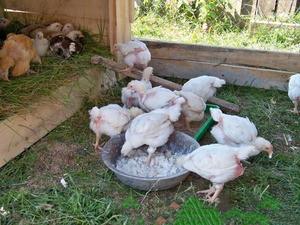
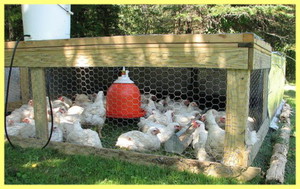
With the first method the poultry house is equipped with loose and dry litter, which can absorb moisture and harmful gases. Wood sawdust, in a 10-cm layer, is most commonly used. Under the litter, the floor should be sprinkled with lime (0.5–1.0 kg per square meter). Chickens require plenty of light, so the room is illuminated 24 hours a day.
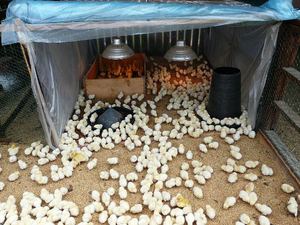
During the first days of rearing, the temperature in the poultry house should be between 26°C and 33°C. It should then be gradually reduced to 18°C and 19°C. At this temperature, the hens should survive until they are four weeks old. At lower temperatures, the chicks grow poorly, become weak, and die.
 During the first days of rearing, the temperature in the poultry house should be between 26°C and 33°C. It should then be gradually reduced to 18°C and 19°C. At this temperature, the hens should survive until they are four weeks old. At lower temperatures, the chicks grow poorly, become weak, and die.
It is possible to heat the room using household electric heaters, which have a temperature control. If the birds begin to huddle around it, the room is not warm enough. The temperature should be lowered if the hens lie with their heads extended and wings spread. When raising broilers on litter, it is recommended to house no more than 18 birds per square meter of house.
In the cells the air temperature should be higher, since the chicks have no opportunity to choose a warmer location. The temperature standard is determined for the upper tiers, where it should not fall below 34°C. This temperature regime is especially important for day-old chicks.
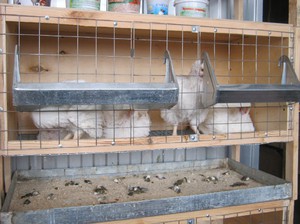
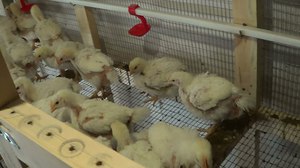
When housing young birds in a cage, keep in mind that no more than 10 birds can be raised per 0.5 square meters. In this case, there will be no need to change the cage until the hens are no longer housed.
Broilers chickens need constant fresh air, so it's crucial to use hoods in the room where they will be kept. Ideally, hoods should be equipped with a thermostat so they can be turned on and off at the right time. This is essential to prevent the chicks from freezing.
What to feed broiler chickens?
Unlike common chicken breeds, broilers need feeding with increased protein and vitamin content. For this purpose, special compound feeds can be used, including:
- Starter feed. This type of feed is rich in building blocks, including protein. It's essential for poultry, as it plays a role in all development and growth processes. This type of feed is best fed to chicks.
- Finishing feed. This feed is fed to adult broilers that have reached six weeks of age. This feed has a reduced protein content of 20%. It should be fed to the birds until slaughter.
 But Combo-coms are most often used At broiler poultry farms and owners of large poultry houses, various mashes and dry grain mixtures are used to save money at home. Table scraps and kitchen scraps are also suitable for broiler chickens.
While it's certainly much easier to raise and feed chickens using compound feed, mash and mixed feeds are still more acceptable. Therefore, let's take a closer look at the second diet.
Feeding day-old chicks
At home a properly composed diet From the first day of a chicken's life, proper nutrition is the key to its good development and rapid growth. From the first day, broiler chicks should be fed carbohydrate and protein foods. These include egg powder and regular grain mixes, which should form the basis of the diet. Mineral supplements and a vitamin premix are added.
Because broiler chickens at the genetic level Although broilers are accustomed to receiving dry feed at poultry farms, at home they should be fed dry millet five times a day. Boiled eggs, which many poultry farmers are accustomed to feeding to regular breeds, should not be given to broilers. Eggs can cause diarrhea in broiler chickens, which will quickly lead to their death. It is recommended that day-old birds be given water with special additives or a weak solution of potassium permanganate.
Seven-day-old chicks
Chicks that survived 5-10 days are the first guarantee of successHowever, there won't be any time to rest any longer, as the baby should begin developing rapidly and gaining weight from the age of one week. Now, their diet should be more varied.
From the fifth day of life, the chick should be fed:
- dry food, which should always be in the feeder;
- starter feed;
- chopped greens such as green onions, alfalfa, nettles;
- five grams of grated carrots for each baby;
- from the age of 10 days - whey and cottage cheese, which are mixed into the mixture.
 dry food, which should always be in the feeder;
Dairy products in their pure form It is not recommended to give to chickensTo prevent infections, birds should be given Triavit, adding five grams of the preparation per liter of water. An additional feeder with chalk, shells, or gravel should always be available in the coop.
Two-week-old broilers
When fattening for meat14-day-old broiler chickens are still fed compound feed and dry mixes, dairy products, and greens. Since young broilers have a weak stomach, new foods are introduced gradually.
Some poultry farmers They practice feeding broilers with wet mashBut this must be done gradually and very carefully. Starting at one week of age, coarsely grated pumpkin or carrots are added to the young hens' diet. From twenty days of age, boiled potatoes or leftover bread are added to the porridge. The result is a moist mash, to which don't forget to add chopped nettle, alfalfa, and dandelion greens.
At the age of 10-14 days the babies for preventive purposes they are given a solution for coccidiosis Baycox. Dissolve 0.5 grams of the medication in one liter of water. Three days before administering Baycox, the chickens should be given water with vitamin B dissolved in it.
Twenty-day-old chicks
By three weeks of age broilers gain muscle mass and reach the peak of their intensive growth. Therefore, their diet should be increased and varied. Starter feed is replaced with fattening feed, the amount of protein is increased, and animal products are introduced.
 It is added to the compound feed Liver, meat and bone meal, boiled fish, and two grams of baker's yeast. The mash is prepared in meat broth. It's important to remember that the fish and meat must be fresh, otherwise the young fish may die.
From the twentieth day of life, broilers can be given boiled potatoes. From greens they prefer Dandelion, nettle, lettuce, and Chinese cabbage. Peanut or sunflower meal added to the mash will provide the birds with a source of plant protein. As a preventative measure against various diseases, it is recommended to give the birds a weak solution of potassium permanganate every other day.
Feeding month-old chicks
The main feed for month-old broilers should be crushed oats, wheat, peas, and corn. To avoid confusion, all ingredients can be mixed in equal parts and diluted with meat broth or whey. Fish oil and cottage cheese should be added.
When raising young chickens the diet should be rich in vitamins and nutrientsGarden greens are suitable for this purpose. Broilers readily eat green onions, lettuce, beetroot leaves, and cabbage. Broilers over one month old can be fed pre-sprouted whole grain wheat and barley. Compound feed can be replaced with a finishing mix consisting of the following ingredients:
- 25% barley;
- 25% wheat;
- 20% soy;
- 20% corn;
- 10% peas;
- 5% sunflower cake.
At any age don't forget Add small amounts of crushed shell rock and chalk, fish meal, vitamin supplements, and yeast to the feed. Broilers readily eat fresh food scraps, pumpkin, and squash pulp.
How to feed broilers correctly?
When raising broiler chickens, you need to know some rules for feeding them:
- Broiler feeders should always be full to ensure the birds have enough to eat.
- Since chickens enjoy healthy, organic pasture-based food, they can be let out to roam during the summer, where they can satisfy their hunger, reducing the cost of special feed.
- Layers should be given calcium in the form of eggshells or special calcium supplements. Even ground chalk, used as coop litter, is suitable. Hens peck at the fine grass they find, allowing the chalk to enter their bodies in small amounts.
- To prevent broilers from chewing the muscles in their mouths, sand supplements are used. Since chickens have no teeth, food is ground only in the gizzard by contractions. Sand helps break down large food into smaller pieces.
- Food made from high-quality grain and various additives must be stored properly. Otherwise, it will only cause harm. It should be stored in a tight, airtight container, which should be kept dry. Excessive humidity and moisture can ruin the food. It should also be protected from rodents and wild birds, which can introduce parasites and viruses.
 To prevent broilers from chewing the muscles in their mouths, sand supplements are used. Since chickens have no teeth, food is ground only in the gizzard by contractions. Sand helps break down large food into smaller pieces.
Very It is important to take care of drinking bowls and feeders, which must always be kept clean. Poor sanitation can lead to digestive problems, which will slow down the bird's growth. Therefore, whenever food and water containers become dirty, they should be thoroughly washed in hot water.
Broilers are practically omnivorous, but it is not recommended to add the following products to their diet:
- vegetable and butter in pure form;
- jam;
- fermented foods and alcohol;
- chocolate and cocoa;
- cheeses;
- fresh milk;
- sausages;
- peel of melons and citrus fruits.
When feeding chickens food from your table or kitchen, you need to be careful that the remains of these products do not end up in the broilers' feeders.
With proper maintenance, care and feeding of broilers, during the period from May to August at home You can raise two batches of broiler chickensAt the same time, with minimal feed costs, the family will be provided with dietary, tasty meat.
 Anna
Anna
1 comment