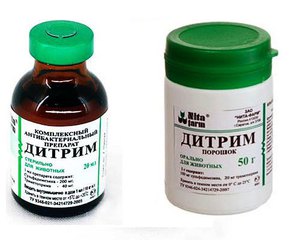
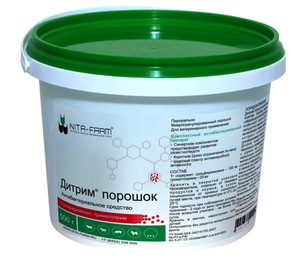
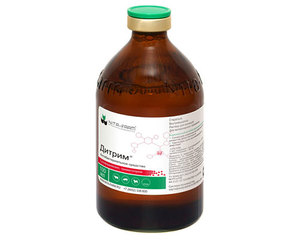
 In veterinary medicine, Ditrim is prescribed to animals to treat infections caused by various bacterial microorganisms. Ditrim is a complex antibacterial drug for animals, occupying a leading position in Russia and the CIS among trimethoprim and sulfadimidine-based drugs. It is available as a sterile, light-yellow solution, packaged in 20, 50, and 100 ml hermetically sealed glass bottles.
Description and composition of the drug
The medicinal product Ditrim consists of 20% sulfadimesine, 4% trimethoprim and additional components.
1 ml of the drug consists of the following substances:
- 40 mg trimetaprim;
- 200 mg sulfadimezine;
- other substances (benzyl alcohol, 1 ml of water for injection, pyrrolidine-2, sodium thiosulfate, disodium salt - EDTA).
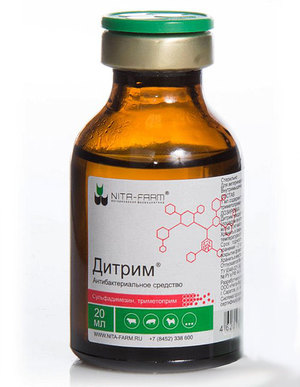
Ditrim is an alkaline solution of light yellow color. 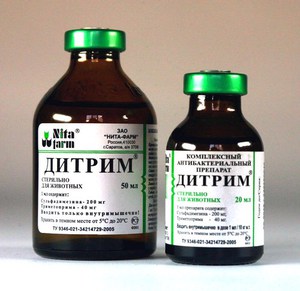 The drug is released in the form of a highly sterile solution., packaged in sealed glass bottles with capacities ranging from 20 to 500 ml. The label on the initial packaging contains detailed information about the drug, including the manufacturing date, serial number, expiration date, and the name and composition of the drug. The bottles should also be labeled "for animals" and "sterile." Instructions for use, administration methods for animals, and storage conditions are included.
The injection's action is based on a broad-spectrum antibacterial effect. The drug can be administered to animals orally or by injection.
Properties of ditrim
The drug's effect extends to the following bacteria:
- Clostridium spp;
- Corynebacterium spp;
- E. coli;
- Streptococcus spp;
- Staphylococcus spp;
- Fusоbаsterium spp;
 Salmonella spp;
- Bordetella spp;
- Pasteurella spp. and some others.
 Salmonella spp;
Used in Ditrim substances enhance the effects of other components, affecting the metabolism of various acids in the infected cell, providing an extended-spectrum antibacterial effect. The medication is highly active against many microorganisms.
Peak levels of Ditrim in the blood are felt 2–3 hours after an intramuscular injection. The drug's effects last for two days. In lactating animals, the drug is partially excreted in milk. In all other animals, it is excreted in urine.
Indications for use of the drug
Ditrim is prescribed to animals that have contracted bacterial infections.
- For dogs with pulmonary infections and intestinal diseases, as well as cystoisosporiasis.
- For chickens, ducks and turkeys with eimeriosis.
- For cattle with diarrhea, pneumonia, paratyphoid fever, colibacillosis and some other diseases.
- For small cattle with diarrhea, salmonellosis, metritis, pasteurellosis, respiratory infections, eimeriosis.
- The drug is prescribed to horses for pneumonia of bacterial origin, diarrhea in young foals, paratyphoid fever, and septicopyemia.
- For pigs with malignant edema, eimeriosis, isoporosis, paratyphoid fever, respiratory diseases, colibacillosis and others
- Ditrim is prescribed to rabbits for eimeriosis.
 For dogs with pulmonary infections and intestinal diseases, as well as cystoisosporiasis.
Method of administration and dosage calculation
Ditrim is administered to various cattle and other farm animals in the form of injections. For every 10 kg of animal weight, 1 ml of solution is calculated.The injection is administered once daily. For horses, the drug is recommended to be administered intravenously.
In acute infectious diseases the highest dose of ditrim is taken During the initial 2–3 days. The dosage is calculated similarly: 1 ml of solution per 10 kg of body weight. The injection is administered twice daily, 12 hours apart. After the acute symptoms of the disease have disappeared, Ditrim is withheld for another 2 days. Long-term treatment (longer than a week) is not recommended. It is necessary to use different injection sites; no more than 20 ml of Ditrim should be administered at any one site.
For poultry and rabbits, prepare a fresh drinking solution:
- To prevent disease in rabbits, a liter of water with 1 ml of the preparation is used. Drinking is offered for 3 days. For treatment, a solution of the same dosage is prepared, but given to rabbits for 3 consecutive days, 2 days off, and 3 days of treatment.
- For health maintenance in chickens and turkeys, prepare a liter of drinking water containing 1 ml of Ditrim. This water is also offered to the animal for three days. For the treatment of various illnesses, a similar solution is prepared and administered to the animal according to the same schedule as for rabbits.
- For ducks, the solution is prepared in the following proportions: 2 ml of ditrim and 1 liter of water for prevention (the course is 3 days) and 1 ml of ditrim and 1 liter of water for treatment - the course is similar to the courses for other animals.
 To prevent disease in rabbits, a liter of water with 1 ml of the preparation is used. Drinking is offered for 3 days. For treatment, a solution of the same dosage is prepared, but given to rabbits for 3 consecutive days, 2 days off, and 3 days of treatment.
In some cases, redness and swelling may appear on the animal's skin at the injection site. Such phenomena do not require intervention. These side effects typically resolve within a few days. Long-term use of the drug and exceeding the recommended dosage are strictly prohibited. This may affect the gastrointestinal tract and kidneys. When following the instructions and correctly calculating the dosage, no side effects or complications have been reported. If any health problems or adverse reactions to the drug occur, discontinue use of Ditrim immediately and consult a veterinarian.
Contraindications
Ditrim not indicated for use in cases Individual intolerance or hypersensitivity to any of the drug's components. The drug is not prescribed to animals with kidney or liver disease, as well as to pregnant females.
Peculiarities
After the last injection should be kept for 28 daysBefore using the animal for meat. In some cases, premature slaughter is unavoidable, in which case the meat can be used as feed for fur-bearing animals or for producing meat and bone meal. After the final injection of Ditrim, milk from dairy animals should not be used for 5 days. Previously expressed milk is heat-treated and used as animal feed.
Storage conditions and safety measures
 Ditrim dmust be stored using the precautions listed in List BThe temperature should be between 5 and 25°C, and the storage location should be dry and dark. The medication has a shelf life of 2 years if stored under the above conditions.
When using ditrim safety precautions must be observed When handling veterinary medications, as well as personal hygiene rules, are important. The low-toxicity drug Ditrim helps effectively combat bacterial infections without causing resistance.