 The cuckoo is one of those secretive birds that are not only shy but also love to hide. This makes them quite difficult to spot. Their lifestyle is also interesting, and their diet deserves special attention. We'll tell you more about this bird later in this article.
The appearance of a cuckoo
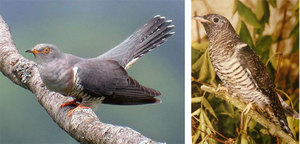
Common cuckoo weighs about 100 grams, and its body length is 40 centimeters. The male and female differ in plumage coloration. The male's back is dark gray, while the rest of the body is light gray and white with stripes. The bill of this individual is black and slightly curved, and its legs are short.
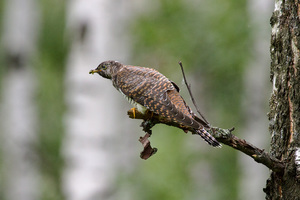
Females have brownish plumage, while the rest of the body is rusty-red with white or black stripes. It's impossible to determine the sex of juveniles by their plumage, as they are either gray or red, but always have dark stripes all over their bodies.
Distribution of the Common Cuckoo
Cuckoo is quite widespreadIt usually nests in the following areas:
- Europe.
- Africa.
- Asia.
- Arctic Circle.
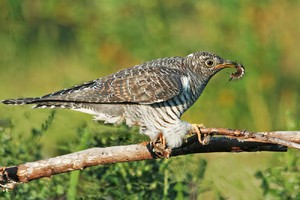
Cuckoo is a migratory bird, so they can be found in the taiga, the steppe, by water bodies, in parks, in gardens, on the outskirts of cities and towns, in the mountains, on the edges of deserts, and even high above sea level. When migrating, they move in a northeasterly direction, covering a distance of 80 kilometers per day.
In Russia these birds are usually appear in late May - JulyThey inhabit almost everywhere except the northern tundra. The common cuckoo's favorite habitats remain forests and parks, forest edges and clearings, coastal thickets, and low bushes.
Reproduction of the Common Cuckoo
Cuckoos trying to toss their eggs In nests where they match the eggs laid by the nest's owners. Matching is usually determined by both color and size. At first, the bird watches the nest being built for a while, choosing in advance which ones to lay its eggs with. When the nest's owners begin laying eggs, the bird flies to the nest, removes one egg with its hooked beak, eats it or carries it away, and then lays its own. This egg-laying procedure for the common cuckoo lasts no more than 10 seconds.
It is worth noting that a female can produce up to 20 eggs in one summer, but she only manages to lay five of them. If she can't find a nest, she will leave her egg on the ground or in an abandoned nest. If necessary, the female can hold onto an egg that's ready to lay for several days.
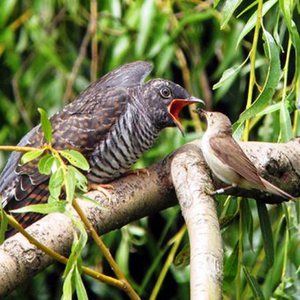 Rarely do feathered nest owners notice the egg substitution. But the embryo in the cuckoo egg develops very quickly And on the 13th day, they are ready to hatch. They hatch naked and blind. At first, the little cuckoo chicks look very much like the chicks of their foster parents; sometimes, even their voices resemble those of their foster parents. A hatched cuckoo chick has a sensitive back and a small depression near the coccyx. If one of the chicks touches it, it can use this depression to throw the egg or the chick out of the nest.
The cuckoo is very demanding: It frequently opens its orange mouth wide, demanding food. Due to the cuckoo's constant demand for food, the nest's owners don't even have time to notice the chick's fall and help it, and sometimes they simply ignore it. The cuckoo chick grows very quickly. It is known that by the 22nd day, it not only exceeds its foster parents in size, but also leaves the nest at this time. But the nest's owners rush after it, feeding it insects for several more weeks.
The lifestyle of the common cuckoo
Males cuckoos immediately occupy a fairly large area, attracting females with its loud and meaningful call. This call is what gives this bird its name. Females are less melodic and prefer to remain silent, but sometimes they can also emit a resonant trill in flight, attracting males for mating.
The male flies around his territory to mate with the females one after another. The females, however, settle down in a specific area, where they try to find foster parents for their future offspring in advance. In summer, these birds are generally solitary: they don't build nests or incubate eggs, and the mating season is already over.
To date More than 120 species of birds are known, into whose nests the cuckoo has ever laid its eggs. However, they usually try to choose songbirds of the passerine order. This is why cuckoo eggs are so easy to plant in nests, as they match in size and color. It is known that if a female cuckoo grows up in a nest, the following summer she will return to the area where her foster parents nested, remembering the appearance of those who raised them. The young begin to reproduce later than the older bird. Incidentally, the lifespan of a cuckoo in the wild does not exceed 5-10 years.
Diet of the Common Cuckoo
It is known that The cuckoo, like its young, is very voraciousBut what does it eat? It's worth noting that cuckoos are not picky eaters. Their main diet consists of insects and their larvae. They are especially fond of hairy caterpillars, devouring them in large quantities. Many birds, however, avoid such hairy caterpillars. Among the insects eaten by cuckoos are beetles, butterflies, grasshoppers, and wasps. They also eat bird eggs and sometimes berries.
The diet of cuckoos varies considerably different from what other insectivorous birds eatTo more fully understand this bird's diet, a study was conducted in Russia, tracking everything the bird ate daily. The results showed that the common cuckoo in central Russia can consume the following foods in a single day:
 Young lizards – 18 pieces.
- Large green grasshoppers – 40 pieces.
- 5 Dead Head butterfly pupae.
- Cabbage worms – 45 pieces.
- May beetle larvae – 5 pieces.
- Mealworms – 50 pieces.
- Ant eggs - unlimited quantity.
 Young lizards – 18 pieces.
Another study was conducted where the cuckoo was fed only caterpillars. It was found that it can consume over 1,900 of them in a single day.
Of course, the cuckoo is strong stands out from the rest of the bird world, after all, its very lifestyle is unusual. But despite all the difficulties, the population of this bird is quite stable, and its numbers are not declining at all. It's worth noting that the cuckoo is, after all, a useful bird, as it easily finds places where insects breed or live, helping to suppress this very dangerous breeding ground.