 Anyone who's ever built a birdhouse probably knows whether the starling is a migratory bird or not. These feathered harbingers of spring begin settling into their nests in late March. And even if winter drags on in their homeland, the inclement weather doesn't deter them. They chirp merrily, even in the snow.
To encourage birds to move into your birdhouse, you need to know what they eat so you can provide the right food to attract them. In our article, we'll discuss how starlings overwinter, what they prefer to eat, and how they raise their chicks.
Content
Description of the appearance of the starling bird
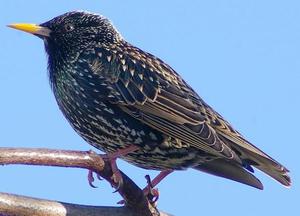
The birds weigh only about 75 grams, their body length reaches 18-22 cm, and their wingspan is 39 cm. Starlings differ in appearance:
- Black, metallic-looking plumage that molts to brown in the spring. Some subspecies of birds may have bronze, purple, greenish, or bluish feathers.
- With a long, sharp beak, slightly curved downwards, it can change color from black to yellow during the mating season, like a chameleon.
- With large, strong, brown-red paws and curved claws.
- Massive body.
- Short neck.
- With a shortened tail.
Taking a closer look at the plumage of the starling, can you tell a female from a maleThe male has lilac spots on his beak, while the female has red spots. The male has longer feathers on his chest, while the female has shorter ones.
Types of starlings
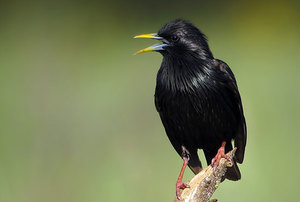 In addition to the common starling described above, there are several other species of this songbird in nature.
Rosy Starling. This bird's name derives from its coloring. When a flock of these starlings flies, from a distance it appears as if a pink cloud is moving across the sky. Since individuals of this species feed primarily on locusts, they settle near semi-desert and desert plains and steppes. If locusts are unavailable, they must make do with other insects.
And yet, pink starlings try to find locusts, for which fly long distancesDuring the day, one bird eats about two hundred grams of insects, which is twice the weight of the starling itself.
These birds build nests between rocks, in various burrows, and in rock crevices. This species of bird is peaceful, so you won't see them quarrelling or fighting.
The wattled starling. Found only in Africa, this bird gets its name from the fleshy, wattled growths that form on the male's head during the breeding season. These birds build nests not in tree cavities, but in tree branches. They use dry twigs to construct their nests. create a dome-shaped structureSince starlings live in flocks, there can be several dozen such "houses" on a single tree.
Wattled starlings feed exclusively on locusts. Therefore, they hatch their chicks only when the insects stop near their nests to breed. As soon as the locusts move, the entire flock follows.
Habitats
The songbird has inhabited almost every part of the world. It is widespread throughout Eurasia, New Zealand, Australia, North America, and South America. Starlings are sedentary in western and southern Europe. In eastern and northern Europe, where winters are colder, they are migratory. fly south for the winter.
Starlings prefer plains as their habitat; they don't settle in the mountains at all. They prefer to live near rivers and marshes, but they are also found in steppes and sparse forests. Their nests are often found near farms and human dwellings. Starlings may also nest near fields, using them as feeding grounds. During the breeding season, they rely on hollow trees or building niches.
The lifestyle of starlings
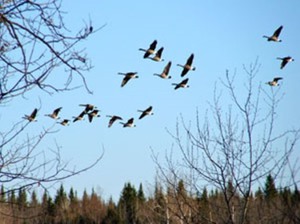
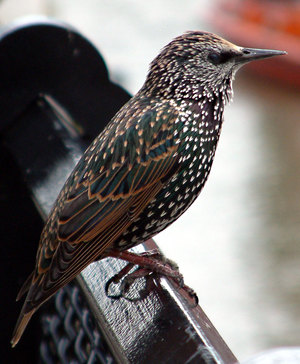 Starlings flock together and settle in small colonies. Sometimes you can see several thousand individuals flying together, repeating each other's turns. They hover before landing, and on the ground scattered over a large area.
Birds also roost in groups. They choose coastal areas densely populated with willow or reeds for roosting. They can be seen perched on the branches of bushes and trees in city parks and gardens at night. In areas where starlings migrate for the winter, the number of individuals roosting together is simply impossible to count. It seems as if there are more than a million of them.
During the breeding season, the birds maintain a small territory, which they protect from other birds. During this time, they feed away from the nest, searching for food on riverbanks, in crop fields, in vegetable gardens, and on the outskirts of villages.
In relation to other bird species starlings are very aggressive, and are capable of competing for suitable nesting sites. For example, in Europe, green woodpeckers and rollers fall victim to this behavior. In the US, starlings compete for nesting sites with red-headed woodpeckers, which they have literally displaced from their nesting sites.
According to researchers, the lifespan of a songbird in the wild is about 12 years.
Starlings' diet
These birds are omnivorous, so they can feed on both plant and animal matter. In early spring, starlings returning from their wintering grounds readily consume earthworms, which emerge as soon as the sun warms. They also feast on the larvae of various insects that overwinter in tree bark.
In summer, the starlings' diet consists of:
 worms;
- caterpillars;
- butterflies;
- grasshoppers;
- cherry fruits;
- plums;
- apple trees;
- pears.
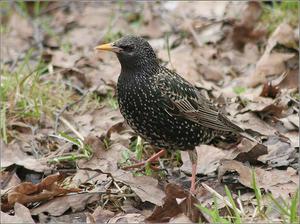 worms;
Although birds protect fields and gardens from pests by eating caterpillars and other insects, they can also cause serious damage. Vineyards, orchards, and fields are favorite feeding grounds for birds, so harvests are often under threatThey can even split the tough skin that protects some fruits. To do this, the starling inserts its beak into a small hole and begins to gradually pry it apart. This causes the fruit to split open, revealing its contents.
Reproduction
Soon after arrival, starlings begin their mating season, the duration of which depends on food availability and weather conditions. In the Southern Hemisphere, the breeding season begins in September, and in the Northern Hemisphere, in March.
In Asian and European populations, females may breed throughout the season. lay eggs three times:
- The first clutch begins simultaneously in all surrounding birds and contains from six to ten eggs.
- The second clutch is associated with such a feature of starlings as “polygamy”.
- The third clutch begins forty to fifty days after the first and again occurs in all individuals at the same time.
After wintering, the males are the first to arrive at their permanent nesting site. They immediately begin searching for a nesting site, which could be a tree hollow, a birdhouse, or a hole in the wall of a building. Having selected a nesting site, the starlings perch near it and begin singing, thereby attracting females and signaling that the site is occupied.
After a few days, the females arrive, and after some time, pairs are formed, which immediately they begin to arrange the nestTo do this, both parents collect leaves, stems, roots, feathers, and down from other birds, which they use to make bedding.
Males can court several females at the same time, fertilizing first one, and after some time, the second female.
Starling eggs are light blue and measure 21 mm wide and 31 mm long. They weigh only 6.6 grams. The female incubates the eggs, but is occasionally replaced by a starling. Helpless chicks hatch after eleven to thirteen days.
During the first few days, the young are silent. The only way to tell if starlings have hatched is by the eggshells discarded from the nest. Both parents feed the chicks simultaneously. While they are foraging, the babies are left alone in the nestThe young feed mainly in the mornings and evenings. The parents may leave to feed dozens of times a day.
During the first few days, the chicks eat only soft food. Over time, they are fed tougher insects, including large caterpillars, beetles, and grasshoppers. Small snails may also be included in the chicks' diet.
After 21-23 days of hatching, the fledglings leave the nest, but their parents continue to feed them for a few more days. If a young bird is frightened and reluctant to leave the nest, adult starlings lure it out using various tricks. Most often, they fly around the nest with food in their beaks.
Enemies of starlings
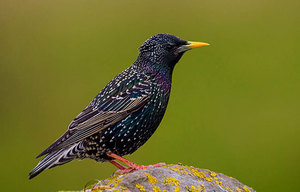 Crows and magpies cause harm to starlings because destroy their nestsPeregrine falcons, eagles, and golden eagles pose a significant threat to small birds. Predators prey on chicks and eggs, climbing through trees to reach nests.
Although starlings can cause damage to crops, they are undoubtedly more beneficial to humans. As early as the 18th century, in Russia, the birds were deliberately attracted to gardens and vegetable plots to eat harmful insects. Those who killed starlings or destroyed their nests were considered criminals.