 The Moscow Black chicken breed gained popularity thanks to its excellent egg production and meat yield. The breed was officially recognized in 1980. These versatile birds are extremely easy to care for and can survive the harsh conditions of Russian winters.
New Hampshires, as well as Orlov and Italian Partridge chickens, were chosen as the ancestors. And this is no coincidence: the New Hampshires were the source of excellent quality meatThe Moscow Black was bred from Italian hens for their high egg production (over 200 eggs per year), and from the Yurlov chickens, the Moscow Black was expected to gain unpretentiousness and increased survival rates. Further selection of the most viable specimens and further crossbreeding resulted in the emergence of a new, universal breed known as the Moscow Black.
Content
Moscow Black Chicken Breed: Description
To avoid making a mistake when choosing chickens and becoming a victim of unscrupulous sellers, you should carefully study the external characteristics of the Moscow Black chicken and its main differences from other chicken breeds.
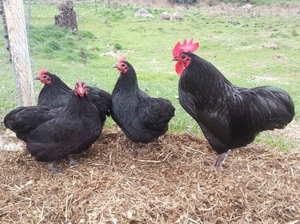
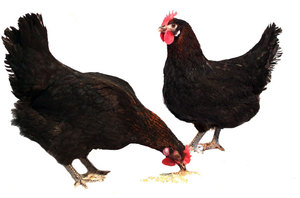
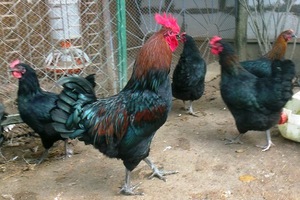
Representatives of the breed have a very neat and attractive appearance. Young animals almost completely blackAdult hens are also black with a sheen, and most have a golden-copper neck. Roosters have a similarly colored back and shoulders.
- The head is broad with an erect, leaf-shaped comb;
- beak of medium length, curved, black;
- earlobes are white or red;
- eyes are orange, sometimes they can be dark brown;
- the chest is convex, wide;
- the back is long and straight;
- legs are wide apart, powerful;
- The tail and wings are of medium length, well developed.
The legs are dark in color, with roosters having a lighter shade. Sometimes birds are found with a greenish tint to the legsIndividuals with yellow paws and beaks are subject to culling.
Positive qualities of the breed
The breed owes its enormous popularity among farmers and amateur poultry breeders to the following: positive qualities:
 The Moscow Black's easygoing, calm nature, inherited from its meat-producing breeds, allows it to roam freely in open spaces without fencing.
- Ability to regulate egg production. If nutrition deteriorates, the bird may temporarily reduce egg production, followed by an increase when the diet is adjusted.
- Stress resistance. Representatives of this breed adapt quickly to unfamiliar living conditions, making them widely used in industrial production.
- Moscow Black chickens have relatively high egg production rates among meat and egg breeds. They can lay approximately 300 eggs per year, each weighing up to 75 grams.
- High immunity. This is a very important indicator when keeping birds, both on a small farm and in industrial-scale breeding.
- The resilience of Moscow Black chickens makes their breeding quite profitable and cost-effective.
- Excellent taste qualities of meat, inherited from ancestors.
- They are easy to care for and feed. Thanks to their dense plumage, they tolerate harsh climates and thrive in an unheated coop. However, it should be noted that such living conditions reduce egg production.
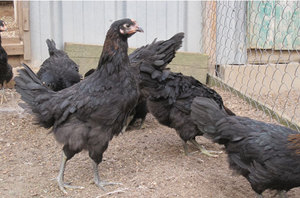 The Moscow Black's easygoing, calm nature, inherited from its meat-producing breeds, allows it to roam freely in open spaces without fencing.
Disadvantages of the breed
Despite having a large number of advantages, the Moscow black has some disadvantages too:
- Tendency to obesity. If overfed, birds quickly gain excess weight.
- Insufficiently developed maternal instinct.
- Slow growth. Moscow Blacks reach sexual maturity only at 8 months. Only at this age should eggs be collected for incubation.
- But perhaps the main negative quality is that it is impossible to determine the sex of the chicks until they are almost 5-6 weeks old.
However, all the aforementioned shortcomings do not have a significant impact on the demand for this breed.
Content Features
 To maintain the egg production of chickens at a high level, it is necessary to provide them with favorable conditions of detentionBecause this breed has a balanced disposition, is quite calm, and displays no aggression, it's not necessary to build a high-fenced enclosure for them. Moscow Blacks do well in cages, but a spacious coop is ideal.
Although Moscow Black chickens are not afraid of cold weather, the floor of the coop should still be insulated when winter arrives. Straw, sawdust, and other insulating materials can be used as bedding. During the summer (if free-range chickens are not allowed), the floor of the coop should be covered with sand, at least 20 cm thick. Bathing the birds in sand will help prevent various parasites (fleas, lice, etc.).
Due to the fact that the breed refers to the meat and egg direction, chickens will need several times less feed than meat chickens, but more than egg-laying chickens.
Although Moscow Black hens aren't picky eaters, to achieve maximum productivity, they require a balanced diet. Hay flour and compound feed form the basis of their diet, but don't limit yourself to these foods. It's important to diversify their diet with succulent foods. These include fruits, vegetables, greens, and even boiled potatoes.
The following grains should be included in the diet: millet, oats, barley, and buckwheat. Additionally, while out for a walk, the birds can supplement their diet with green grass and various insects.
If there is no free range, feeding the chickens is necessary supplement with food of animal origin (dried larvae, meat slices, etc.). This will increase productivity. Constantly feeding a monotonous plant-based diet weakens the bird's body. To support the digestive system, small limestone pebbles should be added to the diet.
Since this breed is quite phlegmatic, sedentary, and prone to obesity, it's essential to constantly monitor the calorie content and quantity of food. Feeding is necessary 3-4 times a day.
Commercial qualities of products
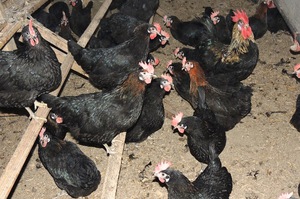 The meat quality of the Moscow Black is much better than that of other egg-laying breeds. Thanks to the bird's more developed muscle mass, the meat yield is much higher, but still less than that of broilers.
Processing the carcass presents some difficulty: due to the dark down and black plumage, many black stumps remain, especially if the chicken was slaughtered during the molting period.
Many consumers complain about the toughness of the meat and its unsightly appearance in main courses. However, it is excellent for making delicious soups and broths. Excess cockerels are typically slaughtered, and since selecting a good breeder is essential for breeding poultry, many farmers keep the males until they are 7-8 months old.
Content Tips
There are often cases when the feed is of poor quality leads to the death of chickensIn this regard, it is recommended to prepare the food yourself.
For wet mashes, it's best to use a ground grain mixture consisting of barley, corn, and wheat. If boiled potatoes are added to the feed, a small amount of bran should be added to improve crumbliness and facilitate digestion.
Don't forget about beneficial ingredients, too: fish oil, tetravit, premixes, shells, and chalk. These ingredients will help your hens lay larger eggs with stronger shells.
If you are thinking about breeding Moscow Black chickens for the first time, it is better to store the first batch of eggs for incubation or already hatched chicks buy from trusted manufacturers.
The Moscow Black is considered the most suitable breed for small farms. These chickens have proven themselves to be excellent egg-laying and meat producers, and their tolerance to climate change allows them to be raised almost anywhere.
Reviews
For some reason, the Moscow Black breed is undeservedly forgotten these days. Although these hens are undemanding and very good. They're slightly larger than Kuchinoks, but produce the same amount of eggs. They're beautiful and calm. They're a good breed for getting good eggs. Get them, you won't regret it.
 In my opinion, the Moscow Black's meat is more suitable for soups in terms of taste: fragrant, rich, and not particularly fatty. The eggs are creamy and medium-sized. They lay eggs regularly, literally in any conditions. They are omnivorous in terms of diet. They don't require warm coops. The bird can and loves to fly. resistant to stress, does not panicShe enjoys digging in the ground and easily finds a place to lay her eggs. She rarely incubates. The hatched chicks are disease-resistant and very resilient.
It's an interesting breed, hard to argue with. However, I think raising these hens on large poultry farms is unprofitable, so they're more often kept by small farmers. They start laying eggs late, and they don't sit on the eggs. I consider their main advantages to be their low feeding and care requirements, their resistance to viruses and microbes, and their strong immune system.