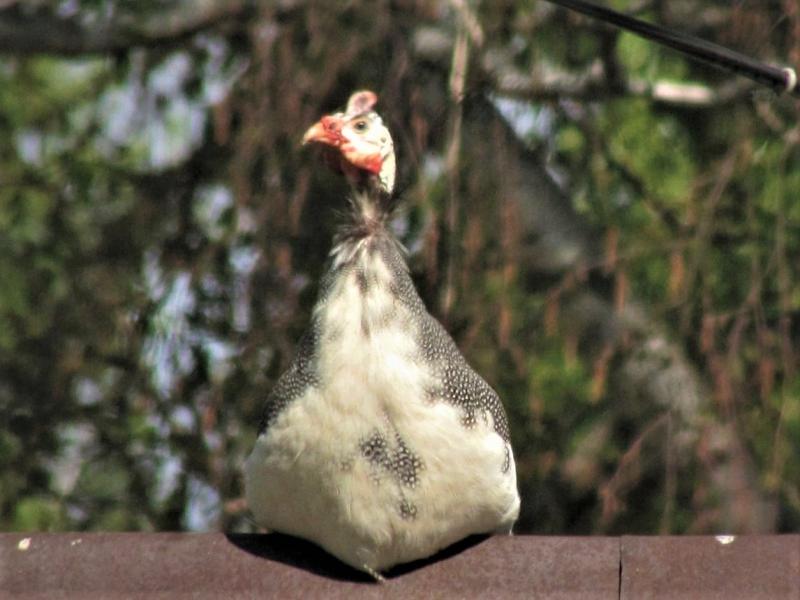
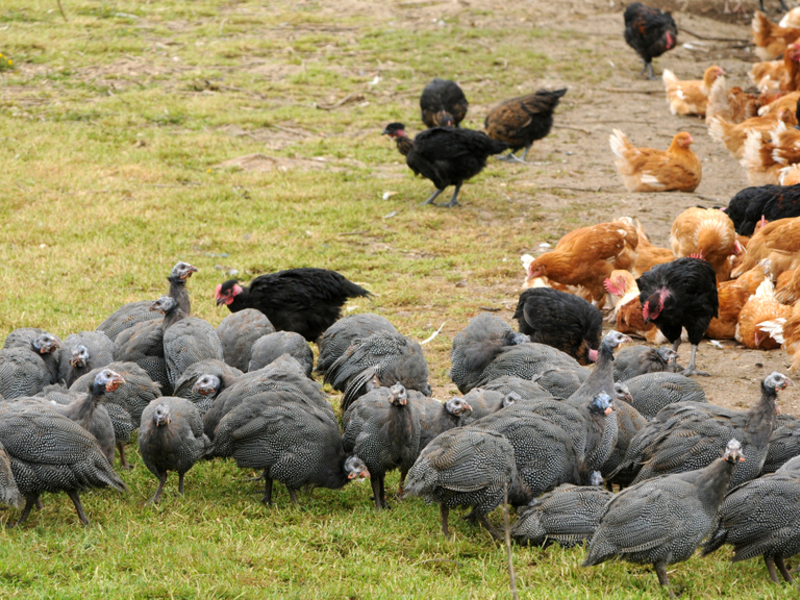
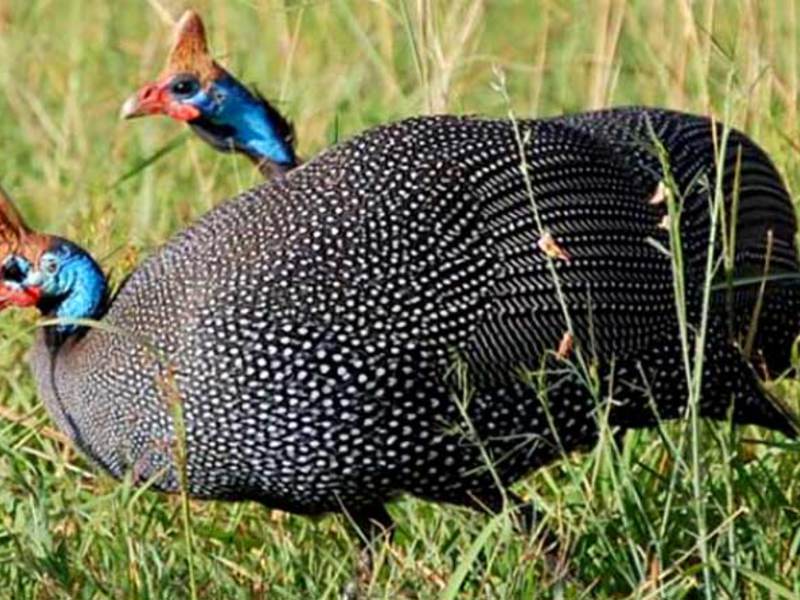
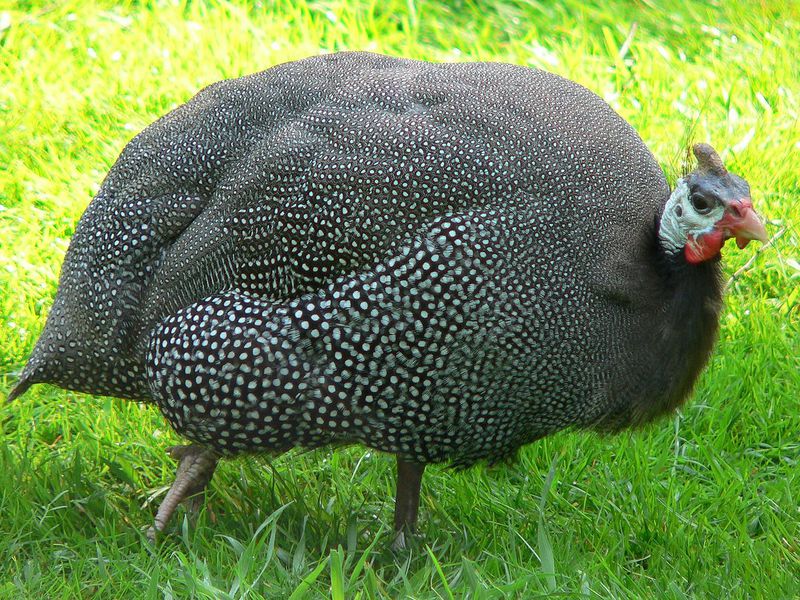
 Guinea fowl appeared on farms in our country not long ago, and now they can be seen on private farms. This speckled, domesticated bird, slightly smaller than a chicken, descended from the common wild guinea fowl, which still lives in the wild in Africa. This bird arrived in Europe before the Common Era, brought from Numidia, but failed to thrive. Later, in the 16th century, the guinea fowl was reintroduced from Guinea by the Portuguese.
History of the bird's name
Common guinea fowls have their own species The name was given thanks to the Greek myth about the hero MeleagerMeleager, who killed a huge, bloodthirsty boar sent by the goddess of the hunt to ravage his father's lands. The boar uprooted trees and killed people. To deal with it, Meleager issued a call throughout Greece and gathered the strongest fighters. The scene of this boar hunt has come down to us in the form of a vase depiction dated 550 BC.
 The culprit of the defeat was killed, but a feud began between the fighters for the title of the beast's conquerorThe disagreements culminated in civil war. During one battle, Meleager accidentally killed his uncle and mother. She became enraged and appealed to the gods to punish him. Meleager's sisters, shedding tears, began to beg the gods for mercy, but it was all in vain. The gods refused to change their minds and transformed them into guinea fowls with spotted plumage, which became a symbol of their tears. Here is the story of this bird, according to Greek mythology.
Carl Linnaeus described the bird in 1766 and named its species Numida meleagris. The name honors the native land from which it was brought, and the patronymic is in recognition of Meleager's legendary exploits.
The word "guinea fowl" appeared in connection with the Old Russian name "tsar", thus, the guinea fowl is a royal bird.
Therefore, the first ones The birds that appeared in Russia in the 18th century were decorativeLater, they began to be bred on poultry farms for the production of dietary foods. Domesticated birds are similar in appearance to wild birds, but their weight and egg production have changed significantly. These figures have increased significantly. For example, guinea fowl in the wild lay up to 20 eggs per clutch, while some domesticated birds can lay up to 150 eggs per year.
Dietary meat and eggs
Guinea fowl are bred for their high-quality meat. It's similar to game meat and isn't fatty. Guinea fowl eggs are also delicious.
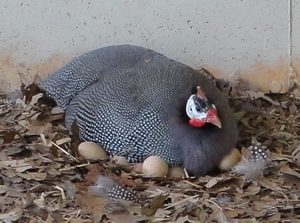 Guinea fowl meat and eggs are superior to all others in nutritional value and taste., obtained from any other poultry. It's no wonder they were once called "royal birds." Three- to five-month-old guinea fowl are especially good; their young, milk-producing meat has an exceptional taste and is eaten fried or stewed. What are the nutritional benefits of the carcass? Approximately 81% of it is edible; the edible parts contain 27% protein, about 0.6% fat, and 1.1% minerals.
Meat is high in calories. It has a distinctive taste characteristic of gameand (pheasants, partridges). They weigh approximately 45 g; they are smaller than chicken eggs, but they contain significantly more dry matter, vitamin A, lipids, and carotenoids. Their composition is almost twice as high as chicken eggs: vitamins A, D3, E, and group B.
The eggs are pear-shapedEggs have a thick, durable, light-brown shell and a large, pleasant-to-eat yolk. Compared to chicken shells, they have fewer pores and are thicker, limiting pathogenic microflora access and reducing moisture evaporation. These qualities allow eggs to be stored for long periods and transported over long distances. Stored at 4 to 6 degrees Celsius, they retain their freshness and nutritional value for up to 3 months.
Guinea fowl breeds
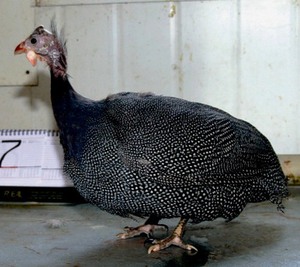 About 20 breeds of domestic guinea fowl have been developed.Most guinea fowl breeds are used for meat production. We're interested in the most popular and in-demand breeds, including the Gray Speckled, Siberian White, and Zagorsk White-Breasted.
- Grey-speckled breed
This breed has another name - silver-gray. Adult the individual reaches a weight of 1.6 to 1.8 kgThis breed distinguishes itself from others by its meat, which is particularly valuable for its taste. It lays up to 90 eggs per season, each weighing approximately 45 g. Its plumage lives up to its name—gray-speckled, with a violet-gray neck.
 Siberian Whites
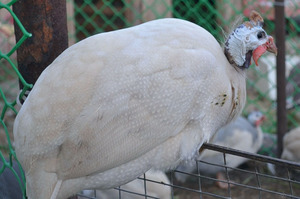 Siberian Whites
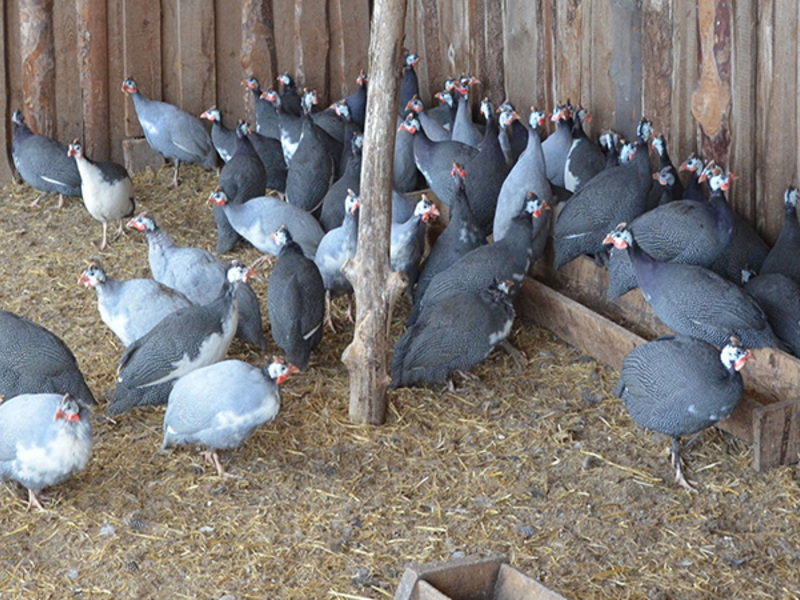
Siberian white guinea fowl have a dark grey beak and matte white plumage with shiny snow-white spots. The bird's head is smallThe neck is blue-white and featherless. Males and females can be distinguished primarily by their wattles. Males have bluish-red wattles, while females have light red wattles. The bill is dark pink and slightly curved, and the comb is light brown. Males weigh up to 1.8 kg, and females 1.6 kg. They lay eggs weighing 45 g, and about 100 eggs per year.
- Zagorsk white-breasted
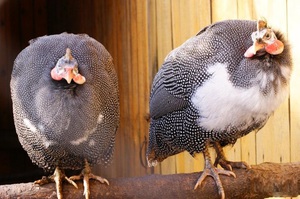 Zagorsk white-breasted
This breed was developed in the city of Zagorsk. They mixed the blood of white Moscow roosters and grey-speckled guinea fowlsThe coloration is grayish-mottled on the back and wings, and white on the belly and chest. The bare head is neither small nor large. The crest is brownish and leathery, and the wattles are small but fleshy. The bill is curved. Females weigh about 1.7 kg, males about 2.1 kg.
Character traits of guinea fowl
Negatives:
- Unlike other domesticated birds, these domesticated birds have retained their wild habits. Even today, it can be difficult to train them to lay eggs in a nest; they always tend to choose a more distant location. Once laid, a guinea fowl refuses to incubate the eggs, so if you need a brood of guinea fowl, it's best to use an incubator or buy bantam hens to act as a "live incubator."
- This bird flies well, so you can trim the flight feathers on one wing. This will prevent it from flying too far and the problem will disappear. However, this procedure must be repeated regularly.
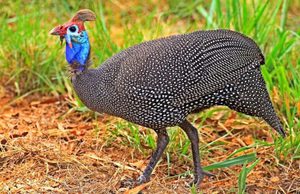 Unlike other domesticated birds, these domesticated birds have retained their wild habits. Even today, it can be difficult to train them to lay eggs in a nest; they always tend to choose a more distant location. Once laid, a guinea fowl refuses to incubate the eggs, so if you need a brood of guinea fowl, it's best to use an incubator or buy bantam hens to act as a "live incubator."
Advantages of breeding guinea fowl:
- Guinea fowl tolerate winter cold well (down to -50°C), making them suitable for breeding in northern regions. They also thrive in hot weather, down to -40°C.
- Compared to other poultry, guinea fowl are less susceptible to illness. They are virtually immune to leukemia, Marek's disease, and other diseases. However, this bird dislikes stale or spoiled feed. Such feeding can cause mortality in the rearing generation.
Guinea fowl are active and timid birds. I'm scared by loud noises, the presence of strangers. They become very attached to their owner, even climbing onto their shoulders and pecking food from their hands. They do not tolerate strangers and, if picked up, will scratch and peck viciously.
Even if you're not near the dog's enclosure, you'll be alerted to any approaching danger by the bird's calls. They'll let you know if a cat, dog, or stranger is nearby, so you'll always be aware of what's going on.
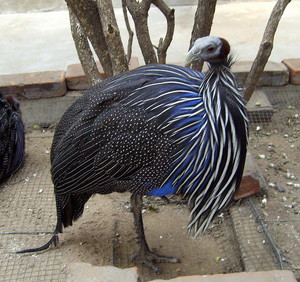 One of the characteristic features of guinea fowl is their indifference to the Colorado potato beetleMany are already aware of this particular preference. However, these birds eat not only this insect but also any other insect equally well. If they are free to feed during the summer, they will easily feed themselves, but the Colorado potato beetle will be their first victim, as its coloring is quite conspicuous.
Very It's interesting to watch birdsWhen Colorado potato beetle hunting season opens, guinea fowl are clearly visible in the green potato field, their speckled backs and brightly colored heads. They peer carefully under the leaves from various angles, hoping to find a beetle larva or the beetle itself. Upon seeing one, they seize it with lightning speed, before it can even recover. During their "hunt," they often call out to each other, informing their relatives of their find. This feeding habit is readily exploited by gardeners. Another important addition: this is the only bird in the Galliformes that does not have the habit of paddling. Therefore, releasing guinea fowl into the garden will ensure the garden beds remain tidy.
Thus, The domestic guinea fowl is a very profitable bird from any point of viewWhether you choose to raise them for their beauty or for their meat and eggs, their nutritional value is significantly higher than that of other poultry kept at home.