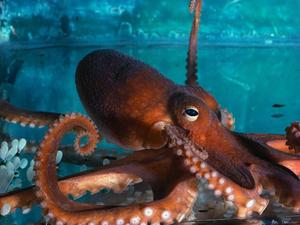
Octopuses are the oldest inhabitants of our planet and, as it turns out, the most intelligent of all invertebrates. Although their lifespan is relatively short—no more than four years—in this time they can reach impressive sizes and possess amazing biological properties.
The octopus's ancestors had armor.
Five hundred million years ago, a distant ancestor of the octopus swam in the ocean, protecting itself from predators with armor. But over the course of evolution, armor gave way to other defenses and atrophied, becoming a useless organ.
The octopus is susceptible to hypnosis
These invertebrates can be easily hypnotized. The simplest method is to hold an octopus in your palm, mouth up, with its tentacles hanging down. Once hypnotized, various manipulations can be performed on the octopus without it waking up. Even if dropped from a height, the octopus remains conscious!
Giant octopus
A giant octopus can reach up to 50 kilograms and a length of nine meters. The largest specimen weighed 198 kilograms! If its tentacles were unfolded, the width of a large octopus would be almost 10 meters—the height of a three-story building. Each tentacle contains hundreds of independently functioning suckers. A single sucker can hold up to 100 grams.
The octopus can change color
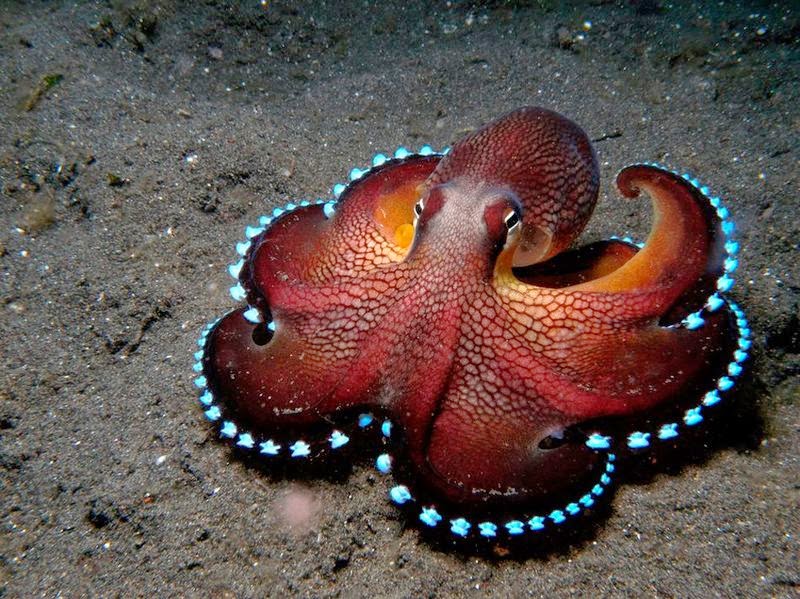
A stunning feature of these animals is their ability to camouflage. In a split second, the octopus can completely change its color. It is a master of coloration and can adopt the colors of a wide variety of animals, plants, and the shelters in which it hides.
Color changes occur when the animal's mood changes abruptly. When the octopus is at rest, its body is colored in various shades of brown, blending in with its surroundings. However, when frightened, its color changes to white. And when angry, reddish hues become predominant.
An octopus's color change is directly related to its vision. If it loses all sight, it cannot change its skin color. And if one eye is blind, half its body loses this function.
His skin changes texture
The octopus's capabilities are astonishing! It can change not only its color but also its texture. The structure of its subcutaneous tissue can make its body appear lumpy when needed. The octopus is the only animal in the world with this ability.
The octopus senses the world through its tentacles.
An octopus's suckers are multifunctional. They capture prey, hold it, and direct it directly into the beak. Furthermore, the animal uses the suckers on its tentacles to determine the suitability and edibility of the caught prey.
He can distinguish colors with his skin.
Octopuses seem to see with their entire body at once. Their skin contains hypersensitive pigments called chromatophores, which are normally located in the retina. These pigments expand in response to light, even when the light falls only on the skin, leaving the animal's eyes untouched.
Chromatophores rapidly expand and pulsate rhythmically when exposed to bright white light. Red light causes rhythmic but slow muscle contractions. They are most sensitive to blue light.
A tasty morsel
Some countries with access to the sea eat octopuses alive. They are also used to prepare everyday dishes such as takoyaki and sushi.
Octopus meat is a good source of easily digestible protein. It's also rich in vitamins B3 and B12, as well as trace minerals such as potassium, phosphorus, and selenium.
An octopus doesn't have tentacles, it has arms.
The octopus has eight arms, which many call tentacles. Each arm has numerous suckers (about two thousand), arranged in rows. Each arm has one to three rows. The arms themselves are connected by a thin membrane.
Each sucker of an adult octopus can support up to 100 grams of weight. The octopus's limbs contain a huge number of nerve cells—several times more than the brain.
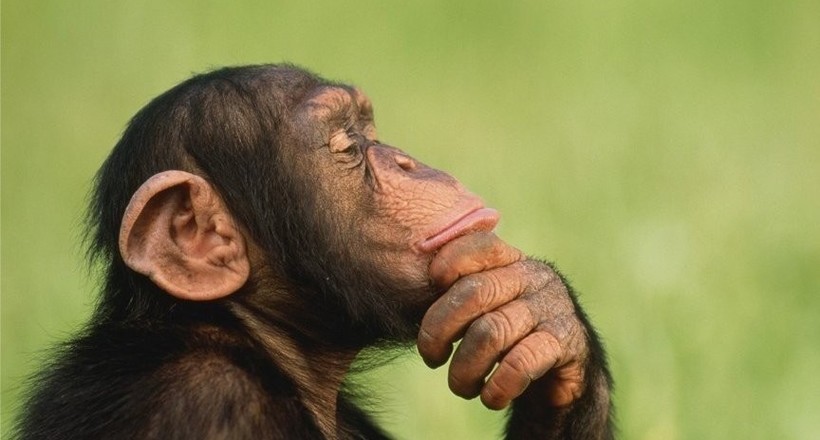
One of the smartest animals in the world
Octopuses, among the invertebrate inhabitants of the seas and oceans, stand out for their mental abilities.
The facts that scientists rely on when making such conclusions:
- octopuses can be trained and tamed;
- have a good memory;
- able to distinguish geometric shapes;
- recognize the person who feeds them;
- In case of danger, they emit an ink spot, which can be shaped like an octopus, which misleads the enemy.
Octopuses are amazingly large and powerful animals with highly developed brains that can be domesticated. How many more incredible discoveries will science reveal?