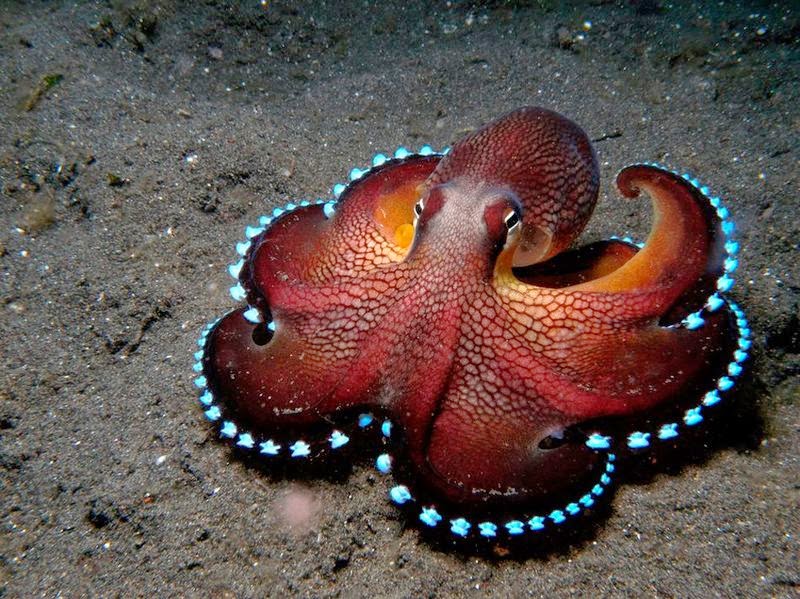
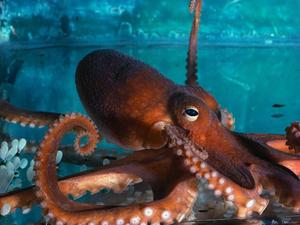
 The octopus is a member of the cephalopod family. It is more commonly known as the octopus, due to its eight enormous tentacles. Since ancient times, this sea creature has been the subject of numerous legends and myths. For example, sailors believed that a giant octopus, or kraken, inhabited the ocean, capable of dragging an entire ship underwater. These cephalopods form two suborders: deep-sea octopuses (Cirrata) and true octopuses (Incirrata).
Most octopuses are no more than half a meter in size; only the common octopus, the Apollyon octopus, the Hong Kong octopus, and the Doflein octopus are considered large. Some species are venomous. They inhabit subtropical and tropical seas and oceans, most often in coastal rocky areas. They feed on crustaceans, mollusks, and fish. Octopuses breathe through gills and can stay out of water for short periods of time.
Anatomy and physiology of octopuses
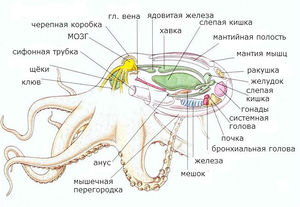 The octopus is a typical representative of the cephalopod mollusks. Their body is compact, soft, and rounded. The length of an adult octopus ranges from from 1 centimeter to 4 metersThe octopus's weight can reach 50 kilograms.
The octopus's body is covered with a mantle, which is a leathery sac. The mantle length in males reaches 9.5 centimeters, while in females it reaches 13.5 centimeters. The octopus has no bones.Because of this feature, he can easily change his shape and stay in a limited space.
The octopus has eight tentacles that are connected to each other. A thin membrane serves as a connector. The tentacles are covered with suction cups in 1-3 rowsAn adult can have up to two thousand suckers. Each sucker can hold approximately 100 grams of weight. This hold is achieved solely by muscle action, not by adhesion.
The mouth opening is located where the tentacles grow from. The mouth is equipped with with two strong jaws, similar to a bird's beak. The pharynx contains a radula, similar to a grater, which grinds food. The anus is hidden under the mantle.
A common octopus can change colorThis occurs under the influence of signals transmitted by the nervous system in response to the external environment. In its normal state, the octopus is brown, in danger it is white, and when enraged, it is red.
The octopus's eyes are similar to human eyes: large with a lens and an outward-oriented retina. It is noteworthy that the pupils are rectangular in shape.
Features of the octopus organism
This cephalopod has three hearts: one is responsible for distributing blood throughout the body, and the other two are responsible for conducting blood through the gills.
The octopus has highly developed brain and the rudiments of the cortex. The brain's shape resembles a donut. This shape allows the brain to be compactly positioned around the esophagus. Cephalopods are capable of perceiving not only normal sounds but also infrasound.
Also, thanks to the huge number of taste buds, they determine the edibility of food. Compared to other invertebrates, the octopus very large genomeIt has 28 pairs of chromosomes and approximately 33,000 protein-coding genes. In this latter respect, the octopus even surpasses humans.
Lifestyle and behavior of octopuses
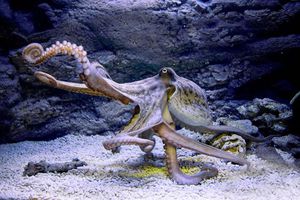 Octopuses can be found in all seas and oceans in the tropics and subtropics. These animals typically lead a solitary, bottom-dwelling lifestyle. They prefer to settle among stones and algaeThey can settle in the empty shells of other underwater inhabitants.
They choose a lair with a narrow entrance but a spacious interior. They keep clean using a funnel. They do not keep garbage or scraps inside their habitat. On hard surfaces, even vertical ones, octopuses move by crawling, using their tentacles.
To swim, an octopus fills the cavity where its gills are located with water and forcefully expels it in the opposite direction. To change direction, the funnel through which the water is expelled rotates.
Any of the octopus's modes of movement is very slow, so the animal actively uses ambushes and color changes to hunt for food.
The main enemies of octopuses are:
- dolphins;
- whales;
- sea lions;
- sharks;
- seals.
In case of danger, the octopus often flees, releasing a dark liquid from special glands. This liquid remains compactly suspended in the water for some time, allowing the octopus to escape. Some zoologists believe these shapeless spots also serve as decoys.
Furthermore, if a tentacle is captured, it can be torn off by a strong muscle contraction. The tentacle continues to move for a while, allowing the octopus to escape its prey.
Reproduction of octopuses
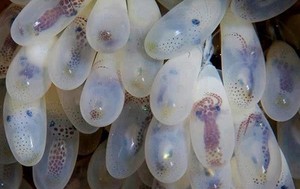 The breeding season occurs in April and October. In some areas, the timing shifts to June and October. Octopuses mate by releasing sperm from the male's mantle into that of the female.
Female octopuses after fertilization lay eggsThey choose depressions in the ground to lay their eggs and build a nest, lining it with shells and stones. Octopus eggs are spherical, grouped in groups of 8-20.
There may be in one clutch 80 thousand eggsThe octopus cares for the eggs, letting water through and removing dirt and foreign objects. Until the eggs hatch, the female remains near the nest without food. Sometimes she even dies after the young hatch.
During their first months, newborn octopuses feed on plankton and live exclusively near the bottom. After a month and a half, they reach 12 millimeters in length and weigh several grams, and by the time they reach four months, they weigh about a kilogram.
Of the entire clutch, only one or two individuals reach sexual maturity. The lifespan of animals can reach 4 years, but on average octopuses live 1-2 years.
What do octopuses eat?
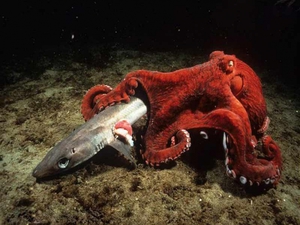 Bottom-dwelling octopuses are ambush predators in their feeding habits. Hidden in their shelter, they patiently await passing fish. crabs, lobsters, langoustes and quickly pounce on them, enveloping them with their long arms. The octopuses' favorite food is Kamchatka crabs.
Having caught a crab, the octopus carries it, clutching it in its tentacles like hands, to its lair. Sometimes a single octopus will carry several crabs at once. Octopuses also catch large gobies and floundersPrey is captured using suction cups on the tentacles. Their strength is astonishing: a 3-centimeter-diameter suction cup can support 2.5–3.5 kilograms.
That's a lot, especially since these animals have hundreds of suckers. Some very clever experiments were conducted to determine the strength of their suckers. A crab tethered to a dynamometer was thrown to octopuses kept in an aquarium. The octopus instantly grabbed the crab with its hands and rushed to hide with it, but the tether prevented it from doing so.
The octopus would then firmly attach itself to the crab and begin to forcefully pull it toward itself. It would hold the crab with three arms, while the others would attach themselves to the bottom of the aquarium. Octopuses weighing approximately 1 kilogram or more could generate a force equal to 18 kilograms.
Octopuses taste food not with their tongues, which are transformed into graters, but with their hands. The entire inner surface of their tentacles and suckers are used to taste food. These marine animals have an incredibly sensitive sense of taste; they even taste their enemies.
Octopuses prefer to eat:
- Fish.
- Crustaceans.
- Marine animals and mollusks.
If you drop a drop of water taken from an aquarium where a moray eel, the mollusks' worst enemy, lives near an octopus, the octopus will immediately turn purple and run away.
Like many other cephalopods, octopuses belong to predatory animalsThey capture their prey with their tentacles and kill it with venom before consuming it. If the prey is caught with a shell, the octopus breaks it with its "beak" located near the mouth.