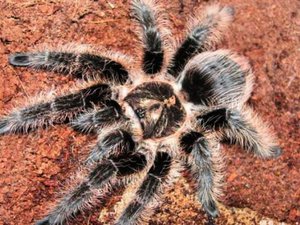
 The Brachypelma albopilosum tarantula is native to the tropical rainforests of Honduras and Costa Rica. It has bright colors, long hairs, and a fairly large body. This species of tarantula is ideal for keeping as a pet because of its calm nature, beauty, and affordability, and, most importantly, its bite is harmless.
Description of Brachypelma albopilosum
This species of tarantula does not have venom toxic to humans, so it poses no threat. For self-defense, the albopilosum uses irritating hairs, which it will not hesitate to use if threatened. As soon as the insect begins to scratch them, you should immediately move your face away from them to prevent the hairs from getting into your eyes and mucous membranes.
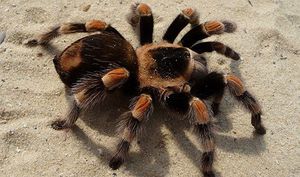
The adult Brachypelma albopilosum is distinguished by:
- body size 7 cm;
- paw span up to 16 cm;
- hairs from dark brown to black shade;
- golden-bronze sheen;
- thick hairs that give the spider a ruffled appearance;
- slowness and lack of mobility.
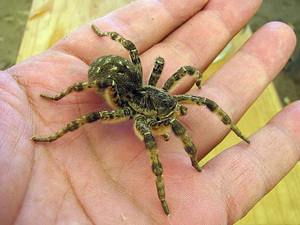
A calm and cute little spider can sometimes sit in one place for a whole day. However, young tarantulas run very fast, so the terrarium lid must be opened carefully, otherwise the pet may escape. The Albopilosum can be handled, but only very carefully. If frightened, the spider may shed its protective hairs.
Brachypelma albopilosum is an ambush spider and is nocturnal. It hunts small vertebrates and insects, which it detects using its legs, which are sensitive to taste, smell, and vibration. It holds the prey with its forelimbs and injects venom through two hollow fangs. After the venom takes effect, the prey is paralyzed, digestion begins, and the tarantula is able to digest fats and proteins.
Reproduction in nature
Spiders mate during the rainy season. Females that are not ready to mate behave aggressively toward the male and may even try to kill him. If mating is successful, the female will die after a few weeks. will lay from 300 to 500 eggsAt an air temperature of 24°C-27°C, the young spiderlings will hatch from the eggs in seven to eight weeks. They develop and grow very quickly. Within a few weeks, the young tarantulas begin to live independently.
Brachypelma albopilosum – keeping at home
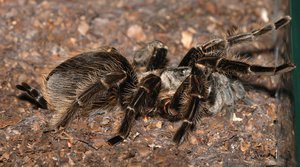 This species of spider is very easy to keep. A terrarium, an aquarium, or simply a plastic container can serve as a home for the tarantula. The container must be horizontal. A size of 40x40x30 cm is sufficient for an adult spider.
It is necessary to pour some on the bottom of the terrarium about five centimeters of substrate, in which the tarantula will dig its burrows. Coconut shavings can be used as a substrate.
The air temperature in the pet's habitat should be between 24°C and 28°C. If the room temperature is lower, a dim fluorescent lamp can be placed on the terrarium for heating.
Humidity should be maintained at around 70%. To achieve this, mist a third of the substrate, located near the watering bowl. If humidity is too high, bacteria and fungi will begin to grow. If mold is discovered in the spider's habitat, replace some of the substrate immediately and reduce the humidity.
The terrarium must be equip with a drinking bowl and you can install some kind of shelter in it.
Feeding
To promote rapid growth, young spiders should be fed once every 2-3 days. Their diet may include:
- bloodworm;
- small mealworms;
- Marmorated cockroach juveniles;
- small crickets.
If the insect intended for feeding is too large, then it divided into parts or immobilizedTo avoid frightening your pet, adult albopilosums can be fed once a week with three crickets, a large cockroach, a locust, or a newborn mouse.
Your pet should be well-fed, and its abdomen shouldn't be allowed to become too small. However, overeating can cause a hernia.
Reproduction
Brachypelma albopilosum spiders mate successfully in captivity, producing numerous offspring. Before mating, the sexually mature female must be well-fed, otherwise she may attempt to eat the male. After the male has loaded his bulbs, he approaches the well-fed female. After mating, the male moves back. Females of this spider species rarely show aggression toward males, so mating is usually unproblematic.
Sometimes fertilization doesn't occur after the first mating, so the male will need to be reintroduced after some time. If everything goes well, then the female will begin to weave a cocoon, into which she will lay eggs after five weeks.
How do spiders grow?
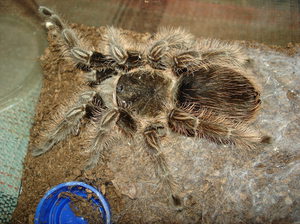 Tarantulas increase in size during molting, which occurs throughout their life. Some time before molting, the spiders darken in color, refuse to eat, and become inactive.
Just before molting, the tarantula begins to weave a mat. It "extracts" itself from its skin by lying on its back, settling itself on the woven mat. Sometimes, the spider may molt while lying on its side, which is also considered normal.
Preparation for molting and the post-molting period lasts from a week to six monthsThe molting itself takes place in 15-60 minutes.
Advantages and disadvantages of keeping Brachypelma albopilosumа
The advantages of keeping this species of tarantula at home include:
- calm and non-aggressive disposition;
- unpretentiousness in maintenance;
- the life expectancy of females is about 20 years;
- very low price.
Albopilosum has very few disadvantages and all of them are quite minor:
- the spider's sedentary lifestyle;
- slow growth rate;
- irritated hairs.
If you're looking to get a spider as a pet but don't have any experience keeping them, the peaceful and calm Brachypelma albopilosum is the perfect choice. Buy a tarantula This type can be purchased by anyone, as the cost is very low.
 Shika
Shika
1 comment