 The pristine tropical environment of the Amazon has been, is, and will continue to be a source of inexhaustible interest not only for botanists and zoologists, but also for tourists who prefer active recreation with elements of extreme sports. Traveling through these virgin forests allows you to fully satisfy your curiosity and passion for exploring the endless mysteries of living nature.
Fauna of the Amazon characterized by a wide variety (The humid tropical climate favors this): numerous exotic animal and bird species inhabit this area. However, few know that, percentage-wise, insects, the majority of which are ants, occupy the leading position in terms of species inhabiting this region. Their laws of existence and mechanisms of interaction with the environment are of interest to researchers, Amazon travelers, and adventurers.
To list and describe in detail all the representatives of tropical ants would require a lot of time and effort, so below is a brief summary of the main characteristics of the most common species of ants that a tourist who decides to fully enjoy the beauty and grandeur of the Amazon nature will certainly encounter.
Bullet ant (paraponera clavata)
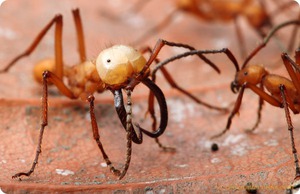 It differs from its relatives in body size (it can reach 2.5 centimeters) and painfulness of the bite, which is how it earned its name. However, its length isn't the only characteristic that distinguishes it from other ants. It also has a rather massive build, with a pair of long, blunt-tipped horns on the front of its body. Its forelimbs are also covered in yellow hairs, and its eyes have distinctive niches where its antennae are attached. They inhabit the base of trees, so these insects are typically seen by tourists as they move in endless streams along tree trunks in search of food.
Ectatomma (ectatomma tuberculatum)
Tourists can most often see this tropical ant species hanging in the crowns of low trees (up to 1.5 m) or shrubs. Their body length averages 1 cm and their body color is reddish. They feed on insects that absorb plant sap.
Ponerines (odontomachus)
The maximum length of these ants is 1.5 cm. Their main striking species feature is massive hammer-shaped jaw, which is a formidable trap for the ponerines' prey. Despite their slow movements, their mandibles (upper jaws) snap shut with incredible speed, leaving no chance for their prey.
PACYHONDYLA VILLOSA
Belongs to the subfamily Ponerinae. This tropical ant species can be confused with the bullet ant. While not as large, the sting of Pacyhondyla Villosa resembles that of its relatives. Pacyhondyla Villosa prefers dead tree trunks and areas with moist soil. Their bodies are reddish-black and covered with a dense layer of hairs with a golden hue.
PACYHONDYLA APICALIS
A distinctive feature of this species is that they hunt alone. Their average length is 1-1.2 cm. Their body is dark gray, and their antennae are bright yellow. This unusual color combination makes PACYHONDYLA APICALIS ants resemble wasps, and their distinctive hopping gait only adds to the resemblance.
GIGANTIOPS DESTRUCTOR
The external resemblance of this ant to the tropical species described above is striking: size, coloration, and movement patterns. They are distinguished by the length of their limbs (GIGANTIOPS DESTRUCTOR has longer ones) and the shape of their eyes (large, located on the sides of the head). This is one of the most peaceful ants—it is completely incapable of stinging.
Campomotus (wood borer)
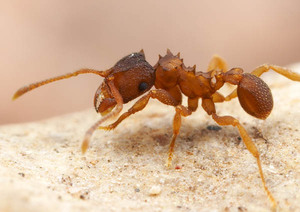 Representatives of this species densely populate the Amazon rainforest. These ants range in length from 3 to 15 mm. They feed on plant sap or insects, which also enjoy eating it. They earned their second name due to their habit of nesting in tree trunks. Campomotus ants have a rather interesting body structure: a thin waist separates the thorax from the rounded abdomen. They come in two colors: yellow for nocturnal ants and dark brown for diurnal ants.
Golden-crowned bat (Camponotus sericeiventris)
The insect has a very striking appearance: its black body is covered in a layer of shiny hairs that sparkle with golden or silvery iridescence in the sun. It has a rather interesting gait—it moves its limbs while simultaneously pressing its abdomen to its chest.
Carpenter ant (Camponotus atriceps)
These are brown ants with unusually long limbs. Among ants active at night, this species is the most common. Their bodies are densely covered with a layer of stiff hairs.
Dacetone Armigerum
Their habitat is tree trunks, where they settle, forming colonies of thousands. Their bodies are light amber. The massive hammer-shaped jaws and three spines on their bodies indicate active predatory behavior.
Turtle ant (Cephalotus atratus)
These insects are 10 mm long. Their bodies are covered with numerous spines. A distinctive feature of Cephalotus atratus is their ability to glide. This ability allows them to jump from a branch and land on another branch, rather than falling to the ground where they face numerous dangers.
Acrobat ant (Crematogaster)
A relatively small insect, reaching no more than 0.6 cm in length. Representatives of this species may have:
- black color;
- yellow color;
- two-tone color.
Their main notable feature is the atypical structure of the abdomen: the sharp tip points upward and can even be tilted back, which is how the ant earned its nickname.
Big-headed ants (Pheidole)
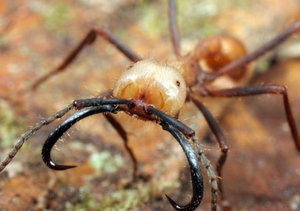 Their main difference from other species is hidden in their name: the gigantic size of their head compared to their small body. Big-headed ants live on the forest floor. Pheidole ants are among the most numerous inhabitants of the Amazon rainforest.
Leaf-cutter ants (Acromyrmex and Atta)
The long-limbed, red insects are commonly seen by travelers carrying leaf fragments that serve as food for the fungi that feed on the leafcutters.
Army ant (Eciton burchellii)
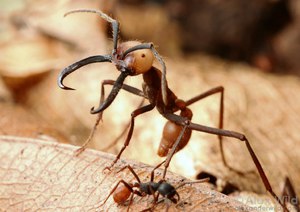
Their body size reaches 1 cm in length. These insects have a unique upper jaw structure—shaped like pincers. Nomads regularly carry out raids, their victims include:
- arthropods
- small vertebrates
Although numerous stories from impressionable tourists about Eciton burchellii being able to "gnaw" a person are, to put it mildly, at odds with reality, it is still best to avoid areas where these insects congregate, to avoid experiencing the very painful effects of their bite.