 Recently, a fashionable trend has emerged: along with familiar pets, people are increasingly acquiring exotic animals, one of which is turtles.
These reptiles have inhabited our planet for over two hundred million years and, depending on their habitat, are divided into aquatic and terrestrial. This article will focus on terrestrial turtles.
Content
General information about turtles
Currently, science recognizes approximately 40 species of land tortoises. Their sizes range from very small—the size of a matchbox—to gigantic—weighing at least 500 kilograms. However, a representative of this species, quite average in size, has proven itself well suited for pets.
Central Asian (steppe) or Horsfield's tortoise - A reptile that thrives in a home terrarium. Its natural habitat is considered to be the semi-desert and steppe regions of Central Asia, but it is also found in Pakistan, Afghanistan, and even on the Caspian coast.
These turtles live primarily in sandy soils, but are also found in clayey soils. Despite the arid climate, the soil in these animals' habitats must be moist. This is because turtles dig burrows, and if the soil is dry, they are forced to wander in search of a suitable location. Another reason why reptiles prefer moist soil - the presence of large quantities of grass, which is their food source.
These turtles are most active in the early morning and evening. During the day and evening, they prefer to sleep, sheltering under rocks, snags, or in burrows.
In the wild, these reptiles hibernate in winter and summer to protect themselves from the effects of unfavorable temperatures and from starvation, which they face due to food shortages during this time. If the turtle's home environment is comfortable, it will not need to hibernate.
Appearance
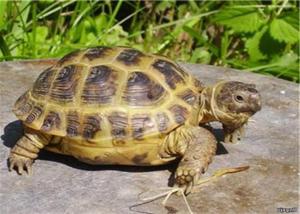 The Horsfield's tortoise is a relatively modest size. Its shell length ranges from 13 to 25 centimeters. Males are smaller than females: their shells range from 13 to 20 cm, while those of females range from 15 to 25 cm. However, in captivity, these animals grow up to 17-18 cm in length.
Their shell consists of 16 keratinized scutes The tortoise has a scute on top and 13-15 similar scutes on the bottom. Another 25 scutes are located on the sides of the shell. It is rounded, slightly flattened at the top. Its coloration on top varies from olive-yellow-green to olive-brown. Dark spots appear above the base color, their color corresponding to the soil in which the tortoise lives. The tortoise's head and feet are brown. Each foot has four clawed toes.
In the wild, these animals live for 40-50 years, but in captivity, under comfortable conditions, their lifespan can increase.
What do steppe tortoises eat?
In the wild, reptiles feed on plant matter: grass and young shoots of shrubs. Occasionally, they may indulge in berries and fruits.
Home conditions for keeping a turtle are suggested varied diet:
- 75-80% of the total food intake should be fresh greens and hay.
- 5% should be vegetables
- 15-20% fruits
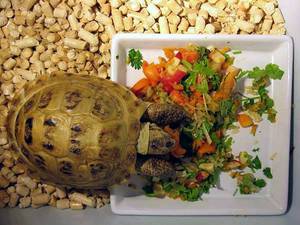
Prepared food should be placed in a bowl or on a special surface where it will not be possible for the animal to eat soil along with the food. Hand feeding is not recommended.
As for feeding frequency, young turtles need to be fed daily. Adult turtles are usually fed once every 2-3 days. The serving size should be approximately half the volume of the turtle's shell.
It should be noted that excessive consumption of juicy food and fruits by a turtle can lead to the fact that in the turtle's stomach the fermentation process will begin.
It is not recommended to feed the turtle food from the owner's table - this can negatively affect the pet's health.
In order for an animal to receive the required amount of calcium and other microelements, it is necessary to include special mineral supplements in its diet.
A land pet does not require constant access to water, so there is no need to put a container with it in the house.
Maintenance and care
The care your land-dwelling friend will need isn't particularly difficult. However, there are a few things to consider.
How to choose the right house?
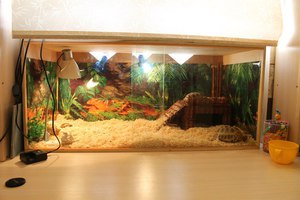 It's okay if you bought a turtle but didn't have time to buy it a home. A turtle can initially use a home in cardboard boxThe size of the turtle should not restrict its movement. Leaving the reptile to live on the floor before purchasing a suitable habitat would be a bad idea, as this could negatively impact the turtle's lifespan. Your new land pet could catch a cold or retreat to the farthest corner, where it could later risk starvation. If the turtle is small, even with a shell, it could be crushed by an owner who steps on it unnoticed.
Therefore, proper care and maintenance of a turtle implies the presence of a well-equipped terrarium, where your pet will feel as comfortable as possible.
Setting up a terrarium
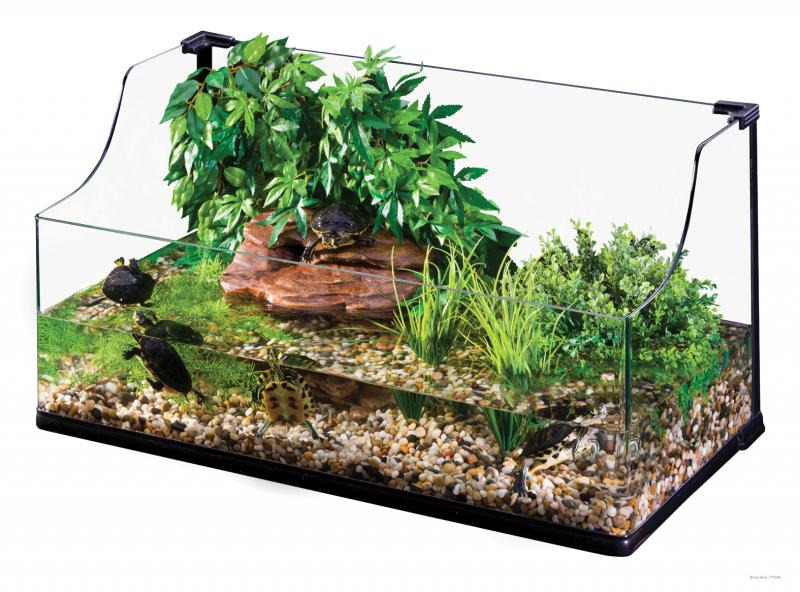
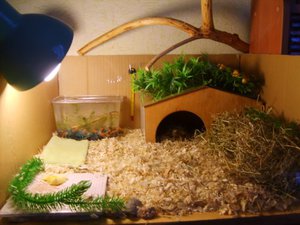
 A standard glass aquarium is perfect for these purposes. The turtle's enclosure should be large enough to allow its inhabitant to move freely within it. A tank with a capacity of about 100 liters is sufficient for housing one individual. The enclosure should be at least three times wider than its inhabitant.
- A special house should be built inside the terrarium so your land-dwelling friend can hide and relax in solitude. This can be purchased at a pet store or made yourself from plywood.
- Next, carefully select the substrate for the terrarium floor. The thickness of the substrate can vary from 5 to 10 cm. Medium-sized pebbles (small ones can be ingested) or sawdust can be used, but their drawback is that they get dirty very quickly. Hay with pebbles mixed in is ideal. Avoid using cat litter, sand, or soil as bedding. Ingestion of such substrate can cause serious health problems.
- A home terrarium should have a microclimate as close as possible to the animal's natural habitat. Temperatures should range from 25 to 30 degrees Celsius. To ensure the proper temperature, a 75-watt incandescent lamp should be installed 30 cm above the bottom of the terrarium. There should be a separate area under the heat source where the temperature reaches 33 to 35 degrees Celsius. A special ultraviolet lamp for reptiles, whose rays are similar to those of the sun, is required. It should be placed 30 cm from the animal. Exposure to ultraviolet radiation triggers the production of vitamin D3 (cholecalciferol), which helps the animal absorb calcium.
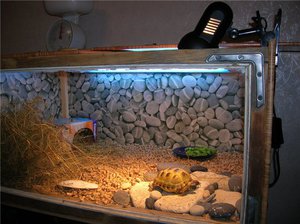 A standard glass aquarium is perfect for these purposes. The turtle's enclosure should be large enough to allow its inhabitant to move freely within it. A tank with a capacity of about 100 liters is sufficient for housing one individual. The enclosure should be at least three times wider than its inhabitant.
Caring for a land turtle is essential. includes a bathing procedureThis helps stabilize the water-salt balance, replenish the body's moisture reserves, and normalize gastrointestinal function. It is recommended to bathe your pet in warm water (32-35 degrees Celsius) once every two weeks.
The process of reproduction
 In the wild, Central Asian tortoises reach sexual maturity at about 10 years of age.
Between April and July, the female makes holes in the soil where she then lays her eggs. A single female can lay up to three clutches, each containing up to six eggs. At a temperature of 30 degrees Celsius and humidity of 60-70%, the incubation period lasts 60 to 65 days.
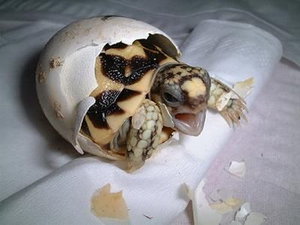
Between August and October the eggs hatch. the cubs are about 3 cm in size.
At home, steppe tortoises can become parents at the age of 5-6 years.
Breeding requires a female and two young males. After mating is complete, the female should be immediately isolated. For two to three months, the expectant mother is busy carrying the eggs. During this period, her diet should be rich in vitamins and microelements.
The female lays her eggs in the soil and then forgets about them. They should be removed immediately and placed in an incubator—a special place with at least 18 cm of soil, a temperature of 29-30 degrees Celsius, and air humidity not less than 60%The egg-laying female should be kept separate from the others for some time, continuing to feed her generously. This is done to allow the animal to recover from pregnancy.
After three months, newborn turtles hatch from the eggs.
Caring for cubs
To ensure maximum survival of the offspring, proper care is necessary. Baby turtles should not be placed in the same terrarium with adult reptiles, as they may cause fatal injuries to the babies. The bottom of the terrarium for hatchlings lined with small sawdustThe temperature regime is the same as for adult animals. The babies should be fed a plant-based diet with added calcium.
Problems with keeping and diseases of turtles
- An animal can catch a cold if it is often exposed to a draft.
- Using the wrong soil can cause problems with the digestive system (if the pet swallows soil particles).
- Excessive amounts of vitamins added to food can cause premature death of a turtle.
- In order to detect the presence of parasites or infections in time, it is necessary to visit the veterinarian periodically.
 An animal can catch a cold if it is often exposed to a draft.
The most common disease faced by tortoise owners is rickets. Its symptoms are only noticeable in the later stages, when the animal the shell and skeleton are deformedThis disease occurs due to a lack of ultraviolet light.
Treatment involves exposing the reptile to ultraviolet radiation and adding calcium and vitamin D to its diet.
If you take proper care of your turtle, it will delight you with its company for many years!