The echidna is a rare and unique animal, little studied until recently. It somewhat resembles a hedgehog or porcupine: it has quill-like fur and the ability to curl up into a ball at any sign of danger. However, the animal has one unique feature: a marsupial structure on its abdomen, which it uses to carry eggs and care for its young.
Content
General information and origin
Echidna family members belong to the class of mammals in the order Monotremes. Their origins still raise many questions. Three genera are known, one of which is considered extinct. They are found only in Australia, Tasmania, New Guinea, and the small islands of Indonesia. They are endemic; members of the family are not found anywhere else on the planet.
What does it look like?
This relatively small animal resembles a porcupine or hedgehog in appearance, as its body is covered in a thick layer of fur in the form of needles up to 5–6 cm long. It measures 30 cm in length. It has two pairs of short, but strong and fleshy legs with large claws, which allows it to dig deep burrows.
The head is an extension of the body; there is no neck. The muzzle is beak-shaped, with a small mouth at the tip. The animal has no teeth, so it chews by rubbing its tongue against the roof of its mouth. The eyes are small and have not only eyelids but also a special nictitating membrane.
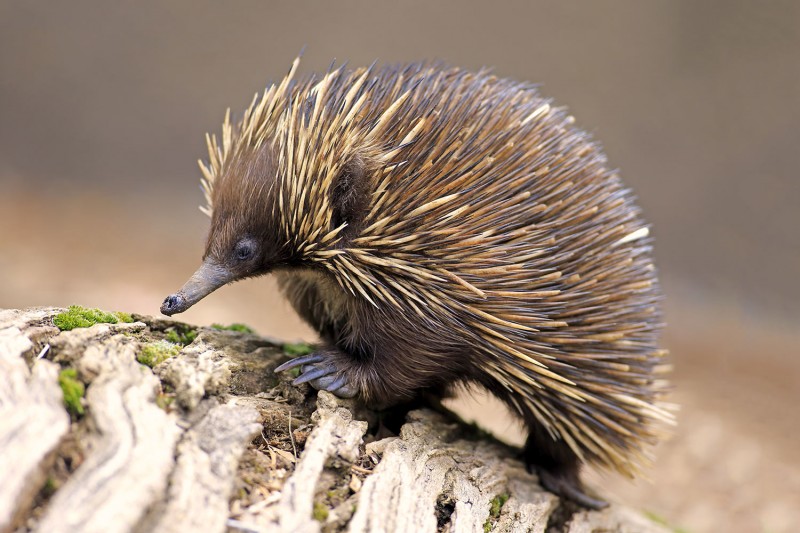
It is one of the few mammals that lay eggs.
The mammal has a tail, although it's difficult to notice because it's covered in spines. The animal is a monotreme, meaning all waste products (urine, genital secretions, and feces) exit through a single opening—the cloaca.
Where it lives, lifestyle
These mammals spend most of their lives alone. The exception is the mating season in the winter months. Each individual inhabits a specific territory where it hunts and finds food. This territory is predominantly wooded or mountainous; the animal avoids plains. They have no permanent home. Instead, they wander throughout their territory in search of food, resting in random places. The animal digs well and can swim.
The animal has excellent vision, which detects movement. When threatened, it seeks refuge in burrows, dense thickets, or rock crevices. If the terrain is open, it burrows into the ground, leaving its spine-covered upper body exposed. When the ground is too hard, the animal curls up into a ball like a hedgehog.
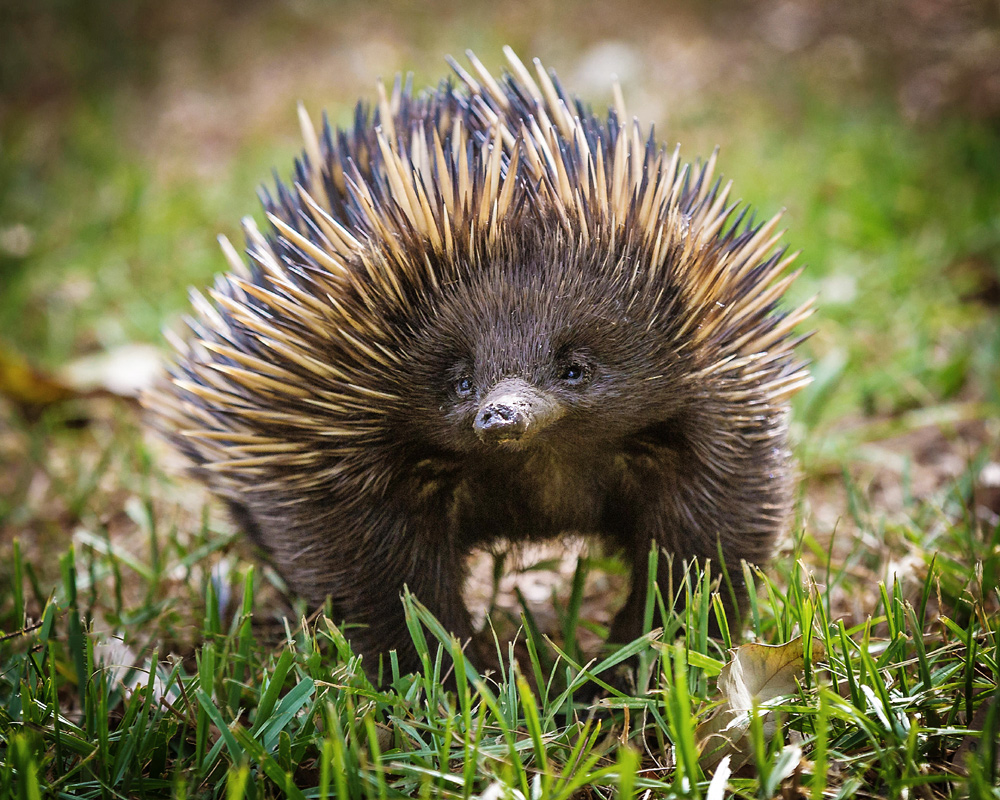
Animals are more active on summer nights
These mammals have almost no natural enemies. Only wild dogs, dingoes, and foxes can eat an adult. They try to attack it from the belly, where there are no spines, and to unfold the "ball." Young individuals do not yet have strong, powerful spines, so they are also preyed upon by other predators, such as large monitor lizards.
What does an echidna eat?
The main source of nutrition is ants and termites, which they spend most of their life searching for. Having discovered an anthill, the animal begins digging it up, licking up the ants with its sticky tongue. Its long snout simplifies the process and also helps it dig in the soil.
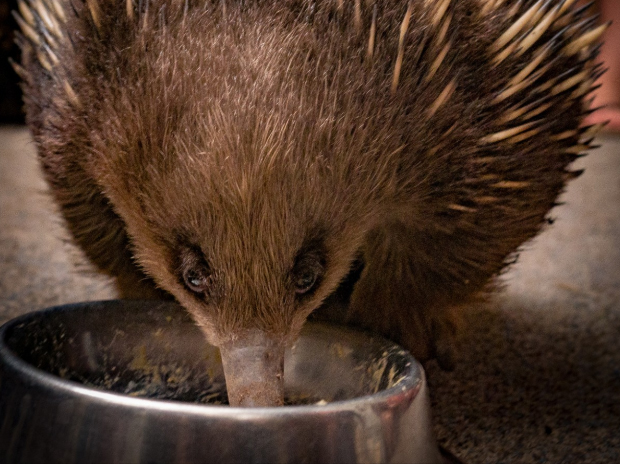
The mammal mixes a lot of sand, dust, grass and dry wood into its food.
Its strong paws and large claws allow it to strip bark from trees or destroy termite mounds. It can move large stones, exceeding its own weight. In rare cases, it digs through turf or moss, which may harbor larvae or insects.
While feeding, they swallow large amounts of soil and small stones. This helps them digest their food better. The animal does not drink water at all.
Reproduction
Reliable data on the reproduction of these animals was only obtained in 2003, after 12 years of continuous research. The mating season for these egg-laying animals begins in May and ends in September. In the Southern Hemisphere, this occurs during winter. During the mating season, the animals gather in groups of 4-5 individuals, including one female and the rest males. To attract males, the female uses a special secretion from her cloaca, which she rubs on the ground.
During the breeding season, the animals travel in groups, always led by a female. They always hunt and rest together. Other individuals are not allowed into the group.
The males constantly try to court the female by nuzzling her, and after about 3-4 weeks, she allows one or more males to approach her. The female lies on her back, indicating her readiness. The males, in turn, begin to circle around her, digging up to 30 cm deep.
Once the trench is prepared, the males try to push each other out. Ultimately, the strongest one wins and fertilizes the female. Mating occurs on their sides in a recumbent position and lasts up to an hour.
The duration of pregnancy depends on the air temperature. In hot weather, pregnancy is shorter, lasting 3–4 weeks. At the end of the period, the female lays an egg and places it in a pouch on her abdomen. This is a unique fold designed specifically for carrying the egg.
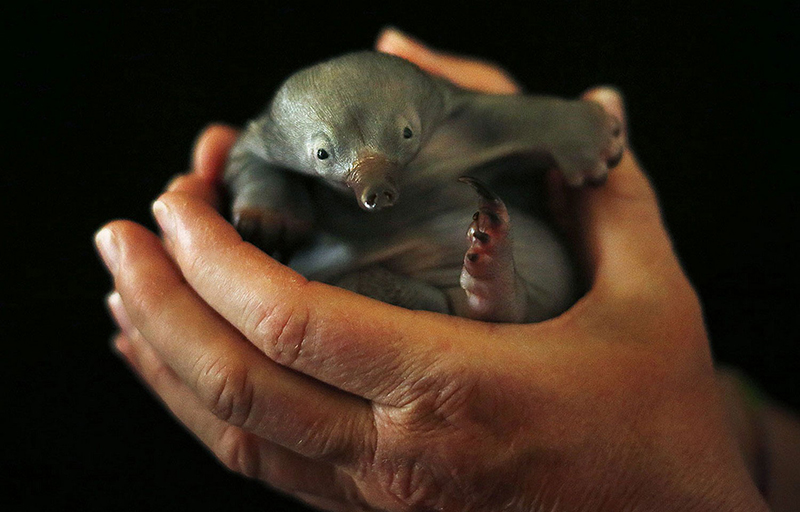
Only five zoos in the world have managed to produce offspring
After 9-10 days, the egg hatches into a baby weighing approximately 0.5 g and measuring no more than 15 mm. The newborn is not yet fully developed and adapted to life, so it uses its legs to attach itself to the upper part of the mother's pouch, where the mammary glands are located. This area is called the "milk field." The baby licks up the mother's milk with its tongue, which, incidentally, is pink.
The mother carries the puggle (as the baby is called) in her pouch for up to two months. During this time, it gains weight up to 400 g, an absolute record for growth rate among all mammals. The mother herself pushes the newborn echidna out when the spines begin to grow, causing discomfort.
Scientists still don't know how the female places the egg in her pouch. Her legs are too short to do so. Perhaps the animal twists itself in a special way, allowing the egg to pass directly from the cloaca into the pouch.
However, the mother still doesn't abandon her cub and digs a burrow for it somewhere under the roots of a tree. She visits it twice a week to nurse it. This process continues for six months, until the cub becomes independent.
It is during the period of feeding that the highest mortality rate is observed. Puggles are still weak and unable to fend for themselves. They use a special secretion with a pungent, unpleasant odor as a defense. Furthermore, the young animals are extremely quiet, not attracting attention.
Interesting facts about the mammal
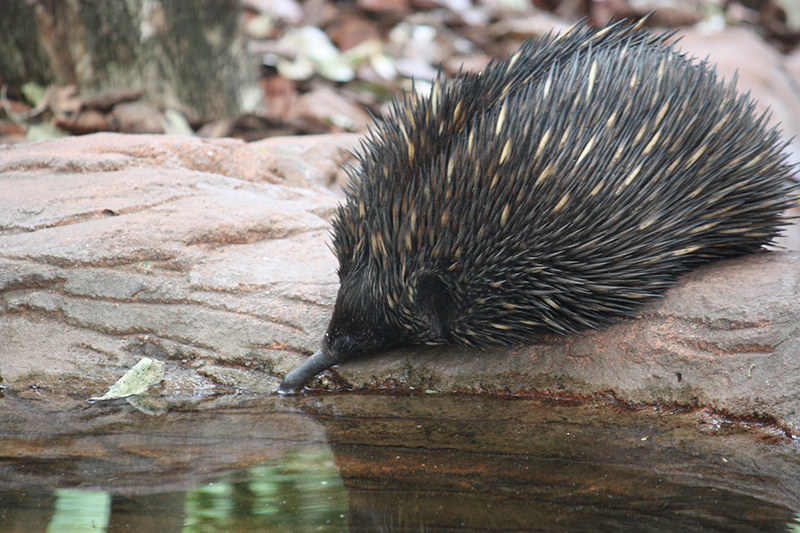
With ants, the animal receives 70% of its moisture.
Let's highlight some interesting facts:
- The Australian echidna was first described in 1792 by the British zoologist George Shaw. He mistakenly classified it as an anteater. Ten years later, another British scientist, Edward Home, discovered the unique feature of a single antechamber and created a new order, Monotremes. Incidentally, the platypus also belongs to this order.
- This mammal can be confused with its closest relative, the platypus. It differs from the platypus in having spines and lacking a beak. Its lifestyle and habitat also differ. Platypuses are closer to reptiles in their features, although they are mammals.
- This animal has special receptors on its nose that help it detect electromagnetic vibrations from prey or its fellows.
- They lay eggs in the same way as birds, that is, through the cloaca.
- The average lifespan in the wild is 15 years. In captivity, animals become long-lived, reaching 40–50 years.
- The female's milk is pink. This is due to its high iron content.
- The male penis has as many as 4 heads.
- They are capable of licking with their tongue up to 100 times per minute.
- Fleas on an animal reach 4 mm in size.
- When temperatures drop sharply, they hibernate, which can last up to several months. During this time, they use subcutaneous fat for nutrition.
- The needles are so sharp that even the slightest touch can cause a puncture or cut to human skin.
- Males have spurs on their hind legs that contain a poisonous secretion. During all the observations, no males were observed using these spurs.
- They are kept in zoos all over the world, but the animals do not reproduce in captivity.
- The brain is primitive. However, the animal is extremely curious.
- An albino echidna occurs once in ten thousand.
The echidna is an unusual and fascinating animal. It can only be found in Australia and nearby islands. It is harmless to humans and, when encountered, curls up into a ball or tries to escape into the undergrowth. Handling it is not recommended, as it can cause skin damage due to its sharp spines.