 Owners who keep female pets enjoy more than just pleasant company. They often overlook the problem of unwanted litters. It's much easier for those with female cats, as simply limiting their outdoor time prevents them from delighting you with "soft lumps."
Things are much more complicated with dogs. It's easy to get distracted while walking, and your pet might take advantage of this by going to a male dog she likes. And when puppies are born, it's not always possible to find new homes for them. Therefore, many people have to consider the unpleasant procedure of spaying or neutering their dog.
Content
Reasons for castration of male dogs
 A male dog's hormonal levels never remain constant, as they depend on the amount of hormones produced by the testicles. Because of this, males are eager to mate at any time of year.
And they demonstrate greater aggression and attraction During their sexual behavior, more so than females. Any healthy dog found on the street will constantly mark, attack other males, and try to make friends with unfamiliar females.
Castration of a male dog is necessary in cases where the testicles are affected a certain disease or due to the animal's behavioral characteristics, which cause a lot of problems for the owner in urban conditions.
If his pet constantly displays aggressive behavior, can't control himself when seeing individuals of the opposite sex, and also often leaving the owner for long periods of time, then the owner increasingly begins to think about castrating the pet.
Almost every male dog enjoys marking objects around him, not only outdoors but also in his own home. This habit is most pronounced in male hunting and small toy breeds.
If the owner is satisfied with the dog's behavior, the medical basis for castration is often a suspicion of the presence of infection in the testiclesThe most common cases are when a tumor or inflammation begins to develop in them, which is very difficult to treat.
Castration is a radical method of solving the problem, since it acts quickly, saving a significant amount of time and money that is required with conservative therapy.
Dog sterilization: pros and cons
 First, it's important to clarify what is meant by sterilization. We're talking about removal of the female's sex glands dogs, so that she will no longer have puppies.
However, this procedure has its pros and cons, so these should be taken into account when deciding whether to undergo it.
The main advantages of castration are:
- A chance to avoid an unplanned pregnancy. When a dog goes into heat, it's easy to lose sight of her while walking, especially if there's a male nearby.
- The ability to prevent the occurrence of sexually transmitted diseases.
- Helps reduce the likelihood of developing tumors in the area of the mammary glands and genitals.
- The ability to avoid false pregnancies, during which diseases dangerous to the animal's health often develop.
Disadvantages of sterilization
But this operation also has its disadvantages:
 Neutered animals gain weight. This occurs because the dog's appetite increases after spaying. However, an effective solution can be found by limiting the amount of food your pet is fed or switching them to a special diet.
- Urinary incontinence. This condition is usually diagnosed only several years after sterilization. Its primary cause is hormonal changes.
 Neutered animals gain weight. This occurs because the dog's appetite increases after spaying. However, an effective solution can be found by limiting the amount of food your pet is fed or switching them to a special diet.
In practice, this results in a weakening of the urinary sphincter, which prevents the animal from excreting urine in the traditional way.
The solution to this problem may be use of special drugs, which will help the sphincter function properly. To choose the right one, it is necessary to discuss this issue with the veterinarian who will perform the surgery.
How is dog sterilization performed?
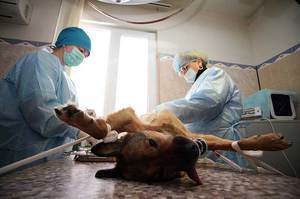 Sterilization is generally understood to be an operation in which removal of the ovaries and uterusEach of these organs must be removed, because if any of them is left, within a couple of years it could become a source of dangerous disease.
Moreover, the presence of even one ovary makes the entire operation pointless and can also lead to deterioration of health.
- Castration takes approximately 40–60 minutes and is always performed under general anesthesia;
- To do this, the abdominal cavity is first cut, and after the main procedures are completed, stitches are applied.
When to spay a dog
 To date, experts have not reached a consensus on the appropriate age to neuter a dog. Some say any animal can be neutered. from 4 months of age.
However, their opponents say that the operation can be carried out no earlier than the dog will be 8 months oldTo avoid negative consequences, it's advisable to discuss this matter with a veterinarian first. However, in any case, you'd be wise to hold off on spaying until your pet reaches full adulthood.
At the same time, it would be a mistake to consider spaying a dog if it's already quite old. In this case, there's a high probability that, given its health, it will will not survive such an operation.
During sterilization it is necessary to use general anesthesia, therefore, it is not recommended to castrate those animals that have problems that do not allow surgical intervention.
Postoperative period
After the surgery, the animal must rest for 24 hours to allow the anesthesia to wear off. During this period, the animal will feel weak and have impaired coordination.
When the dog wakes up from anesthesia, it need to give waterEvery other day, she can be fed, but only soft food. Over the next two weeks, the stitches should be regularly cleaned, preventing the dog from licking them.
You can avoid this by attaching it to her body. special collarIn most cases, after surgery, the owner receives a list of antibiotics from the doctor to help prevent infection.
Sometimes, a dog that has been neutered may experience constipation. To understand how to handle this situation, you should discuss this issue with a veterinarian.
Dog behavior after sterilization
 This operation should be taken calmly: practice shows that an animal that has been castrated, the character remains the same.
Many people know that in natural conditions, female dogs are dominant over males, so after the surgery, your pet will demonstrate this trait even more clearly.
Be prepared for what your pet will experience after surgery. appetite will increaseSo, you need to decide in advance what exactly you'll feed her. You'll also need to keep her active.
Advice from veterinarians
Many potential owners are wary of female dogs. They require constant supervision, as if they're left unattended for a while, they could one day cause trouble. unwanted offspring.
For many, this is a big problem, so they try to avoid it in advance. The easiest way to solve this problem is to by castrationHowever, it should be kept in mind that this operation has its pros and cons.
Therefore, the decision to spay or neuter should be made only after familiarizing yourself with these guidelines. However, in most cases, owners who choose to neuter their pets do not regret their decision. However, afterward, their dogs begin to behave slightly differently—eating more than usual and becoming more active.