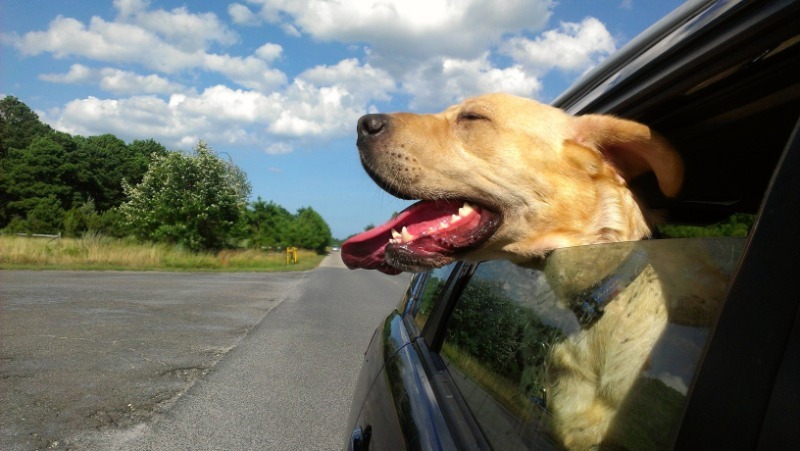
A familiar summer scene: heat, a highway, traffic, and a dog peering out of the open window of a nearby car—mouth open, tongue hanging out, nostrils greedily gulping in the scorching air. A winter scene: traffic, cold, strong wind, and a dog's nose scanning you from the crack in the side window of a stopped car. Why this happens? Read this article to find out.
Respiration and thermoregulation
Thermoregulation is the ability of warm-blooded animals, including dogs, to maintain a comfortable body temperature regardless of changes in environmental temperature. The animal's skin and fur serve as thermal insulators in both hot and cold temperatures. Dogs lack sweat glands like humans, so evaporation and cooling do not occur through the skin. The few sweat glands that do exist are located on the paw pads and in the ears.
Dogs thermoregulate through respiration. Rapid breathing through an open mouth and protruding tongue (thermal panting) lowers body temperature. When breathing this way, a dog inhales through the nose and exhales through the mouth. Moisture evaporates from the nasal mucosa. The nasal mucosa must receive sufficient moisture during heat exchange. In 1664, the Danish anatomist Nikolaus Steno discovered the nasal gland in dogs, which supplies moisture to the nose and performs the same functions as human sweat glands.
It can be concluded that an open window is another opportunity for an animal to stick its nose out and cool off. But why then do they act up and force their owner to open a car window in winter, in cold weather, with the air conditioning running?
Life in a world of smells
Dogs belong to a group of animals called macrosmatics. Macrosmatics navigate their surroundings using their sense of smell.
A dog's nasal receptors consist of olfactory epithelium, which is 15 times thicker than a human's. This is how the sense of smell is formed and transmitted to the animal's brain, which can distinguish 1,000,000 odors at a distance of over 1 kilometer.
Now you understand the sea of aromas that enters a car when a side window is opened. You can't detect them, but a dog can discern even the concentration and freshness of the smallest particles in the air flow. They've long since learned the scent of your car's interior. As soon as they detect an unfamiliar scent, they raise their muzzle, point their nose into the wind, and unerringly determine both the source of the aroma and its distance. Canine experts call this behavior "upper sense."
So, dogs love to explore new smells from the car window, and this is due to their keen and sensitive sense of smell.
What does a dog see from the window?
A dog's vision is weaker than a human's. As befits a predator, it reacts primarily to movement. For example, a dog can spot a walking person at a distance of 400 meters, but might not notice a standing person even 100 meters away.
Perhaps that's why, when driving a car, a four-legged pet's instinct to hunt or protect its owner awakens. Everything around is moving, flickering, and the images are constantly changing.
Opinion of an Australian scientist
Chris Daniels, an Australian zoologist, compared a dog's head to a complex sensory apparatus that needs a reboot from time to time. When a car is moving, sticking a dog's head out the window causes a kind of reboot under the air pressure. This, according to the scientist, is how dogs experience new sensations and have fun. And they do this for pleasure, just like humans.
"A dog, like a person, loves to have fun. A moving car is like a home with adventures for a dog."
Why do our pets love car rides and adore hanging out the window? Dog owners agree on several reasons: they cool off, explore different smells, feel like hunters, and spend more time with their owners. If your dog loves car rides, consider taking them on more frequent trips.