 The loss of a pet can be devastating to any family. However, prudent owners know how to avoid such an unpleasant situation. Today, there are many effective ways to quickly find a missing pet.
Content
Where and how to look for a dog?
Basically, there's no point in making any guesses here: you need to search for the dog in the exact place where it got lost, and it wouldn't hurt to also look in the places where it often walked with its owner. Keep in mind that The pet's sense of smell helps it navigate, therefore, if personal belongings are placed near the walking area, the dog will find out about this and will come to wait for the owner.
Posting flyers can also be a great help in finding a lost dog. When creating flyers, you should describe your pet's appearance in detail and include a photo. additionally specify the rewardWhen writing your ad, it's recommended to omit the fact that you have a rare breed. You never know who might contact you, as scammers might take advantage of your misfortune.
 Make sure that the tear-off strips on which you need to write a short text with the dog's characteristics are large. After all, Not everyone can remember this information after reading it.It is recommended to post flyers at the nearest veterinary clinic, pharmacies, and pet stores.
You should look in places where a lot of people gather, as well as near garbage containers and where other owners walk their pets. If your dog goes missing at your dacha, then you should look in nearby villages. Perhaps you should even contact schools and playgrounds and ask the children for help. After all, they certainly wouldn't turn down the opportunity to earn money and participate in such an exciting activity.
I would like to give you one more valuable recommendation regarding the search for a lost dog. It is essential to visit all dog boarding centers, veterinary detention centers and sheltersAnd during each visit, be sure to hand the staff the notice. Be sure to inform club representatives, breeders, and kennels about your dog's tattoo.
How to find a lost dog: chip
If you want to avoid losing your pet, you should use technical, psychological and training techniques.
The chip is a device no larger than a grain of rice, injected subcutaneously into the dog's withers. This complex technical device records biometric data about the animal and its affiliation. With the help of a chip you can easily locate your dog., for example, when crossing the border. According to current regulations, transporting animals abroad is only permitted with electronic identification. Therefore, if you have an electronic passport, you can rest assured that your pet is safe.
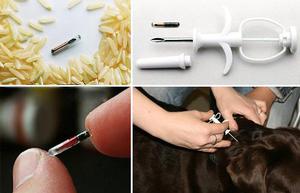 Although some organizations are extremely critical of such measures, RFID chips have been increasingly used by many owners in recent years. In modern conditions, microchipping of animals has become a mandatory procedure, which is required not only for staff of canine organizations. For example, if you plan to travel to Japan, your dog must be microchipped. If your pet has a microchipped chip that doesn't comply with the ISO standard adopted in Japan, you'll need to bring the appropriate scanner.
- A microchip is a highly reliable device that helps track a dog's location throughout its life. After the microchip is implanted, the owner will be issued a registration certificate, which takes the form of a secure plastic card. This document will contain all information about the pet, the owner, and the place and date the chip was issued.
- Such a certificate is officially recognized as a document granting the right to own an animal. Sometimes, when disputes arise regarding the ownership of a found animal, such a certificate can be considered a legal document.
 Once an individual chip is implanted, the animal is entered into a unified electronic database. Therefore, if you need more detailed information about the chip, you can access it. The national electronic identification database, Russiapet.net, is a large-scale repository of data on Russian animals identified by microchips or special tattoos.
- Dog microchips are quite affordable, costing approximately 400–500 rubles. Therefore, if you want to protect yourself from losing your pet, don't deny yourself the opportunity to microchip your dog.
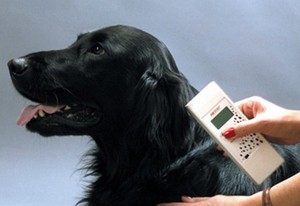 Once an individual chip is implanted, the animal is entered into a unified electronic database. Therefore, if you need more detailed information about the chip, you can access it. The national electronic identification database, Russiapet.net, is a large-scale repository of data on Russian animals identified by microchips or special tattoos.
What does a dog's brand mean and where is it located?
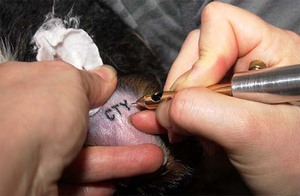
If you own a purebred dog, it must have a tattoo. All breeders are well aware of where it should be placed: a place is chosen on the inner side of the right thigh or right earEssentially, the brand is a regular tattoo.
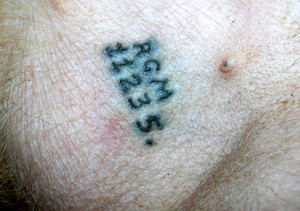
The dog's branding procedure must be carried out in the place of its birth. This allows the identification of the club or kennel where the animal was bred. Typically the stamp contains a combination of several letters and numbers:
- the first ones can be used to identify a club or a nursery;
- according to the second - the ordinal number of the animal in this club.
If an owner keeps a show dog, they'll likely want to have their pet branded. This will protect them from the risk of their pet being swapped during a show.
However, the brand is most valuable in the event of a lost dog. Then, if random people come across the lost animal, By looking at the brand, they can easily identify its ownerSimply contact the club, which will be able to provide complete information about the dog's owner.
To date the procedure for branding purebred dogs Is under the jurisdiction of the RKF. The key document defining the rules of this organization's work is the RKF's regulations on breeding work. According to them:
- the procedure of branding puppies must be carried out by representatives of a canine organization or kennel;
- each animal entered into the RKF database must have a brand;
- the brand is placed in the area of the dog's ear or groin;
- After installing an identifying tattoo, its code must be registered with the RKF;
- If desired, the dog owner can also have a microchip placed in addition to a tattoo, but this procedure should only be performed by a veterinarian.
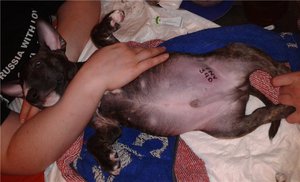 each animal entered into the RKF database must have a brand;
A tag on a dog's collar is a dog passport.
In some cases, a dog tag on the collar is enough to find a lost dog. But it can only help if if the dog ended up with honest people, then you can expect the pet to be returned to its owner fairly soon. However, if you've already given up hope that the dog will be returned to its previous owner, the new owner should find out the animal's name and age.
Training to keep your dog from getting lost
 The risk of losing a pet can be reduced by properly training the dog. This requires taking into account the animal's environment and personality.
First of all, your pet should learn simple commands like "Come" and "Stay." They should master them so well that they obey them unquestioningly under any circumstances. Then you won't have to worry about your pet getting run over by a car, frightening others, or running off in an unknown direction. Don't try to catch the dog., shouting after him, "I'll kill you! Come to me immediately!" You should act completely differently - start running away from him, and it's best if you conduct the training in a safe place.
Conclusion
Any dog develops a strong bond with its owner, so its loss is a great grief not only for the owner but also for the rest of the family. However, if appropriate measures are taken, a lost dog can be found very quickly. Dog tagging is a fairly effective measure.
This is a fairly harmless tattoo that is applied to the right side of the animal's body - the thigh or ear. According to this mark easy to identify the owner, because to do this, it is enough to contact the club, information about which is contained in the hallmark, which will provide the necessary contact information about the owner.


 Anastasia
  Natalia
  Artem
Artem
3 comments