 The ancestors of the German Shepherd arrived in southern Germany in 74 AD. They were herding dogs that accompanied the warriors of the Roman Empire.
Since the late 18th century, shepherds in northern Germany have been selecting dogs that are robust, hardy, obedient, and fast. At that time, all dogs that herded flocks were called shepherds. Translated from German and English, "shepherd" means "sheep dog." Dog shows were held to evaluate the dogs' appearance and working abilities.
Content
Story
In the late 1890s, former cavalry captain Max von Stephanitz founded the first specialized German Shepherd club. He is considered the founder of the breed. male Horand von GrafardHe was entered into the club's first stud book under the number SZ 1. The male was acquired at a dog show. He became the prototype for the breed. He was distinguished by his strong constitution and well-developed muscles. He was energetic, cheerful, and obedient. Selection was based not only on working qualities but also on intelligence—obedience, a non-aggressive nature, and intelligence.
The breed standard adopted in those years remains in force to this day.
The breed's working ability was recognized worldwide. In France, German Shepherds served in the police force, and in England, they earned the nickname "Alsatian Wolfdog."
At the beginning of the 20th century, German Shepherds ended up in Russia, where they were used for search and rescue, police, and guard duty. The domestic East European Shepherd breed was developed from the German Shepherd and adapted to local climatic conditions.
Description of the breed
The basic requirements for external, behavioral and hereditary characteristics are presented in the breed standard.
Appearance
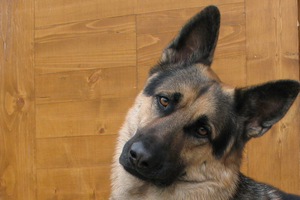
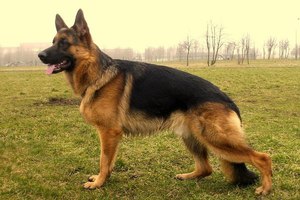
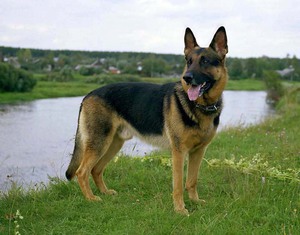
The height is above average, with a slightly elongated body. A strong constitution is combined with a sanguine temperament. The muscles are prominent and well developed. The chest is strong and moderately broad. The outline of the body forms a smooth, sloping line from the withers to the root of the tail.
Coat
The coat is thick, short, with a dense undercoat, lying close to the body. Long, soft hair is considered a fault. Old German Shepherds have a coat the cover was shaggy and thickIn the summer it was cut.
Suit
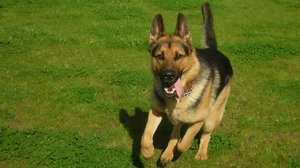 The predominant color is black with tan, dark gray, or light gray markings. Solid black or wolf-colored dogs—a black sheen on an ash-gray background—are common. German Shepherd No. 1, the ancestor of the breed, Horand von Grafhard, had a wolf-colored coat—a gray-shaded pattern. He passed this color on to his descendants. Saddle-back or black-and-red color — the most common in the breed.
All colors have a black nose. Small white markings on the chest, like a tie, and light fur on the inner legs are permitted. White dogs are disqualified at dog shows. However, proponents of this color have succeeded in establishing the white German Shepherd line as a separate breed—the Swiss Shepherd.
Movements
The German Shepherd moves at a low, sweeping trot. Its coordinated, sweeping movements are achieved by its well-proportioned body and well-trained, strong muscles. This spirited, well-trained dog is resilient, capable of running for 14 hours straight.
Service working shepherds, unlike show dogs, must be able to gallopA gallop, combined with a light walk during pursuit, is more productive than a correct trot.
Character
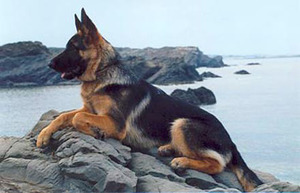 Only animals with an ideal exterior, good working qualities, and a stable nervous system are allowed to breed purebred German Shepherds. A healthy and well-balanced psyche allows the dog to have a high fatigue threshold, expend energy economically, and recover quickly from any work.
The German Shepherd is highly intelligent. It is good-natured and safe around others. It is easy to train and never gets out of control of its owner. It is fearless, determined, and devoted to its owner. It is capable of correctly assess the surrounding environment. They adapt perfectly to their surroundings. These innate qualities make the German Shepherd indispensable in police, guard, and border service. According to owners, they excel as guide dogs.
Children and a shepherd dog
Children and German Shepherds get along well. This breed's primary instincts are to selflessly serve people, protecting and preserving them. An intelligent, well-behaved dog will make a good nanny and playmate. However, it's important to remember that German Shepherds are physically strong animals with a lively temperament. They may overreact to a child's argument, and the consequences can be dire—dogs perceive events differently than humans. It's difficult for a small child to walk a large, active, and strong animal. adult supervision is always necessary.
Review
I first encountered this amazing breed at a show, where I saw a young man who had just returned from the army with his shepherd. I was amazed by the harmonious and precise work of this pair—dog and human. Harmony and understanding were present in their every movement…
How to choose a puppy
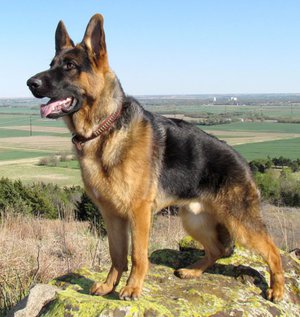 Choosing a German Shepherd puppy is a serious matter. First, you should attend general breed shows and observe the dogs or contact a kennel club for advice from a dog trainer. You need to decide... What color and gender is preferable?It is important to inquire about the mother's personality, living conditions, and diet.
Currently, a distinction is made between German Shepherds bred for show and those bred for working breeds. Show-bred puppies meet the standard, are highly trainable, and are suitable for apartment living. They make excellent companion dogs. Their striking appearance makes them successfully participate in exhibitions.
According to dog trainers, training a working-line puppy requires more time and effort. These dogs are more energetic, more active, and physically stronger than their show-type counterparts. They require long walks—two to three times a day—and more vigorous exercise.
Review
A city apartment doesn't allow a lively shepherd to vent its energy. While you're away, it can be destructive. A country house offers more room for a dog to maneuver. Regular training and exercise will help you develop an easily manageable shepherd with excellent guard qualities.
Breeders typically sell puppies at four months of age. A young dog is not very attractive—its legs are too long, it's awkward, and it's angular. But time passes, and the puppy grows into a dog. strong, beautiful shepherd.
 Choose a puppy with strong bones and straight, thick legs. Pay attention to the color and the length of the fur around the ears and tail. Large, knobby joints on the limbs indicate that the puppy will grow into a healthy, large, and strong-bodied shepherd.
- The puppy must meet the breed standard if it is to subsequently participate in exhibitions.
- In the standing position, the tail hangs down, slightly curved.
- The biggest puppy in the litter is not always the strongest.
- By nature, he should be playful and mischievous, sociable, cheerful, energetic, and inquisitive. The optimal age for separation from his mother and siblings is 9 weeks.
- The puppy needs its own place in the house, a transport cage, and its own toys.
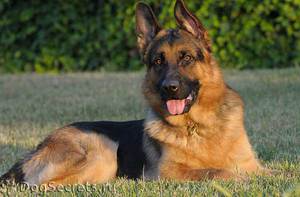 Choose a puppy with strong bones and straight, thick legs. Pay attention to the color and the length of the fur around the ears and tail. Large, knobby joints on the limbs indicate that the puppy will grow into a healthy, large, and strong-bodied shepherd.
In order for the dog to develop a friendly character towards the owner, puppies daily individual communication with a person is required.
For the first 10 days, feeding should remain the same as usual. New foods are introduced gradually over the course of a week.
Feeding and care
A German Shepherd needs to be walked twice a day. A muzzle and a long and short leash are required for walks. A lack of exercise can cause illness. The enclosure should be dry and draft-free.
The coat is brushed daily with special brushes to remove dust, dirt, and dander. Once a month, the dog should be washed from head to toe. In winter, the dog loves to swim in the snow.
Basic principles of feeding:
- the shepherd dog must be fed at a strictly defined time at least 2 times a day;
- the volume of food is from 800 to 1000 g per day with two meals a day;
- food is heated to +20˚ C;
- Feeding should be complete and balanced in terms of calories, nutritional value, vitamins and minerals.
Most animal diseases develop as a result of improper feeding. According to physiological periods nutritional needs varies. During pregnancy and lactation it is higher than during the resting period.
- A dog's greatest growth and weight gain occurs at 4 months of age. A puppy's diet should be higher in protein than fat to prevent obesity. Excess weight can lead to joint deformities.
- An adult German Shepherd requires a calorie-dense, nutritious, and highly digestible diet. Ensure portions are not too large and that the dog doesn't gobble everything up immediately. Eating too quickly can cause gastric torsion, which can be fatal. This is because German Shepherds have short intestines, which means they digest their food slowly.
- Once a shepherd reaches 6 years of age, natural antioxidants—foods with increased levels of vitamins A, E, and C—should be introduced into their diet. This helps prevent premature aging. Senior dog food should be higher in fiber and lower in fat. This diet promotes intestinal motility.
- Supplements containing calcium preparations should be introduced into the diet only as prescribed by a veterinarian.
 A dog's greatest growth and weight gain occurs at 4 months of age. A puppy's diet should be higher in protein than fat to prevent obesity. Excess weight can lead to joint deformities.
The owner chooses what to feed the dog - ready-made food or cook it himself. According to breeders, dogs that fed natural products, prepared by boiling, have a high performance capacity. Super-premium food helps keep your shepherd in good shape, but it increases the cost by 9%.
That's their job.
German Shepherds demonstrated their exceptional working abilities during World War I. Signal dogs delivered messages and documents under heavy fire. They carried ammunition and repaired damaged telephone lines using cable reels. Surgeon dogs would locate a wounded soldier and bite a soldier's personal item as a signal that he was alive. They then accompanied the aid team to the injured.
In Indochina, during the liberation war, a special parachute unitGerman Shepherds became the soldiers assigned to this unit. These four-legged warriors not only mastered parachute jumping but were also able to carry out combat missions after landing.
The German Shepherd is one of the breeds with the most acute sense of smell. Its olfactory memory can store up to a thousand scents. This unique ability allows it to work in customs and emergency services canine units, sniffing out drugs, explosives, and weapons, and searching for victims of explosions in the rubble.
Review
My father's farm and all his property have been guarded by German Shepherds for a long time. They are faithful perform their service dog dutiesThey have proven their love and devotion to their owners time and again. A better guard dog or herding dog is hard to find.
Famous and rich
 A monument to a mountain rescue shepherd named Flambeau has been erected in France. The dog fought in World War I. All of Flambeau's descendants died fighting in World War II.
Irma, a German Shepherd, in 1945. searched for people in the ruins of London, a victim of the bombings. For which she was awarded a rescue medal.
War dogs trained by the Central School of Military Dog Breeding participated in the 1945 Victory Day Parade on Red Square. Lieutenant Colonel Alexander Mazover, chief cynologist of the International Federation of Service Dogs, participated in the procession. He carried a wounded German shepherd named Dzhulbars, wrapped in the greatcoat of Supreme Commander-in-Chief Joseph Stalin. Dzhulbars, a mine-detection dog, was awarded the Medal "For Military Merit" for his heroic deeds during the liberation of Romania, Hungary, Austria, and Czechoslovakia.
According to the Guinness Book of Records, the richest German Shepherd — Gunther IV, a dog who lived in Italy. He inherited his $372 million fortune from his father, Gunther III. Gunther III's owner was so enchanted by her dog that she left him her entire inheritance.