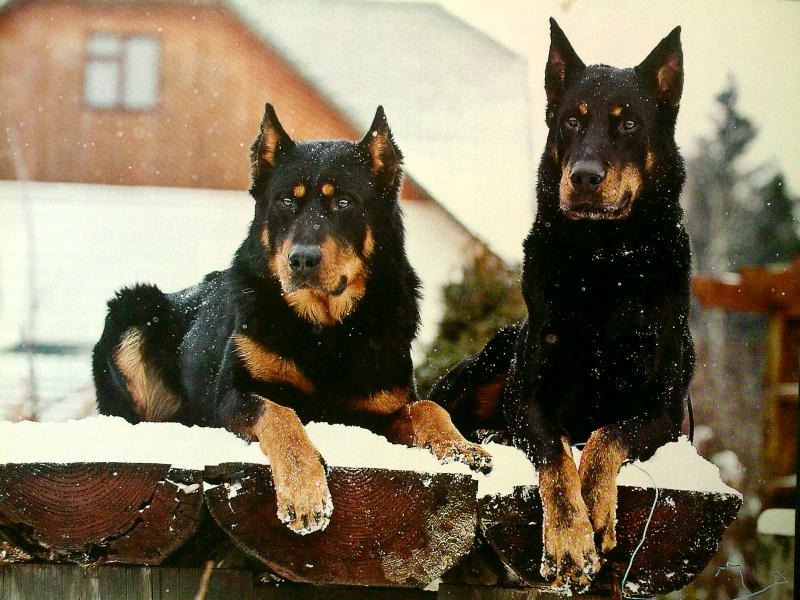
Rare in our region and still unknown to many, the Hovawart is undoubtedly one of the finest working breeds. The history of these dogs spans nearly a thousand years and is filled with memorable events. Thanks to the efforts of enthusiasts and a unique approach to breeding, this ancient breed has not only been restored but practically perfected.
Content
Originates from the Middle Ages
This is a very old breed, whose origins are lost in the mists of medieval Germany—a country that gave birth to many excellent working dog breeds. The first written mentions of Hovawarts date back to 1221–1225. This faithful dog was depicted in ancient engravings—he was highly prized and respected. Initially, the breed's very name reflected its working purpose—the word "Hovawart" means "yard guard" in German; it has always been an excellent guard and bodyguard.
In the Middle Ages, Hovawarts were guards, shepherds, and hunters.
Recent history of the breed
The Hovawart's popularity, and with it its population, remained strong until the beginning of the last century, but then demand for these "yard guardians" began to rapidly decline, and interest in the breed almost dried up. It would likely have disappeared entirely, but for a lucky break in the Hovawart's life.
Incident at the pond
However, the beginning of this story was anything but happy. A teenager named Bertram Köning snuck into a closed city park late one evening to swim in the pond. The boy knew the old Hovawart guarding the park well, and the dog let him pass. The swim nearly ended in tragedy—Bertram suddenly began to drown, and no one was there to help him. And then, unexpectedly, help arrived—the Hovawart jumped into the water and carefully pulled the already waterlogged boy to shore, then brought in people to help him.
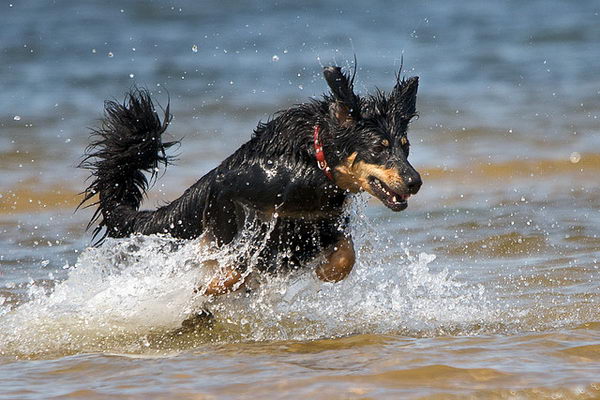
The Hovawart has a courageous character and, being an excellent swimmer, feels great in the water.
Bertram Koening grew up, but he could never forget the dog that saved his life. He became seriously interested in the endangered breed and dedicated himself to its revival, gradually attracting like-minded supporters. The breeders approached the matter with great responsibility, collecting surviving Hovawarts from farmsteads across Germany with typical German meticulousness and selecting the best for breeding—in terms of appearance, working ability, and health.
Systematic selection produced offspring close to ideal, which became the basis for future breeding efforts. By the start of World War I, Germany's high-quality and healthy Hovawart population had almost been restored.
Purely German principles
Returning from the front, young Kurt Köning continued his father's work, and modern Hovawarts owe him a great debt. Kurt undertook the systematic development of the breed and significantly updated it, adding blood from other breeds to the existing gene pool:
- Newfoundland;
- Kuvasz;
- Leonberger.
Many cynologists claim that the updated breed also contains a high percentage of German Shepherd blood, but this theory has not been officially confirmed. Training these two breeds requires completely different approaches.
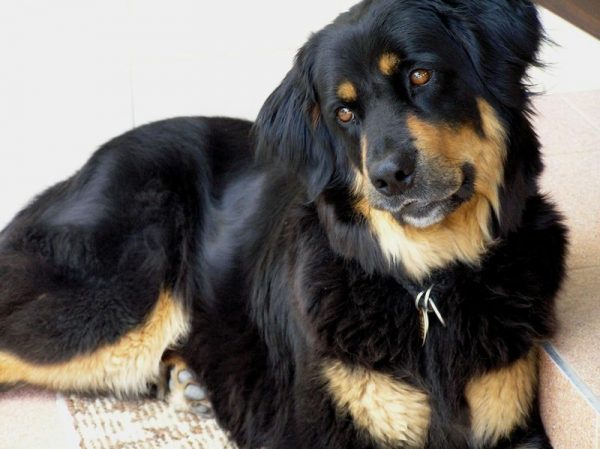
The Hovawart breed was updated with the blood of other working dogs in order to consolidate the working qualities of the dog and expand the range of its application.
Young Koening set himself the goal of creating a universal service dog and developed a breeder's code of honor, the principles of which are still strictly adhered to by all Hovawardians worldwide:
- The priority in selecting producers is working qualities; exterior and other show qualities are not so important in breeding.
- Too close inbreeding (crossbreeding) is unacceptable in breeding work - during mating, the relationship ratio cannot be closer than 3:4.
- All carriers of genetic diseases are strictly excluded from breeding: not only the sick puppy, but also its littermates and the parent pair.
- Puppies are not sold to random people - potential owners are required to undergo special training in the theory and practice of raising, maintaining, and training Hovawarts.
Köning became the first cynologist in the world to institute mandatory testing of breeding stock for dysplasia (since 1995). He founded the Hovawart Breeding Union, which oversees all breeding efforts for the breed to this day.
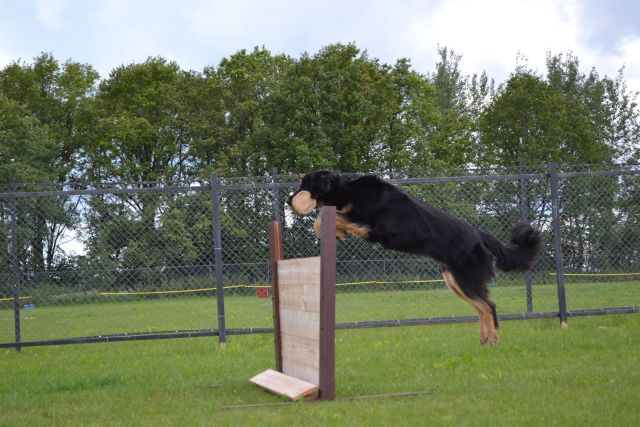
Hovawarts have very strong and healthy joints.
The breed received official international recognition from the FCI in 1972 and was classified as a mountain molosser.
Standard and character of the Hovawart
Thanks to a responsible and rigorous approach to breeding, we have succeeded in producing a very healthy population of service dogs with excellent working qualities. This is unique compared to other breeds, whose commercialization brings nothing but harm. The Hovawart standard was developed with these fundamental breed requirements in mind.
The Hovawart is a universally recognized working dog with a wide range of uses. Balanced in nature, it has a good disposition, a protective instinct, endurance, a moderate temperament, and excellent scenting abilities. Its harmoniously balanced physical proportions, typical of a working dog, and its special attachment to its family make it an excellent companion, guard, protector, and service dog.
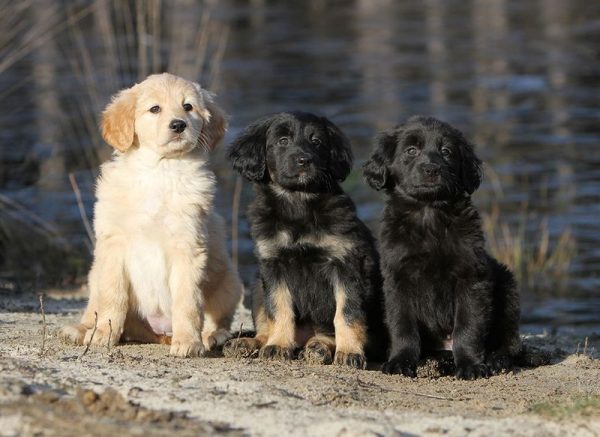
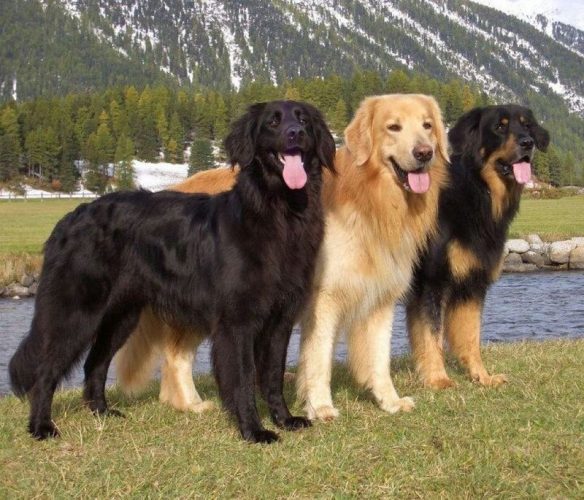
Three colours are permitted according to the Hovawart standard: black, fawn and black and tan.
Both the dog's appearance and character are designed for successful service. This fairly large dog (up to 70 centimeters tall at the withers and weighing up to 45 kilograms) has a long, thick coat, strong, muscular legs, and is very hardy and even-tempered. A true Hovawart is perfectly obedient, but in an extreme situation, he will make decisions quickly and independently, without waiting for a command, and his endurance and strong nervous system are the envy of any dog breed.
Video: Hovawart guards a toy
Buying a puppy
Hovawart puppies in Russian breeders cost around a thousand dollars, with females costing more. If you're looking to import a puppy from abroad, triple that amount. But the high price isn't the issue.
Purchasing a Hovawart puppy is a major, conscious decision that shouldn't be made spontaneously, as you'll have to take on too much responsibility later on. If you are not ready, do not buy. Choose from a variety of dog breeds the one with which you will truly feel comfortable living next to.
Yes, to buy a Hovawart, you no longer need to travel to Germany, join a waiting list, and prove to the breeders there, both verbally and deed-wise, that you're worthy of joining the exclusive circle of owners of this remarkable breed. Breeding kennels exist in Russia and neighboring countries, and the selection process there is less demanding than in the Hovawart's historical homeland. Still, think carefully before deciding to purchase such a puppy.
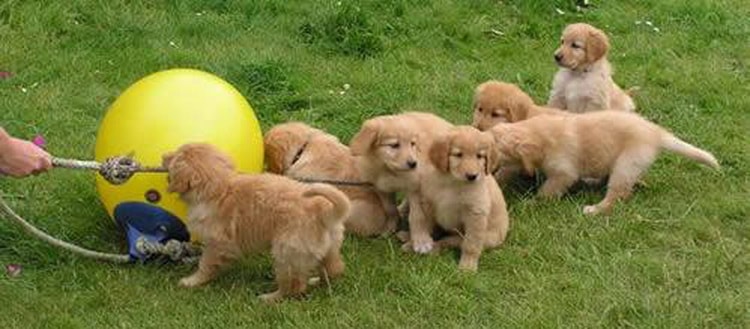
Hovawart puppies begin to show working qualities very early.
The main problem may be the lack of experienced trainers who know this breed, but it is absolutely necessary to seriously engage in the upbringing and training of a young Hovawart, and from the very first days the dog is in your home. Not everyone can do this on their own. The Hovawart's high intelligence and strong character allow them to recognize even in puppyhood that their owner lacks experience or leadership skills and can be easily bullied. An ill-trained service dog is a disaster for the family.
And one more thing: the Hovawart is a rare breed and looks set to remain so. Be careful not to fall for scammers offering "a puppy from an unplanned mating, without papers, but cheap." Similar ads exist online, but they sell all sorts of puppies, just not Hovawarts.
Video: Behavior of month-old Hovawart puppies
Peculiarities of dog care
The average lifespan of a Hovawart is fifteen years—it's not much, but years spent living with this dog are sure to be happy, interesting, and filled with bright events for the entire family.
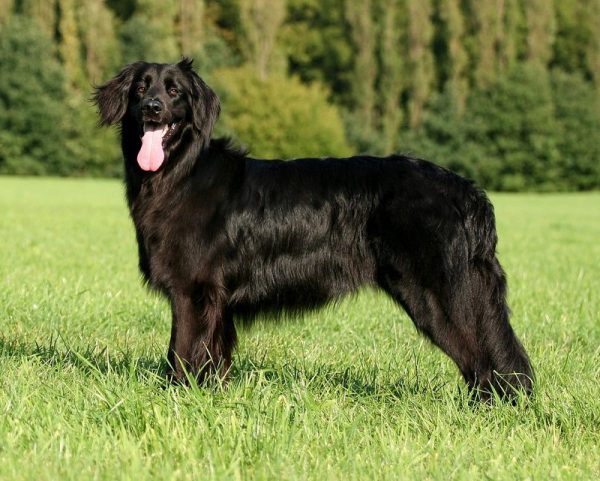
The intelligent, intelligent and friendly Hovawart will become a reliable friend and companion for the whole family.
Is it possible to keep it in an apartment?
Until recently, Hovawarts were kept exclusively in kennels, where, incidentally, these dogs thrive. However, this breed is increasingly appearing in large cities. Contrary to popular belief, keeping them in an apartment is not particularly difficult, provided they receive timely and proper grooming.
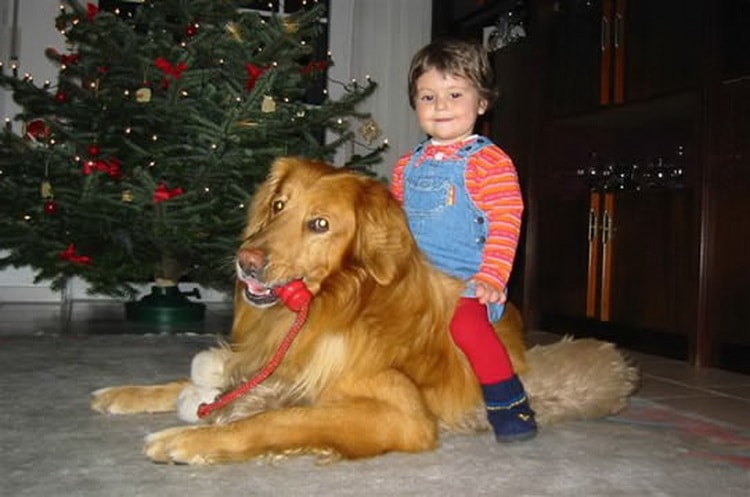
The Hovawart can be a patient, attentive, and gentle nanny.
"Guardians of the Yard" are tolerant of all pets and readily play with children. A well-behaved puppy quickly adapts to a new family's routine, rarely misbehaves in the apartment, and tolerates its natural needs until a walk. Such a dog needs to be walked for one to three hours a day, regardless of whether it lives in an apartment or a private yard. During an active walk, the contact between the dog and its owner is established and strengthened, which is very important for every true Hovawart.
Video: Hovawarts on a walk
Do I need to cut it?
Hovawarts are not typically clipped—only the edges of the paws, top and bottom lines, and other coat imperfections are carefully trimmed with scissors. However, the dog's long, beautiful coat should always be kept clean and tidy.
The condition of the Hovawart's coat depends largely on the conditions in which it is kept. If a dog lives outdoors, as was previously common, seasonal shedding becomes more pronounced. In winter, the dog develops a luxurious, long coat with a thick undercoat, which it sheds with the onset of warmer weather. During shedding, intensify brushing the loose fur with a slicker brush and massage the skin with a special mitten or simply a stiff brush. It may be worthwhile to include a vitamin complex or specialized coat supplements in the diet during this period, especially if the diet is based on natural foods.
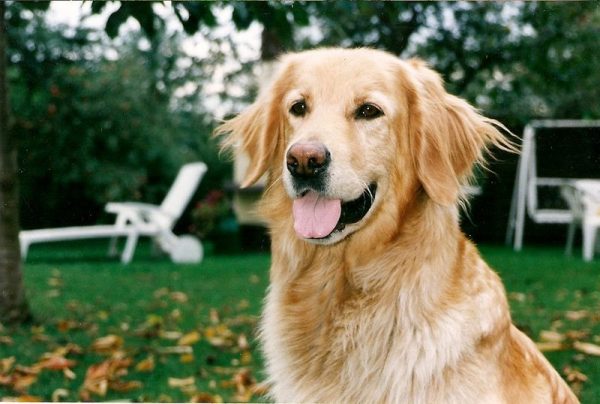
A well-groomed Hovawart's coat is shiny and falls in beautiful waves.
If a dog spends most of its life indoors, shedding usually becomes permanent, and a thick undercoat doesn't grow. In this case, regular, preferably daily, brushing is required. The need for supplements is determined based on the individual dog's condition and its nutritional philosophy.
You should bathe your dog as its fur gets dirty, but not too often, so as not to dry out the skin - once a month is enough. Teeth, eyes and ears also require constant care - they need to be cleaned at least twice a month, and overgrown claws need to be trimmed.
What to feed
This breed is very active, so its balanced diet should be rich in protein, vitamins, and minerals. Premium dry food for active dogs provides a good solution to the problem of balanced nutrition. However, as Hovawarts age, it is recommended to reduce the energy content of their food or even switch them to a dietary diet.
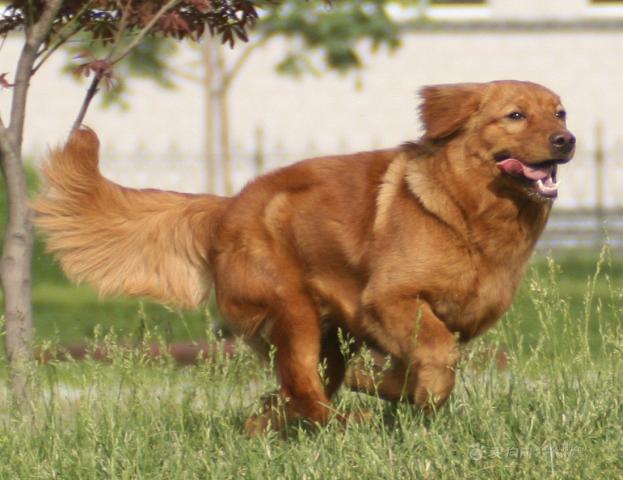
The Hovawart's activity must be supported by a high-energy diet.
Proponents of natural nutrition should take into account that meat makes up the lion's share of an adult Hovawart's diet. He should eat a kilogram of fresh red meat per day, and one and a half times more offal. It's best to discuss the rest of the diet with the breeder when you buy your puppy.
When raising a young dog, pay attention to the digestibility of food - to stimulate digestion, it is recommended to offer the growing puppy fresh vegetables, root vegetables, and leafy greens. It is important that the dog receives enough “building materials” for bones, joints and ligaments from food, especially between the ages of four months and one year. During this period, it is advisable to introduce high-quality supplements with chondroitin and glucosamine into his diet, even if the dog eats dry food enriched with biologically active substances.
Upbringing
From the moment a puppy arrives in your home, it begins to consider its human family its pack. It's crucial that it immediately learns its place in the new pack. He is the youngest in the hierarchy; even small human children stand above him on the hierarchical ladder. The owner must be able to present himself as a clear leader, a chieftain whose authority is not in doubt.
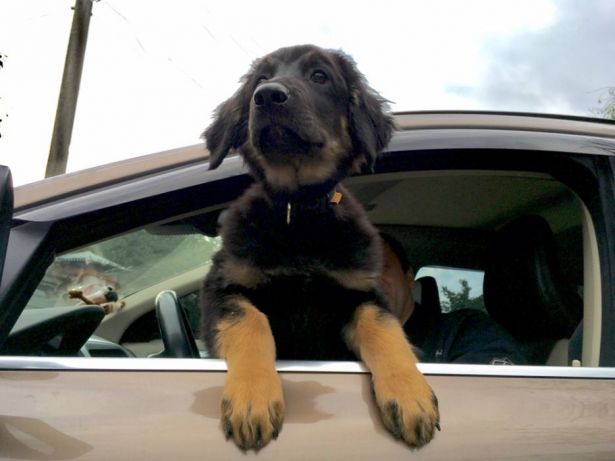
The puppy should be the youngest member of the family pack, otherwise he will try to establish his own rules, and when you try to put him in his place, he will begin to show aggression.
The Basics of Obedience
From the very first days in a new home, the puppy should be taught the basics of obedience through play—basic commands that the puppy should firmly grasp and obey without question. After four months, it can be sent to a training center, where an experienced dog trainer will help the owner find the right way to improve their dog's obedience.
That's exactly it: the trainer teaches not the dog, but its owner, who then trains the puppy. The trainer merely corrects the results of these lessons.
Video: Obedience training for a Hovawart
Training
Specialized training can begin when the puppy is seven months old—by this age, it should have completed and mastered the obedience course. Hovawarts are highly trainable, but they do not tolerate rough handling and the rigid confines of a training "corridor" that German Shepherds thrive in.
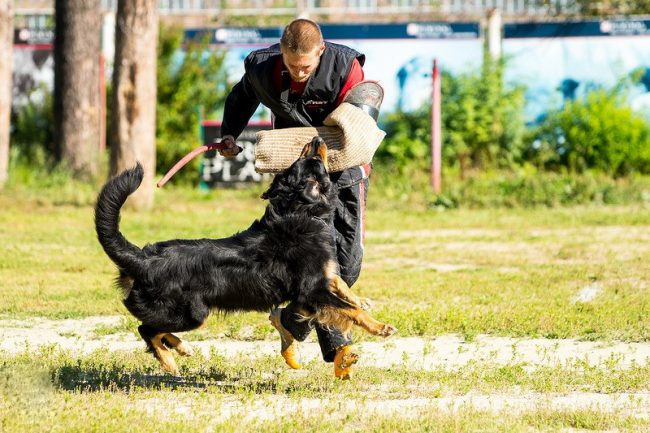
The Hovawart works well both on the training ground and in real conditions.
Pressure discourages the Hovawart from working—this highly intelligent dog wants to understand what it's supposed to do and why. It's not enough for him to simply serve as a service dog, an obedient extension of his master's hand. The Hovawart strives to learn how to act independently and correctly in a real situation when its owner needs protection. Help him with this.
Video: Service training
Veterinary science
Excellent health, a strong immune system, and good genetics—these qualities alone make it worth considering a Hovawart. However, the excellent health bestowed upon the dog by nature and the breed must be cherished and properly maintained.
Diseases and vaccinations
Even the healthiest dogs get sick sometimes. Don't treat your dog yourself in these situations; seek qualified veterinary help. Consult with your veterinarian about which combination vaccines are most effective in your region, and which products are best for regular deworming of your dog, as well as treatment for fleas, ticks, and other blood-sucking insects.
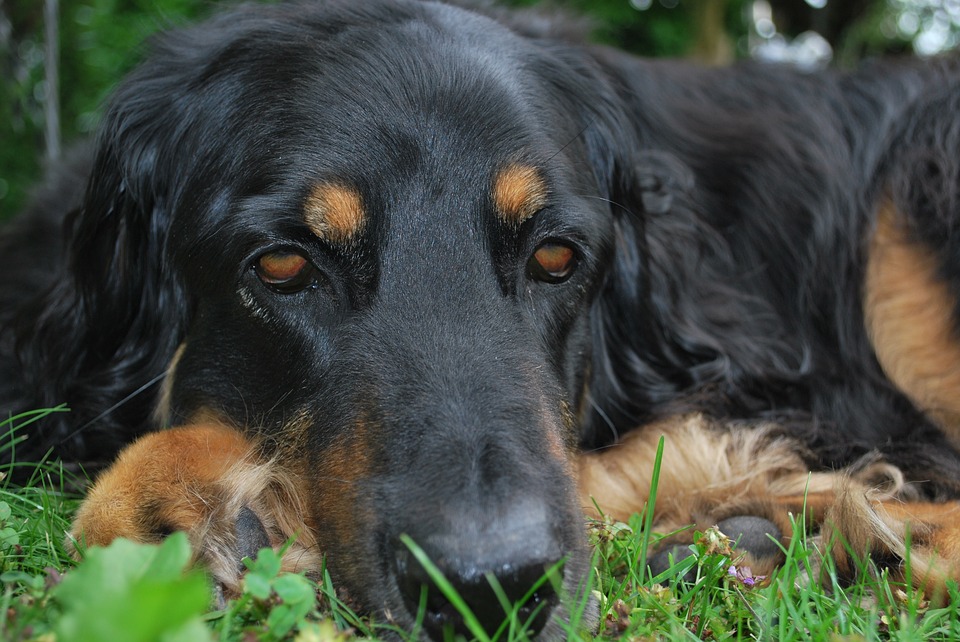
Timely vaccination will protect your dog from many diseases.
Hovawart puppies are vaccinated after deworming according to the standard dog vaccination schedule: at eight and twelve weeks. A rabies vaccination is also given during the second comprehensive vaccination. If recommended by a veterinarian, a third vaccination against major canine infections can be given, but only after the puppy's teeth have completely changed. Adult dogs are vaccinated annually.
Pregnancy and childbirth
Hovawarts are one of the few modern breeds that require a working certificate for breeding: the offspring must inherit the working qualities of their parents. If you are lucky enough to own a working bitch of this rare breed, you have the chance to increase the Hovawart population. It is a great honor, a great responsibility, and a tremendous joy!
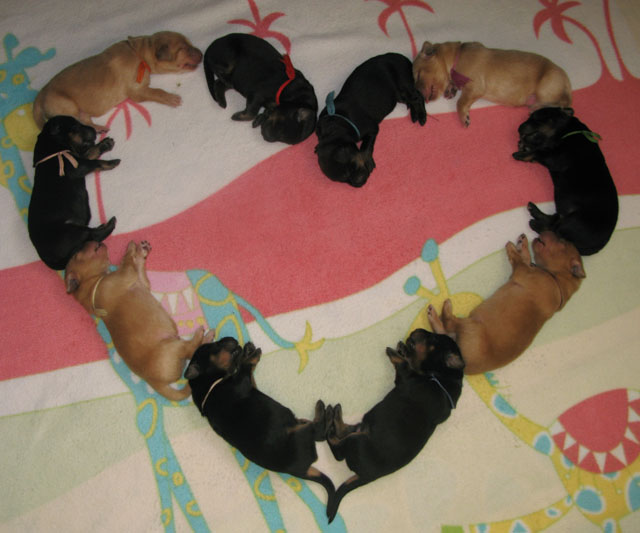
Representatives of the breed are prolific - 10-12 puppies in a litter are not uncommon for them
In most cases, the excellent health of the breeding pigs guarantees a smooth and uncomplicated birth. However, to be on the safe side, it's best to invite an experienced veterinarian to the birth—Hovawart offspring are too precious to risk.
Video: All about the Hovawart breed
Owner reviews
In general, with puppies, I've noticed many times that the most important thing is NOT to interfere with a child's life and development. Believe me, if a walk by the sea is a burden for them, they'll plop down on their bottom and say, "Mom, I'm sleepy, pick me up," and they'll refuse to go. But if a puppy runs around and plays, it's not a burden, but development. If the beach by the sea is also covered in small pebbles, stones, and sand, then it's a pipe dream, as a gentle massage of the paws forms a proper pastern, a tight paw, and naturally wears down the claws. Playing with peers is also not a burden, but development. In my opinion, dangerous things are playing with teenagers or puppies of larger breeds. Climbing down stairs, jumping over fences and hurdles, tumbling down slopes, chasing a bike.
I've tried everything to keep the dog from chewing: sprays and sprinkled ground pepper. The sprays wear off quickly, and the pepper crumbles or gets into the dog's nose. No fun. The only thing that helps is "hellish soup." 🙂 I crush four whole chili peppers and steep them in boiling water, then smear this "broth" on the tempting spots. The main thing is to let it dry. Then you can let the puppy in. It discourages any urge to chew instantly and for a long time.
A Hovawart's coat depends on heredity and habitat. The ZTP conformation test classifies coat length into three categories: short, medium, and long. This is determined by heredity. Coat density depends on whether the dog lives indoors or outdoors. Indoor dogs shed less but wear roughly the same clothing all the time. Outdoor dogs shed almost completely and quickly, then grow back their coats for the winter. But they have such a stunning winter coat!
A beautiful, well-behaved dog. People usually imagine guard dogs and bodyguards as somewhat ominous or menacing, like Rottweilers, but this dog is simply beautiful. The Germans managed to create the optimal combination of qualities—a strong guarding instinct and a complete lack of aggression. A good example for breeders.
The Hovik is not a Malinois, German Shepherd, or East European Shepherd. No force or harshness is used in training, only non-confrontational training based on rewards with treats or toys, and a commitment to maximum interaction with the dog. Training sessions with the owner at the training ground should be engaging for the dog and enjoyable for both of them—that's when excellent results are achieved!
Video: Personal Experiences of Hovawart Owners
Of course, the Hovawart isn't a dog for everyone. It's the ideal working dog, a versatile canine soldier, destined for service, not to show off at dog shows. But once you've seen one, it's impossible not to be captivated by how beautiful this Hovawart is!