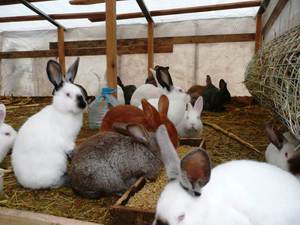
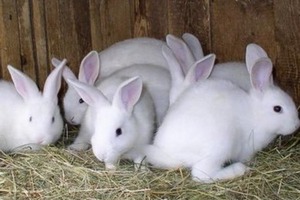
 Home-based rabbit farming is extremely popular worldwide among all forms of domestic animal production. This is due to the low cost of keeping rabbits and their rapid breeding. Success is assured by feeding the animals good food, providing them with suitable living conditions, and adhering to sanitary and hygienic standards. As a result, the breeder will reap the benefits of delicious, nutritious meat and financial profit.
Content
Selecting a breed
Of all the types of rabbits, the most valuable are about 20 breeds, which are divided into three categories:
- a meat breed from which the greatest amount of meat can be obtained;
- down or fur breeds;
- meat and hide breeds.
When planning to breed rabbits at home, you first need to identify a promising market niche in order to understand which breed to choose for breeding.
Young rabbits for breeding are sold on farms. To choose healthy rabbits, pay attention to their appearance. Animals must have:
- clear eyes;
- shiny dense pile;
- strong body;
- well-fed and well-active.
The coat color, length, and weight should be consistent with the chosen breed. It is not recommended to purchase rabbits with the following defects:
- signs of obesity or emaciation;
- falling or ruffled pile;
- sagging back or belly;
- drooping ear tips;
- protruding hips;
- with an elongated head;
- with crooked paws.
If at first the animals will live in a building without heating, you need to take the breed that suitable for the climatic conditions of your region.
Choosing a cage for keeping rabbits
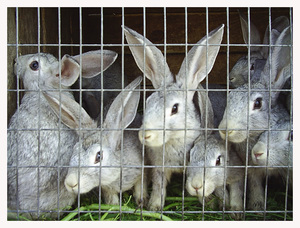 When raising rabbits indoors, it's important to provide them with adequate housing. When keeping animals outdoors, they need to be housed in pens, pits, or cages. When kept indoors, they need to be housed in hutches. These housing methods can be combined, and the hutches can be moved outdoors during warmer months.
Young and sexually mature animals are kept in separate rabbitries, since three-month-old individuals begin to become more aggressive.
Cells come in different types:
- Single-section.
- Two-section, in which nesting and feeding compartments are additionally installed.
- Single-tier.
- Multi-tiered.
You can buy a rabbit hutch at a pet store or make it yourself.
Tips for Building a Rabbit Cage
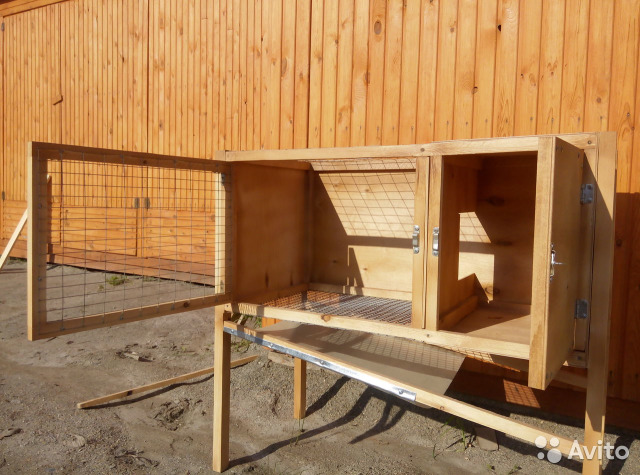
Experienced farmers recommend building the walls and roof of the rabbit hutch from wire mesh and the floor from wooden slats. To make it easier to keep the hutches clean, leave a one-centimeter gap between the slats when constructing the floor.
It is possible to make a rabbit hutch entirely from metal mesh. Such designs have some advantages:
- ease of maintenance;
- compactness;
- ease.
However, animals kept in such a rabbitry often suffer from prodermatitis of the paws.
There is no standard cage size. The minimum dimensions of a rabbit hutch should be 150 x 70 x 70 cm. The hutch size should allow the animals to move freely and not feel cramped. A separate hutch is required for 3-4 does and small rabbits, which will initially be kept with their mothers. After some time, the rabbits are moved to another hutch, and the mother prepares for the next litter.
The front wall of the hutch should be slightly larger than the back wall. This will make it easier to care for the rabbits. a hinged lid should be madeThe rabbit hutch should be divided into sections, with a partition and an opening for the animals placed between them.
Particular attention should be paid to water bowls, which should be conveniently located and always filled with clean water. Water bowls and feeders can be hanging, retractable, or stationary. If they are permanently located inside the cage, they should be equipped with lids.
Rabbit hutches that will be located indoors are best built in the form of a house. Outdoors, the hutch is mounted on supports to prevent rodents from accessing the rabbits and to make care easier.
Peculiarities of keeping rabbits
Rabbit breeding at home involves gradually increasing the number of rabbits, which requires providing the animals with housing, high-quality food, and compliance with sanitary and hygienic rules.
Feeding rabbits
Animals must be fed regularly. Water and hay must be available in the cage at all times. Rabbits drink several times more water per day than they eat.
The following are used as feed:
 root vegetables such as rutabagas, beets, potatoes;
- hay;
- grass;
- white cabbage leaves;
- fresh vegetable scraps from the kitchen;
- bran;
- grains of legumes and cereals;
- granulated feed, which should be enriched with protein and consist of 40% grass meal;
- cake;
- meat and bone meal or fish meal.
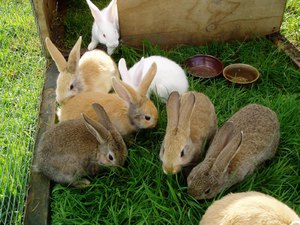 root vegetables such as rutabagas, beets, potatoes;
In addition, the diet should be supplemented with easily digestible supplements in the form of table salt, carotene, phosphorus, calcium, and protein.
In a year, one rabbit can eat:
- about 120 kg of root vegetables;
- more than 300 kg of concentrated feed;
- about 100 kg of hay;
- approximately 400 kg of green grass.
In summer, rabbits can eat anything that grows in the garden. Their diet should definitely include wheat, oats, or barley, and various fruits.
Care Features
Maintaining healthy animals directly depends on compliance some rules for their care:
- The wards need to be provided with fresh air.
- Rabbits should not be kept in a draft.
- Every ten days, equipment in the cages should be disinfected.
- Rabbit hutches, drinking bowls and feeders should be cleaned every day.
- Animals are recommended to be examined regularly. Any sick animal should be isolated and a veterinarian should be called.
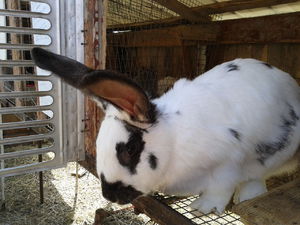 The wards need to be provided with fresh air.
To prevent diseases dangerous to rabbits, they need to be vaccinated on time. A monovalent vaccine or a combination vaccine can be purchased at a pharmacy. Vaccinations should be administered by a veterinarian or experienced farmer.
Rabbit breeding
With proper planning of matings, offspring from these animals can be obtained all year round. The optimal age for breeding is 7 months for males and 5 months for femalesA female that is too young may not carry her offspring to term, while an immature male often produces weak, and sometimes non-viable, rabbits.
To ensure healthy offspring, breeding partners must be carefully selected. If a rabbit's efforts to reproduce fail in 30% of cases, it is culled.
The female rabbit is rejected in the following cases:
- if she was unable to conceive after two or three matings;
- ate her young;
- In two litters in a row she carried less than 5 rabbits.
Breeding animals must be of normal weight. Obese animals may not estrus at all, while those that are too thin produce sickly offspring. Sick kits can also be born even if their parents are from the same litter.
Mating occurs during the female's estrus period. In winter, it occurs every 7-9 days, and in summer, every 5-6 days. Estrus lasts three to five days.
When planning matings, the required number of males is calculated. A young male mates with a female 1-2 times a day, while an adult male can mate up to 4 times a day. Males should be given a rest periodically. To prevent deterioration in the quality of the male, There should be 8 to 12 females per male.
How to carry out mating?
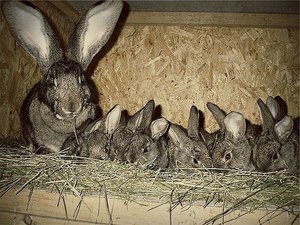 The mating should take place in the rabbit's cage, otherwise the male will feel uneasy. Since rabbits are very active animals, all objects, including feeders and waterers, are removed from the cage beforehand. The cage should be free of any sharp objects, such as protruding wire or nails, which could easily injure the animals. After two weeks, the female rabbit is placed with the male again for a test mating.
A pregnant female begins to run around the cage and behave aggressively towards the male. Pregnancy can determine by palpationTo do this, palpate the rabbit's abdomen. It should be firm near the rump. You can feel pea-sized fetuses arranged in a chain.
A female's pregnancy lasts from 29 to 33 days. Before giving birth, she will begin to drag dry hay into a corner of the cage, pluck down from her breasts, and line the floor of the doe's home with it. This is how the female rabbit builds a nest. During this time, the doe should have two fresh water bowls in her cage. Otherwise, during the birthing process, she may kill the kittens due to lack of fluids.
Rabbits give birth fairly quickly. The female can give birth within 20-30 minutes. The babies are born naked and blind. the female rabbit wraps the baby rabbits in her fluff.
Home rabbit farming can be considered successful if, after deducting all expenses from your income, you're still in the black. This means you've properly set up the entire rabbit care and breeding process.