 When buying meat at the store, we all probably wonder: is the pork high-quality? What was the piglet fed? What additives and growth promoters were included in the diet, and how safe are they? What if we tried raising a pig ourselves at home, using high-quality feed and natural supplements?
Content
Special diet for piglets at different periods
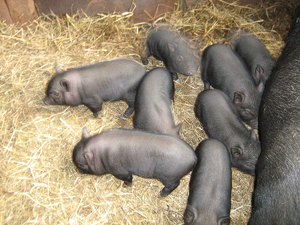
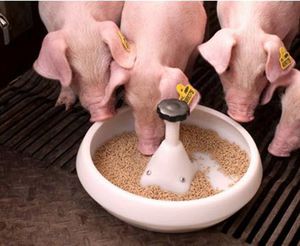 During the first two weeks of life, piglets typically rely on their mother's milk, provided the sow has enough and there aren't many piglets (7-8). In other cases, by the age of one week, maternal nutrition is no longer sufficient for the piglets.
They begin to actively grow and gain weight, so they it is necessary to provide additional feedWith the appropriate diet and proper feeding, a piglet's weight increases fivefold in the first month of life.
Due to the fact that babies have a very tiny stomach, they should receive food until they are three weeks old. at least 8 times a day in small portions. However, introducing animals to a variety of foods should be done gradually.
Milk period
The lactation period for piglets lasts for 2-2.5 months. During this time, choosing the right diet is crucial to ensure rapid growth. Milk is the ideal supplement during this period. It can be either skimmed or whole milk, but it must be warm. During the first months of life, piglets require approximately 5-6 liters of skimmed milk and 6-8 liters of whole milk.
From the first weeks it is necessary to add some to the feeder mineral fertilizers (charcoal, turf, or red clay). Once babies learn to eat minerals and drink water, porridges cooked with skim milk or whole milk can be introduced into the diet.
In addition, pigs need to be gradually teach to eat vegetablesFirst, pureed, then diced. It's best to boil the potatoes and feed them with concentrated food in puree form, but not before the babies are two weeks old.
Starting from 1.5-2 weeks of age, animals can be feed with grated carrots (10-15 grams/day). During the summer, grass and greens are given ad libitum from the first week of life. This has a positive effect on the growth and weight of the young. If you follow these simple tips, by the end of the weaning period, the young will weigh an average of about 25 kg.
Piglet feeders must be kept clean, as piglets are very susceptible to gastrointestinal illnesses. To prevent this, regularly remove any uneaten food from the trough, then thoroughly rinse and rinse with boiling water.
Growing at home
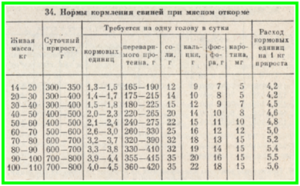 It is believed that during this period (2.5-4 months), the foundation for successful fattening is laid. During this time, active muscle growth occurs and piglets need provide the most favorable conditions feeding and maintenance.
To ensure rapid growth, pigs should be fed thick porridge: oatmeal, barley, peaWhey or skim milk, as well as various cleanings and kitchen scraps, can be used as additives.
Piglets still need succulent feeds, which include potatoes, carrots, garden tops and grassTeenagers should receive at least 15-2 grams of chalk and salt per day.
If the rearing takes place during the winter period, additional feeding in the form of chopped wood, hay dust, silage and vegetables in double quantity is allowed.
Once the rearing period is complete, it's time for fattening. In approximately 2-3 months, the piglet's weight should increase from 50-60 kg to 100-110 kg. To ensure rapid growth, concentrates should be included in the pig's diet starting at three months of age.
Before you begin fattening, it's important to learn as much as possible about the types of feed mixtures, the appropriate diet, and fattening procedures. This will allow you to quickly provide yourself with a high-quality and relatively inexpensive product.
In pigs, body condition and productivity depend to a greater extent on rational nutrition than in any other livestock.
The influence of feed on meat quality
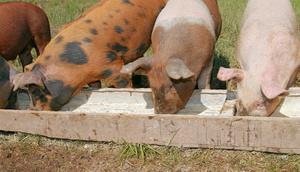 Many pig owners firmly believe that they can feed their animals anything, including household scraps. While this is true, you can't raise a good pig on potato peelings and cabbage alone.
And if we're talking not about one or two piglets, but about ten or more, the issues of rational nutrition and rapid growth of the animals become more pressing.
In addition to garden waste, pigs' diets should include vitamins, minerals, dry and liquid food and various dietary supplements.
It should be taken into account that the quality of meat directly depends on the type of feed:
- If you feed a lot of vegetables, the fat will become flabby.
- If the diet contains fish waste, the meat will smell accordingly.
- Feeding dairy products will give the meat a pleasant aroma.
- To avoid an unpleasant aftertaste and looseness, reduce the amount of corn and wheat bran. Avoid overfeeding buckwheat and potatoes.
- Pigs fed primarily on soy, oats, oilcake and fishmeal will ultimately produce low-quality meat.
But you shouldn’t completely give up the above-mentioned foods, you just need to be sure comply with the norm and the period of feeding them.
First, you need to determine the specific purpose for which you're fattening the piglet at home: bacon, meat, or lard. This will determine the choice of fattening method.
Features of fattening piglets at home
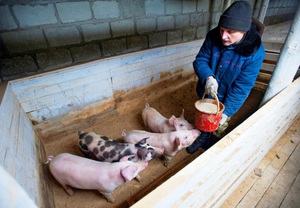 Types of fattening are divided into the following: fattening to fat conditions; bacon and ham fattening; meat fattening.
When fattened on meat, the animal's meat is tender, and its back has an even, 3-cm-thick layer of fat. In this case, fattening the piglet should begin at approximately 2.5 months and be completed by six months of age. By this time, the pig should have reached approximately 100 kg of live weight.
Meat fattening is carried out in two stages:
- Until the piglet reaches a weight of 70 kg, its diet should consist of 1 kg of concentrated feed per day (can be replaced with household waste), as well as chopped greens (legumes, peas, clover) in an amount of up to 5 kg/day.
- Once the animal reaches 70 kg, introduce 2 kg of potatoes and 5 kg of beets into the diet, increase the amount of concentrates to 1.5 kg, and increase the amount of greens to 6 kg. Additionally, add 10-30 grams of table salt and chalk.
Bacon and ham fattening is used to produce marbled pork. It is important to select a pig of the appropriate breed.
Fattening also begins at 2.5 months of age. Boars pre-castrate (at two months of age). Up to 5.5 months, the animal receives 1.5 kg of concentrates, 1.5 kg of skim milk, about 2 kg of beets and pumpkin, 3 kg of greens, and 20-25 g of table salt daily. During this period, the pig should gain at least 400 g of weight per day.
At the next stage (up to 8.5 months), it is necessary to exclude from the diet all products that affect the quality of meat and its taste. Now, to obtain bacon, the animal must be provided with daily active walks With two meals a day, the piglet should gain approximately 500-600 grams per day.
For fattening, it's best to select young piglets that have already reached 100 kg in weight, and sows. To achieve rapid weight gain, animals should be fed carbohydrate-rich food. This is ideal for sugar beets and potatoesConcentrates, which mainly contain corn and wheat, should be given at a rate of about 3 kg/day.
At the second stage of fattening, instead of corn, you should include in the diet barley or millet This will help improve the quality of the fat. With this diet, the animal quickly gains weight up to 200 kg, half of which is fat.
In order to reduce the significant costs of feeding pigs, as well as to ensure rapid weight gain, it is necessary to purchase special feed additives, which, when used correctly, will help achieve the desired result, significantly improve the quality of meat products, and also provide protection for animals from various diseases.
For example, when fattening for meat, it is necessary to add vitamins and amino acids to the feed, which significantly increases the nutritional properties of the product and leads to a rapid increase in live weight.
Stern
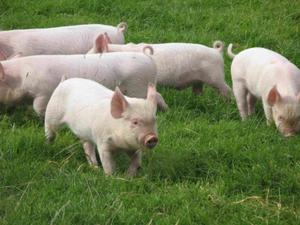 Feeding plays a significant role in raising pigs for meat. For rapid growth, the animal needs ensure adequate nutrition in sufficient quantity. This means that the piglet should receive as much food as it can consume at one time. It's important to monitor not only the quantity of food, but also its quality.
Not all feeds are created equal, and some require preparation. For example, initially, green grass should only be fed fresh and in small portions, while hay should be chopped and steamed.
Small piglets if possible must be released onto the lawn, but the walk should last no more than an hour. Over time, the walk time can gradually be increased to 6-8 hours.
Potatoes should also be boiled first (without the skin) and mixed with bran, chaff, or pea flour. Carrots should be washed thoroughly, cut into small cubes, or grated.
For good growth and weight, piglets should be constantly fed. clean and warm (at least + 15 °C) water, which is poured into a special container with slats and changed daily. If the "kids" are playing and debris accidentally gets into the water, the water should be replaced immediately, after cleaning the trough.
What you shouldn't feed pigs
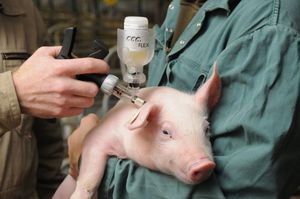 This issue is also very important when fattening piglets and relates to feed quality. If you notice mold, parasites, or signs of fungal infection, discard the feed immediately.
You should also be careful when feeding greens to animals. This is because some plants contain harmful substances, which, if ingested, can cause poisoning in month-old piglets.
These may be the following herbs:
- horse dill;
- black nightshade;
- cicuta;
- caustic buttercup;
- spurge;
- pickle;
- dog parsley, etc.
Particular attention should be paid to castor oil and cottonseed cakes, as they contain gossypol (a toxic alkaloid). Therefore, such feeds should be steamed or treated with alkali before feeding.
Sprouted potatoes are no less dangerous, so their sprouts should be removed beforehand, and green tubers should also be discarded. It is unacceptable to feed pigs water in which potatoes were boiled.
If the purpose of purchasing a piglet was a profitable investment of money, then in order to obtain excellent quality meat you should buy grain and special additivesAnd if you need a pig just to "not throw anything away," it's the perfect receptacle for kitchen scraps.