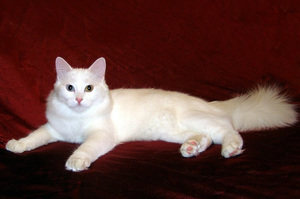
White cats of any breed are aristocratic, rare, and more striking than cats of other colors. This is why they are incredibly popular. Maintaining their snow-white coat requires a great deal of time, effort, patience, and expense from their owners. Another potential problem is the pet's complete or partial deafness.

Why is deafness common among white cats?
White kittens appear in any litter if both parents (or only the mother) are carriers of the W- (Dominant White) gene, a dominant mutant gene responsible for fur and iris color. The gene almost completely suppresses the production of any color pigment. During fetal development, W- causes degeneration of the ganglion of Corti and subsequent destruction of the cochlea. This condition is incurable, and kittens become permanently deaf.
Congenital hearing loss is unevenly distributed among Snow Whites. Researchers from Cornell University (USA) have identified the following patterns:
- blue-eyed animals are deaf in 65-85 cases out of 100;
- odd-eyed - 40 out of 100;
- Non-blue eyes reduce the risks to 17-22 out of 100.
Longhaired breeds (Angoras and Maine Coons) suffer from bilateral or unilateral deafness five times more often than their smooth-haired counterparts. White cats are otherwise healthy and develop normally, compensating for their hearing loss through greater sensitivity to vibrations and recognizing people by footsteps, touch, and scent.
How to determine if a cat is deaf
Strange behavior in a kitten with unilateral or bilateral hearing loss isn't immediately noticeable. When a new family member arrives, their unusual behavior can easily be explained by fear, uncertainty, or adjusting to a new environment. A problem should only be suspected in animals from a breeder's facility; the breeder is obligated to report it.
The adaptation process is complete, but the cat doesn't respond to her name or to sounds associated with feeding—like handling the refrigerator, the banging of a bowl, or the rustling of a food bag being opened. She's uninterested in footsteps, the slamming of doors, or the voices of people and animals. Instead, she begins meowing loudly at the slightest provocation. The owner begins to suspect she has hearing problems.
You can test this at home. While out of sight of your pet, make any sharp, loud noise: drop something rattling, clap your hands, or shout. However, even if a reaction occurs, it's impossible to be certain that the cat turned toward the noise, rather than the source of vibration or air flow.
The best solution is a visit to the veterinarian. If a thorough examination confirms a congenital disorder, you need to consider how to raise, care for, and provide a comfortable life for your pet.
But first, it's important to understand that cats don't feel any emotion about their uniqueness. They were born this way and they live this way. Humans will have to adapt.
How to Train a Deaf Cat
Training these special Snow Whites differs from regular cat training only in that words are replaced with gestures. For example, to call a kitten, you should pat your leg or wave your hand. The cat must be able to see its human. Deaf animals are very sensitive to their owners' movements and remember them well.
A deaf cat's bed should be placed in the safest possible location, avoiding situations that could make it feel insecure or frightened. Being deaf, it needs to be able to see anyone approaching and be able to escape.
Avoid touching a sleeping cat abruptly or approaching it from behind. People should watch their step, especially at dusk, to avoid stepping on a peacefully lying cat. A collar with a bell can be placed on the cat—it won't disturb the cat and will make it easier to locate.
Litter training is the same as for all cats, and displeasure with careless toilet use can be expressed by wagging a finger or lightly slapping the kitten on the bottom. Then, place the kitten in the correct spot. Toilet training is fully established by six months.
It's very dangerous for hearing-impaired cats to be alone outside the home. The streets are full of enemies: cars, dogs, and unruly children and adults. Therefore, in the city, keeping them in an apartment is acceptable, while in the country, they should be kept in a kennel, and their owner should accompany them on walks. Free-roaming is only permitted in areas with a secure and sufficiently high fence.
Of course, deaf cats require attention and care, but the rewards are many. Owners of deaf white cats claim they don't know a more loyal, affectionate, attentive, intelligent, and interesting pet. There are 400 million cats in the world, and only 5% of them are white. And only 1-2% of white cats have hearing loss. A truly rare occurrence!