If a cat has kittens for the first time, her behavior may alarm the owner: she begins biting her kittens. This strange habit can have various causes—it could be natural behavior or the result of a medical condition. This article discusses natural cat behavior.
Raising offspring
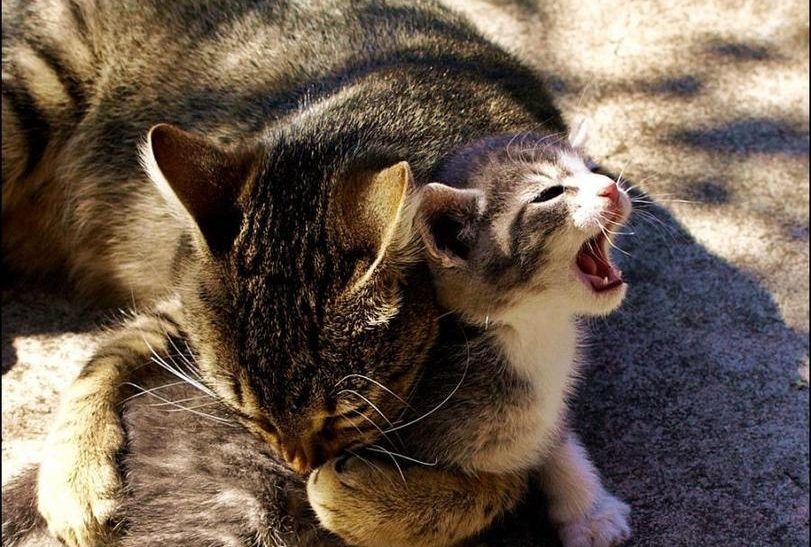
A mother's role is not only to give birth and feed her kittens, but also to raise them. A mother cat is no exception. A mother cat can discipline her kittens verbally (purring, meowing, and hissing) and physically, such as biting or pawing. She knows no other means. Most often, mother cats bite their kittens: this method is the most effective in nature.
While the kittens are very young, the mother cat tries to hide her offspring from prying eyes. If the kitten crawls out of the nest without permission, it may receive a disciplining bite. Typically, the mother cat bites the kitten on the scruff of the neck, leaving no marks on the skin. The kitten's squeak is not a cry of pain or a plea for help, but a response to its mother: "I won't do it again!" After such a bite, the mother cat diligently licks the kitten.
Growing kittens are now allowed to roam freely around their home territory and are happily exploring their new world. And how can they do this without play? Kittens play with each other and with toys. Particularly playful youngsters even try to play with their mother's tail. And they immediately receive a retaliatory bite or a swat with a paw. The mother teaches her kitten to behave within the bounds of decency and to respect older, stronger kittens.
Some mothers housetrain their kittens by teaching them to use a specific place for their natural needs. A single litter box in a house with kittens is not enough. Disobedient or unintelligible kittens are punished by their mother, again in the form of biting.
Protection from dangers
Cats' instincts dictate that there are enemies in nature. Although there aren't many enemies in modern cat habitats, kittens must be prepared to defend themselves against them. The mother cat helps with this training. The most vulnerable part of a cat's neck is the scruff. This is where a mother cat most often bites her kittens, simultaneously demonstrating that they should avoid an enemy's bite on the neck and instead try to bite there themselves.
Lessons are usually conducted in a playful manner, with the mother's bites being light. A little later, the kittens begin practicing the learned techniques on each other, vigorously biting each other with their sharp teeth. At this point, the bites become real, and sometimes either the owner or the mother cat has to intervene to break up the fighting. After such training, the adult cat is able to defend itself from bullies, assert its authority in the feline community, and conquer new territories.
Hunting training
Another reason kittens bite is during hunting training. In this case, the mother cat pins the kitten with her front paws and bats at it with her hind paws. At the same time, the mother cat will bite her "victim," managing to lick the bitten areas. Practicing the "capture and hold" hunting technique is done in pairs with both the mother cat and littermates. Later, elements of ambush, sudden leaps from cover, and stalking will be added.
A mother cat first demonstrates all her hunting tricks to her kittens herself, and then happily participates in chases of toy mice alongside her kittens. Trained hunters never go hungry: every candy wrapper will be mercilessly caught. If a domestic cat has access to the outdoors, the prey may be a real mouse or a small bird.
All the examples of biting discussed above are elements of training, rules of conduct in feline society, and training in protection and hunting. If a cat doesn't harm her kittens or show excessive aggression toward them, then the owner has no reason to worry: she is acting on her natural instincts.