 Despite a cat breeder's experience, they are unable to accurately determine a cat's gestation period down to the day. However, knowing at least approximately how long cats carry kittens is crucial, as it is essential to prepare for the birth well in advance. Puberty in different cat breeds typically occurs between 6 and 8 months of age. At this time, the animal enters estrus, after which the body is fully prepared for the gestation and birth of the future litter.
Pet owners should be clear that mating a cat in the early stages of pregnancy is highly undesirable due to the high risk of producing sick or defective kittens. To use a human analogy, a 7-month-old cat is comparable to a 12-year-old teenager. What parent would allow a pregnancy at that age? Therefore, when adopting a pet cat, it's important to understand how long the cat will carry kittens, the potential number of litters, and any potential problems and complications during pregnancy.
Content
Signs of pregnancy in a pet
The average pregnancy period for a cat is are 65 days from the date of coverageNaturally, these are average figures. Cats are similar to women, who may or may not carry a pregnancy to term.
The main signs of pregnancy in a pet include the following:
- nipple swelling for 3 weeks;
- a sharp decrease in the cat's activity;
- For several days, the animal may experience vomiting in the morning.
Obvious signs of pregnancy in an animal are manifested at 6 weeks of gestationIn the seventh week, you can feel the kittens' activity in the cat's womb if you place your hand on her belly.
How long do cats carry kittens?
 It is impossible to say exactly how long a cat carries a litter, but as mentioned earlier, the approximate pregnancy period make up 65 daysHowever, there are cases where the kittens are born much earlier or later. Premature kittens born before the 60th day of pregnancy are extremely rare. The birth of post-term kittens is also very unfortunate. If you notice that your pet's pregnancy has extended past 70 days or more, you should immediately consult a professional veterinarian.
However, there have been cases where post-term and premature kittens were born without any pathologies or developmental abnormalities. Naturally, this was only possible with normal nutrition and comfortable living conditions for the pet. Deviations from the standard gestation period of no more than five days do not cause any harm to the kittens, and they are born completely healthy.
Approximately a day before the offspring is born, unusual restlessness in an animal's behaviorThis allows cat owners to prepare for the momentous occasion of a new birth. If they notice any warning signs, they should begin preparing a suitable birthing area. If these signs are ignored, they should be prepared for kittens to appear in a closet or even in their owners' bed.
The main stages of pregnancy
Many cat owners don't even realize how complex and fascinating the process of kitten gestation is, mistakenly believing they grow like weeds in a garden. In reality, experts identify several key stages of pregnancy in cats, each of which plays a crucial role in the development of the future offspring.
Today, veterinarians The following stages of pregnancy are noted:
 The first stage of pregnancy lasts just under a month after mating. During this stage, the kittens are developing, and the mother-to-be undergoes various hormonal changes. External changes are also observed, such as swelling of the nipples and a pinkish hue. The animal becomes calm and constantly seeks to remain within human sight.
- During the second stage, beginning one month into pregnancy, the embryos begin to develop rapidly, rapidly gaining weight and size. During this period, the cat sleeps constantly and eats a lot.
- Pregnancy becomes apparent at the sixth week, when the almost fully formed offspring begin to show activity. At this stage, the cat's abdomen becomes noticeably sagging and her demeanor becomes somewhat phlegmatic.
- The most difficult stage for an animal is when kittens begin to rapidly grow fur and their internal organs, including the excretory system, begin to function properly. Due to the significant increase in the offspring's metabolic rate, the animal experiences a decrease in appetite. This period can last from 40 to 50 days.
 The first stage of pregnancy lasts just under a month after mating. During this stage, the kittens are developing, and the mother-to-be undergoes various hormonal changes. External changes are also observed, such as swelling of the nipples and a pinkish hue. The animal becomes calm and constantly seeks to remain within human sight.
At the final stage of pregnancy, if you place your palm on the cat's belly, you can clearly see feel the movement of the offspringThe animal begins to behave unusually restlessly, searching for a place to give birth.
How does the number of kittens affect the pregnancy period?
Many pet owners are concerned about whether the number of kittens a cat has affects the length of its pregnancy. Although there's no scientific evidence to support this, it's often observed that the more kittens a cat has, the shorter the gestation period. Furthermore, if a young mother cat has a large number of kittens, various complications may arise during pregnancy. This is primarily due to the fact that a young animal's body can't always cope with such stress.
How many kittens can a cat give birth to during her first pregnancy?
 It's impossible to say exactly how many kittens a cat can produce in one litter. Typically, an adult female can bring from 1 to 6 kittens, and such a wide range in offspring numbers depends on a number of contributing factors. This is often influenced by the pet's physiological characteristics. The animal has a bicornuate uterus, which contains the fertilized egg during the early stages of pregnancy.
Because the uterine space is not infinite, it's very rare for a single litter to contain more than six kittens. A characteristic feature of a first litter is that a cat produces half as many kittens as in subsequent pregnancies. Incidentally, this tendency can also be observed in older cats. Generally, older cats rarely give birth, but they are happy to adopt.
Why does one litter of kittens have different colors?
The coloring of the future offspring is conditional is divided into three types.
- A cat produces offspring of exactly the same color throughout its life.
- The animal gives birth to kittens of different colors, but in one litter all the offspring are of the same color.
- An animal can give birth to kittens of different colors in one litter.
This is influenced by a cat's temperament. Many cats prefer cats of a certain color.
So, if an animal prefers red-haired males, there's a good chance the offspring will be the same color as the male. Other animals, on the contrary, are unpretentious, although they mate very infrequently. They produce different offspring in different litters. But most animals mate randomly and with different males.
Possibility of heat during pregnancy
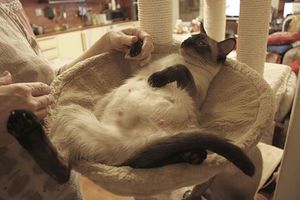 Veterinarians have observed cases where estrus occurred during pregnancy. This condition is very rare and is observed no more than once every ten pregnanciesHeat most often occurs between the third and sixth weeks of gestation. At this stage, the animal can mate again, and the newly fertilized egg begins to develop, a process called superfetation. Late-born kittens usually die when older siblings are born.
In what situations might a cat need help?
Unfortunately, animal pregnancy does not always proceed normally. In most cases, these pathologies do not affect the health of the adult animal, but they can cause irreparable harm future offspring. However, most often, a pet's assistance may be needed in the following cases:
- if the animal refuses to eat for more than 24 hours;
- if there is a large amount of discharge with an unpleasant odor from the cat’s genitals;
- in case of a sharp increase in the animal’s body temperature;
- in case of miscarriage.
As you can see, it's virtually impossible to accurately determine how long a pet's pregnancy lasts. Everything will depend on the animal's physical characteristics and the progress of the pregnancy. The key is to give your pet the attention she deserves during pregnancy.