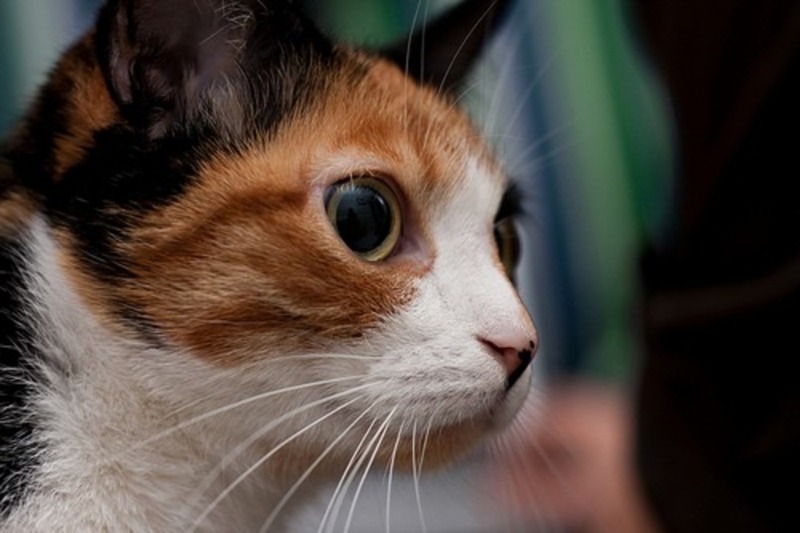
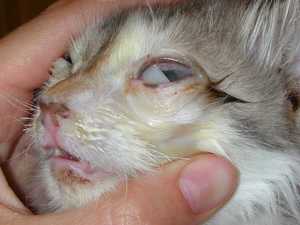
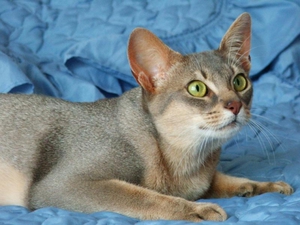
If you're still wondering about the position of your cat's pupils, it's worth clarifying this point and understanding that the shape of an animal's pupil unmistakably reveals its ecological specialization: predators, including domestic cats, have vertical pupils, herbivores have horizontal pupils, and gatherers and sprint hunters have round pupils.
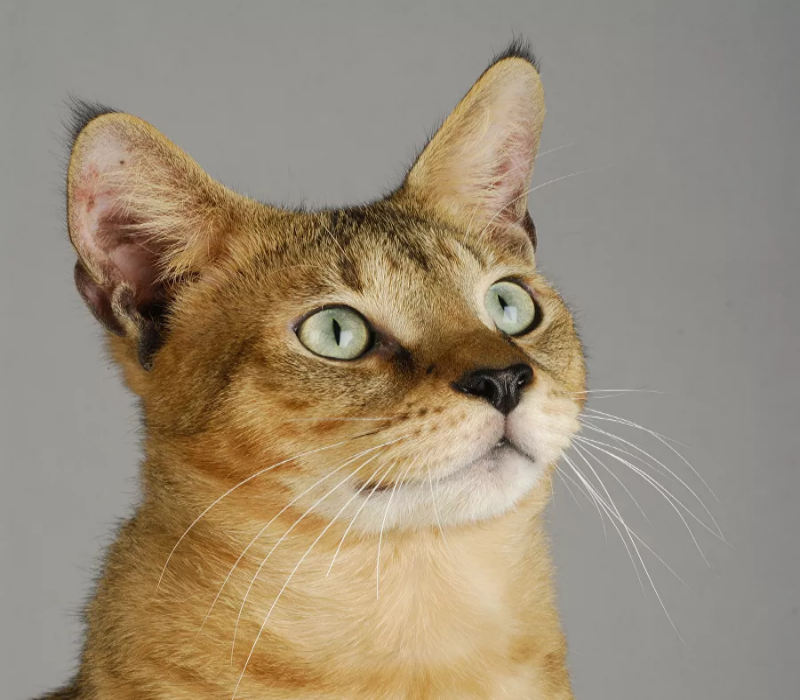
Research by California scientists
To identify patterns in pupil and eye placement, scientists analyzed the daily activity and diet of 214 animals. These included representatives of the feline, canine, even-toed, perissodactyl, viverrid, hyena, and Australian snake families. They found that the ecological niche occupied by the animal plays a significant role.
Vertical pupils typically belong to animals that hunt from ambush, and their eyes are usually positioned frontally.
Horizontal pupils are the prerogative of herbivorous grazing animals (e.g., sheep and goats). Their eyes are curiously positioned on the sides of the head.
Predators that pursue prey have round pupils.
For example, foxes boast vertically elongated pupils. They typically hunt from ambush, quietly stalking their prey. Wolves have round pupils. Their hunting style is to corner their prey.
Members of the feline family, which actively hunt, boast round pupils. Their cousins, domestic cats, are less active hunters. They typically use ambush hunting tactics, like foxes, resulting in vertical pupils.
According to research, vertical pupils are best obtained on a shorter animal, as the sharpness of vertical objects on the ground increases when the eyes are close to the surface. To have vertical pupils, the animal must be shorter than 42 cm at the withers.
Herbivores, however, are burdened with their own concerns. They must always monitor their surroundings and spot predators promptly to escape. They have a panoramic view of the area, allowing them to sense danger early. This is due to the eyes located on the sides of their heads.
Learn more about how cats see
Cats have vertical pupils. This characteristic gives your furry pets the advantage of controlling the amount of light entering their eyes. This is all thanks to their nocturnal lifestyle. The eyes of these small predators are so sensitive that they can see even in pitch darkness. The vertical pupil allows them to reduce the amount of daylight reaching the retina. Otherwise, a cat would simply go blind. Therefore, nature designed their eyes to have this particular shape: in night light, they become large and round, but in the sun, they can narrow into thin slits.
But sometimes cats have dilated pupils even in bright daylight, or, conversely, very small pupils in the dark. There may be several reasons for this:
- heat in cats and rutting in cats;
- stressful situation (fright, fear, absent-mindedness, etc.);
- adrenaline rush during games;
- the intention to take revenge on the offender;
- pain.
If such deviations from the normal pupil occur rarely, there's no need to worry. Pupils of different sizes, meaning one pupil may be dilated and the other constricted, can be a sign of many serious eye diseases.
If you notice that your pet's pupils often react inappropriately to the amount of light, then this is a reason to contact a veterinarian.
Martin Banks (a scientist from the University of California at Berkeley) and his colleagues hypothesized that cats acquired vertical pupils not for the sake of having “round-the-clock” vision, but in order to estimate as accurately as possible the distance of the prey and calculate the force of the jump.
Cats are among the predators that hunt from the ground and whose height at the withers does not exceed 42 cm. The same can be said about the wild ancestors of cats.
But this statement doesn't apply to tigers, lions, and other large cats, despite belonging to the same family. They have round pupils, which are also characteristic of humans and dogs.
This is an interesting biological phenomenon. It can be explained by the fact that the accuracy of determining the distance to prey decreases as the predator's height increases. This occurs because the difference in focus between the object the cat is focusing on and the surrounding world decreases.