All members of the cat family quickly step on their hind legs before jumping, wagging their entire bodies. Scientists don't have a definitive answer to this question, but they have several theories.
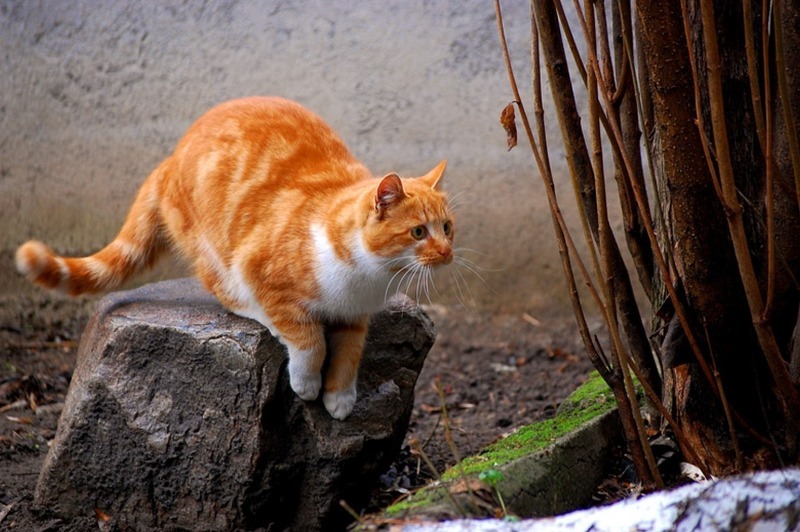
Version #1: The cat is warming up its muscles
Athletes always warm up before training. A short workout helps stretch the muscles, oxygenate them, and prepare them for more challenging tasks. Scientists who support this theory believe that this behavior is instinctive in cats. Just like athletes, they prepare their muscles and ligaments for the stress. Furthermore, quick, repetitive movements help coordinate the movement of the hind legs during the throw.
Version #2: The cat chooses the best spot to jump
When jumping, it's crucial to be extremely precise. One wrong move and the prey will run away or fly away. Many factors can interfere with the leap: an unstable rock, an uneven surface, or overly soft or wet soil. The rock may slip from under the cat's paw, throwing it off balance. Slipping on wet ground can not only lose the prey but also damage ligaments and tendons.
By rocking and shifting its paws, a cat checks its balance before the crucial leap. It analyzes whether the surface it's on is safe for the jump. It also calculates the force of the push required to cover the distance to the desired target.
Version #3: Hormones are to blame
Neurotransmitters are biologically active substances that control many processes in the body. They are produced during an action and stimulate the release of hormones. For example, if a cat performs an action that results in a reward, its body produces dopamine, a chemical that controls emotional responses. Repeating these actions subsequently triggers the release of this chemical, regardless of the reward, giving the animal a pleasant experience.
So, when a cat "dances," a hormonal surge occurs in its body. It becomes excited and derives great pleasure from the process. When the goal is achieved, dopamine production ceases.
Scientists around the world continue to study cat behavior, conducting experiments, and studying throwing tactics. Perhaps they will soon delight cat lovers with new information explaining why their pets behave this way.