 Goat's milk is a nutritious and healthy product. Compared to cow's milk, it contains more calcium, protein, and phosphorus. It's no wonder that children raised on goat's milk in the countryside enjoy robust health and strong immunity. Calcium and phosphorus are the building blocks for bone, tooth, hair, and muscle growth. For someone who drinks a cup of fresh goat's milk a day and enjoys moderate sun exposure, a summer spent in the countryside will greatly help maintain health and restore resistance to various infections.
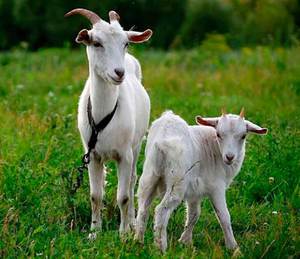
A goat is a very convenient and practical animal to raise at home. The time and care the owner will have to put into it will be repaid a hundredfold in the form of healthy milk and tasty meatLittle goats will make interesting companions for children as they run around the yard. Goats are recommended for households with small children and elderly residents. For the former, the milk will be a useful resource for growth, while the latter will gratefully drink milk for intestinal and stomach ailments.
Content
Variety of goat breeds
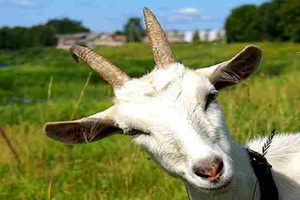 Each continent has its own requirements for goat farming. For example, the Altai Mountains are renowned for the indigenous peoples who raise predominantly downy breeds. In Asia, they raise goat varieties that are good for slaughter and produce delicious meat. Farmers in Europe breed goats for milkLivestock farms supplying food processing plants are common here. Breeding efforts to improve animal conformation and develop new, more productive goat breeds are ongoing.
Goat breeds by type of final product
Having firmly decided to start raising goats or breeding a herd, you need to determine the result that will be achieved as a result of the efforts expended:
- Meat breeds grow quickly and are used to replenish meat in the diet
- dairy varieties will supply the owner with milk, kefir, cheese, cottage cheese and sour cream for a long time;
- The wool of down goats produces excellent threads for knitting and felting natural woolen clothes and blankets;
- Mixed varieties bring a little bit of everything to the farm.
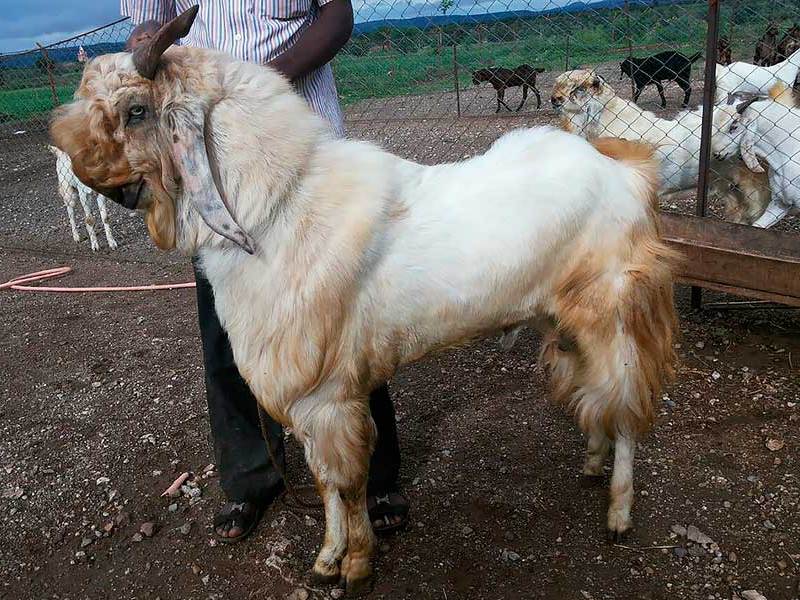
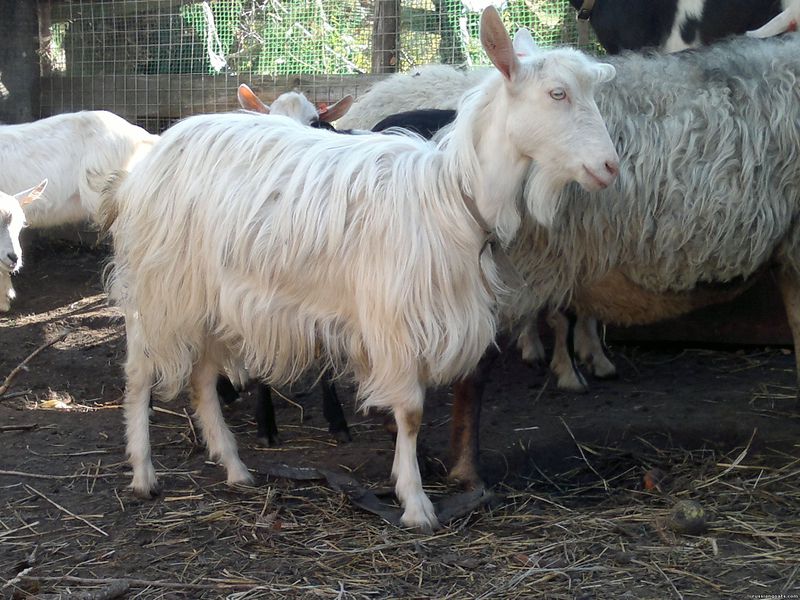
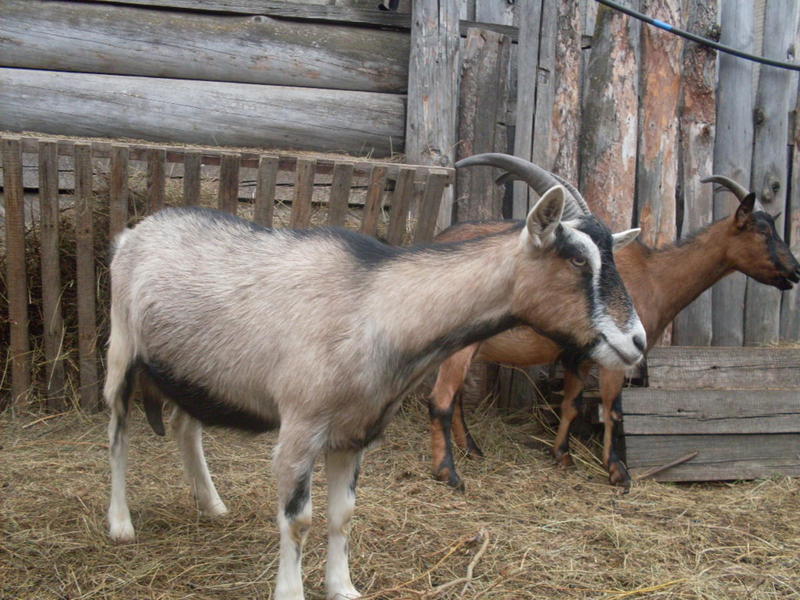
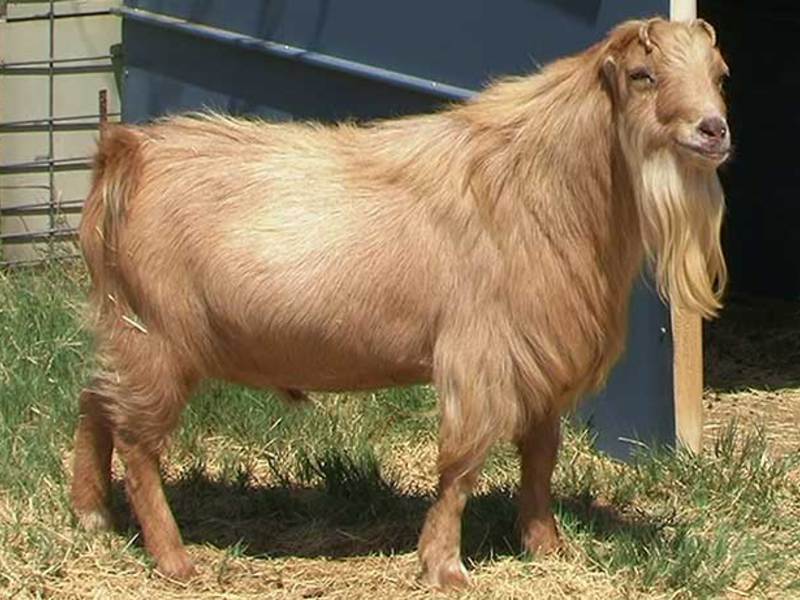
Dairy goat breeds
Animal species that produce milk include the following breeds:
- Saanen;
- Nubian;
- White Russian;
- Toggenburg;
- Alpine.
Saanen breed
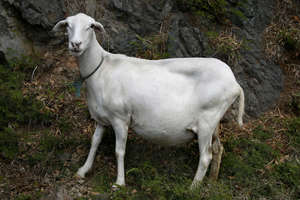
This type of goat is the most common among dairy breeds. They got their name from the name of the area Saanenthal, located in picturesque Switzerland. The modern breed, which predominates in most farmsteads in Europe and Russia in particular, took several centuries to develop. It was exhibited at the Paris Exhibition in the mid-19th century under the name "White Hornless Saanen Goat." Gradually, the breed spread to European countries, where it was crossed with local breeds to improve milk production.
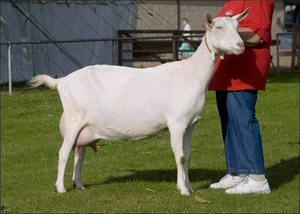
The Saanen breed consistently maintains the highest milk yield among the main known breeds. After the birth of the offspring, the feeding period lasts about a year., for which the owner receives up to a ton of milk from a single animal. The fat content of the milk is approximately 4.5%. The milk is completely odorless or has a pleasant aromatic tint. The odor develops if females are kept near uncastrated males, and the animals are poorly cared for, the stalls are not cleaned, and the bedding is rarely changed.
In addition to high-quality milk, the Saanen goat produces after slaughter meat of average taste and excellent leather, used for the production of chevrolet, kid, and suedeThe Saanen goat is very fertile; her offspring grow and develop quickly, thriving in a variety of conditions. Her fur is non-shedding, so shearing is not performed.
The breed is renowned for its large animals, with breeding females reaching 80 cm in height and some weighing up to 60 kg. There are cases of mothers weighing 100 kg. Saanen kids born weigh 3–4 kg. two-month-old offspring – from 9 to 12 kgYearling does and kids reach a weight of 30–40 kg, respectively. Saanen goats have a strong skeleton surrounded by well-developed muscles, and their flat, long necks sometimes have lateral "earrings." The goat's legs are strong, with light yellow hooves. Black spots are sometimes present on the udder or ears.
The dry, medium-sized head is adorned with ears that slant slightly forward and to the sides. The goat's coat is usually white, sometimes white and yellowish. If the breeding is not closely related, the Saanen goat's traits are completely passed on to its offspring.
Toggenburg breed of animals
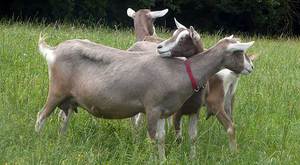 First traced back to the 18th century, the goat was introduced by Swiss breeders. Today, two main varieties of this category have been developed: the Czech Noble and the British. In Russia, the breeding of individual specimens was noted in the last century. animals have a brown or yellowish-brown color, sometimes with spotting. All animals of this species are described as having white markings on their fur and two longitudinal stripes on their faces. The tip of the tail and the lower parts of the legs are white in the goat. Animals reach a height of 0.6 m.
Males have horns on their heads or are hornless. The animal stands firmly and securely on its legs, with a strong back and a broad rump. The wool on this species of goat's back grows up to 20 cm., is distinguished by its silkiness. Males grow up to 70 kg, females reach 50 kg.
This breed is comparable in fertility to Saanen goats. A litter typically consists of 2-3 kids, which easily adapt to the harsh Russian climate. In summer, they prefer shade and are demanding in their diet. The taste and aroma of their milk depend on the quality of the feed. After the first lambing, milk yield can reach up to 500 liters, and subsequent lambings increase this to 1,000 liters per year, with a fat content of 3-4%. The lactation period lasts approximately 250 days.
Nubian goat breed
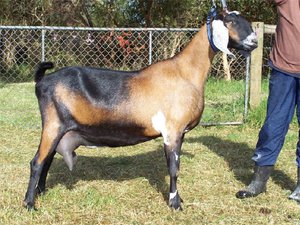 These animals are more of a mixed meat and dairy breed. England has been a leader in livestock farming, particularly goat breeding, for centuries. The international community has long recognized the Nubian breed, but it is not widespread in Russia.
The productivity of goats in terms of milk yield is demonstrated both in purebred individuals and in animals mated with other species. During one lactation they receive up to 1500 liters of milkThe first lambing allows for milk yields of up to 5 liters per day, while the second and subsequent lambings increase yield to 7–8 liters with a constant fat content of up to 4%. These results are achieved by ensuring highly efficient feeding. If an animal lacks even one micronutrient or vitamin, milk yield drops sharply, and fertility declines. The breed boasts fairly large individuals, but they are inferior to Saanen goats.
A characteristic feature of the breed is complete absence of milk smellNubian goats are odorless even during mating season, so they are kept in the same pen with dairy goats to produce aromatic milk. Adult males grow up to 90 cm at the withers, while females are slightly smaller at 75 cm, weighing approximately 80 kg.
The outer color allows for any combination of brown, black and white spots; goats can be completely colored in one of the named shades. The animal's muzzle has a humped nose.Large ears hang down the sides of their heads. These aggressive goats have small horns, which they use at every opportunity. Nubian goats enjoy movement and socializing with their own kind. They view humans as members of the herd and loyally follow them as their leader. These animals are raised with strict discipline, otherwise their wayward nature can cause considerable trouble for their owners.
The milk flavor is at the forefront. Pleasantly sweet, it's backed by an impressive fat content—up to 5%, high protein content ensures high yield in cottage cheese productionFor a breed, the taste of the product depends on the type of feed and the conditions in which it is raised. After slaughter, the owner receives delicious, full-bodied meat with a tender consistency. The prolific Nubian breed produces offspring that require little or no intensive care.
Alpine goats
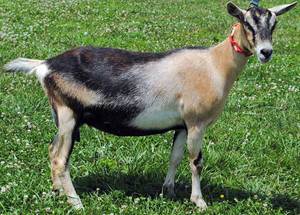 Breeding and selection of the animals took place in the mountainous terrain of picturesque Switzerland. After some time, the process moved to English and French pastures, where the breed was combined with local, highly productive varieties. The characteristic traits of the resulting breed today include:
- the height of adult goats is 76 cm, the animal weighs 61 kg, male goats reach 80–82 cm at the withers, their weight is 75–78 kg;
- a dry head with erect ears is located on a long neck;
- There are horned and polled individuals.
Alpine goats come in a variety of colors. Some are variegated, with the coloring being half two colors. The palette is dominated by shades of grey, black, brown and white.Kids are born in all colors, and can be spotted or white with a brown or gray head. Pure white is almost never seen in Alpine goats; this color is typical of the Saanen and Toggenburg breeds. Common colors include:
- grey, brown or black with a white head;
- variegated and spotted with the presence of all characteristic colors;
- the main color is brown-red with an abundance of black spots;
- dark hindquarters with white or grey shoulders.
Alpine goats produce up to 1,500 liters of milk per year with excellent, varied feeding and good growing conditions; a goat gives birth to several kids in one litter. The fat content of milk is 5.5%, animal protein is 3%.These animals eat a variety of vegetation and are undemanding in this regard. They are friendly and affectionate toward their owners, but strive to be dominant within the herd.
Dairy breeds in Russia
Russian goat
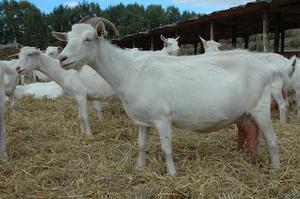 It is a colourful representative of a local breed bred in the north, west and central parts of Russia. These are relatively small animals, their weight reaching 38–50 kg.After lambing, the lactation period lasts on average up to 8 months, during which time the total milk yield is approximately 500 liters of milk with a fat content of 4.5%. If the animal is raised in favorable conditions, the milking period is extended.
The breed is colored gray, black and white, with short or medium length fur. A Russian goat produces up to 200 g of fluff when combed.A litter consists of two to three kids. They have a squat body, a drooping croup, and a light head on a straight neck. The udder is pear-shaped, with the teats directed slightly forward. This very hardy and undemanding breed adapts to Russian winter conditions and is kept in warm stalls.
Gorky goat
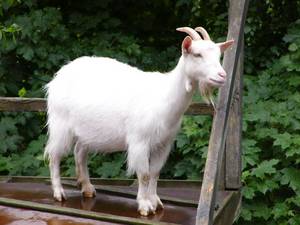 This breed is distinguished as a subspecies of the Russian goat and is also classified as a dairy breed. According to some sources, it descends from white bucks and imported Saanen breeds; this mating took place at the beginning of the last century in the Gorky district, hence the name. Today, a large population of this species is raised in the Nizhny Novgorod region. Domestic breeders have made the breed highly productive and continue to work to improve milk quality and increase yield.
The animal's appearance is similar to the Saanen breed, but it is slightly smaller in size. Representatives grow up to 50-60 kg, have an undercoat that provides 10% down From one individual, the yield is up to 250 g. During the lactation period, the owner receives 500 liters of high-quality milk.
Rules for choosing a dairy goat
To select a productive dairy animal for your farm, pay attention to the following characteristics:
- The animal should have a cheerful appearance, combined with shiny and smooth fur, lying in an even layer on dense skin, easily stretched in the thigh area;
- the ribs are convex, extending from a wide chest, the back is straight, the rear is wide, the belly is voluminous and without sagging;
- the legs are set wide apart and end in strong hooves;
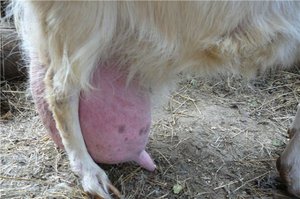
- the udder is voluminous, with protruding veins, elastic, pear-shaped;
- After milking, the udder falls off; if this does not happen, it is considered fatty and the animal will not produce much milk;
- External characteristics that do not affect productivity (ear shape, presence of earrings on the neck, color) are not important when choosing a dairy goat.
If milk is needed only by a small family, there's no point in keeping a cow, as feeding and maintaining one requires significant resources. A goat is easier to care for, requires a much smaller stall, and, while varied, produces less weight.