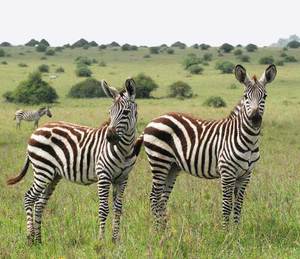
 In North Africa they were exterminated in ancient times. Today's range is the most common lowland zebras covers southern Sudan and Ethiopia, the savannas of East Africa up to the south of the continent. Desert zebra It is found in the dry savannas of East Africa, in Kenya, Ethiopia and Somalia.
Who are zebras?
Zebras, called Hippotigris in Latin, constitute a subgenus of wild horses. This subgenus, in turn, branches into several extant species:
- Burchell's zebra, also known as the savannah zebra (Equus quagga);
- Grevy's zebra, or desert zebra (Equus grevyi);
- Mountain zebra (Equus zebra).
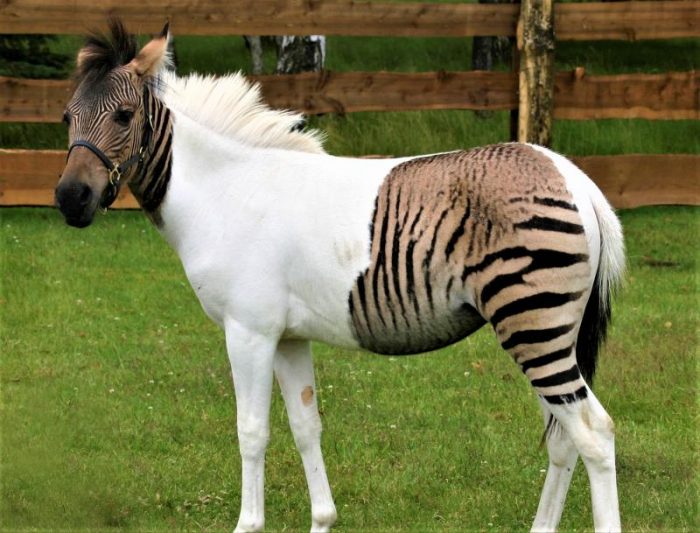
Mixed forms, obtained by crossing Wild striped horses with the same shape as domestic horses are commonly called "zebroids," meaning zebra-like. The offspring of crossbreeding with donkeys are called zebrules. These nomadic herbivores live in groups reminiscent of traditional lion prides: one adult stallion cares for several females and their young of varying ages. The young are called foals, just like horse babies.
The structure of a zebra
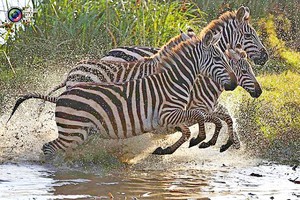 Description of a zebra in its simplest form It may look like a "striped horse." Indeed, these related ungulates have much in common. Zebras, like horses, are odd-toed ungulates—their body weight rests mostly on the third toe, which is covered in a horny "shoe." Their strong hooves are designed to protect the animal's toes while walking and running.
Animal growth determined by the height at the withersAn adult zebra's length can reach 120 to 140 cm. This magnificent appearance is complemented by a long, flexible, half-meter-long tail. The weight of a wild horse varies depending on the species, as well as the animal's age and sex, as males are somewhat larger. Consequently, the weight range is between 175 and 450 kg.
The pattern formed by the stripes on the skin is strictly individual.There's a reason for this: at birth, the foal must remember its mother so that it can soon follow only her. Typically, the mother shields the foal from the rest of the herd for a while, allowing the foal to study the pattern on her body. Because the animal's skin is smooth, the chaotic lines formed by the color sometimes resemble a hand-drawn design to the human eye. Zebras have a short, stiff mane, even a mane that only vaguely resembles that of a horse.
What is the difference?
Although to the untrained eye the entire population appears identical, the animals' appearance varies depending on where the wild horse lives.
Typical coloring, black and white stripes, varies from north to south: northern zebras boast full black long stripes, which are especially noticeable along the ridge, while southern zebras retain a brownish camouflage of short, uneven stripes.
Answer to the question, What color are zebras?, doesn't seem unambiguous. Nevertheless, it exists. White stripes form a pattern on a black coat—so the African horse is black except for the white stripes themselves. On the front of the body, the stripes are vertical, then gradually slant, while the zebra's legs are patterned horizontally.
Why does a zebra need a striped suit?
Some scientists believe that all ancestors of modern horses They were once decorated with stripes. For quite a long time, biologists speculated about the purpose of these stripes in herbivores.
Predator camouflage hypothesis
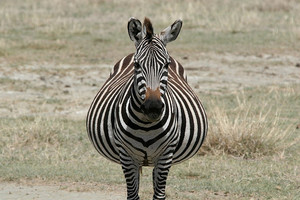 The most common assumption was that this is a variant of protective coloration, intended for such a trivial purpose as camouflage. This hypothesis seemed plausible, since a thin haze hangs in the heated daytime air of the savannah, causing the outlines of stationary objects to shimmer and blur. Consequently, grazing herds have a slight chance of becoming less visible to predators.
However the main hunters of the savannah – lions, or more precisely, lionesses. If camouflage coloration were useful in the zebra habitat, some lionesses would certainly have to become vegetarians. But that's not the case: big cats are excellent hunters, and such quirks of nature clearly aren't enough to confuse them.
Insect defense hypothesis
Further observations led scientists to believe that the stripes actually have a camouflage function, but its purpose isn't to protect against predators. Ungulates of the savannah have enemies no less dangerous than predators—insects. Stinging flies, in addition to their irritating bites, can harass herbivores by infecting them with a dangerous fever. For example, cattle in temperate climates lack protective coloration and are literally swarmed by clouds of horseflies during hot weather. So, it's precisely thanks to their distinctive stripes that some animals avoid certain insects.
Where can you meet the animal?
The ranges of all currently existing species lie in the vastness of Africa:
 The Burchell's zebra lives exclusively in the south and east of the African continent.
- The Grévy's zebra inhabits the arid steppes and shrub savannas of Ethiopia and northern Kenya, as well as Somalia. Near the southern limits of its range, the Grévy's zebra shares grazing land with the Burchell's zebra.
- The mountain zebra, characterized by its reddish nose, is native to a region of southwest Africa, bounded by two mountainous regions and dominated by steppe landscapes. A small number live in reserves and zoos. Despite their superficial similarities, the evolutionary paths of the surviving branches of the subgenus diverged so long ago that breeding offspring from the two species is extremely difficult.
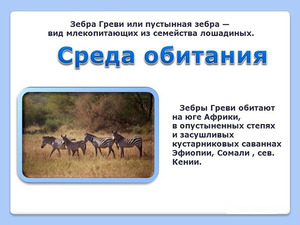 The Burchell's zebra lives exclusively in the south and east of the African continent.
Habits and characteristics
Wild ungulates are unruly and cannot be tamedThe animal's most developed sense is smell, which allows it to detect signs of danger well in advance: for example, the faint scent of a lion wafting upwind causes the entire herd to flee as if on command. Due to their poor eyesight, they are not always able to recognize a threat in time. In the wild, curiosity, leading animals into potentially dangerous places, is often their undoing.
Often the herd cooperates with herds of other ungulates, for example, wildebeest. Furthermore, wild African horses can take advantage of the observational abilities of ostriches. This phenomenon is understandable: the larger the herd, the greater the sense of security felt by each individual. Cooperation has obvious advantages: ungulates use their highly developed sense of smell, while ostriches are farsighted, greatly aided by the view afforded by their long necks. While these environmental adaptations don't make zebras more difficult prey than horned antelopes or heavy buffalo, they do significantly increase their chances of survival: some individuals live to nearly 30 years.