 What do people picture when they hear the word "striped skunk"? They probably picture a small, shaggy animal with a very foul odor. However, this animal is actually quite cute and funny. But what do we really know about these adorable creatures? In this article, we'll take a closer look at what striped skunks eat and where they live.
Homeland and habitat of the striped skunk
The skunk's native continent is North AmericaThe striped skunk lives:
- in forest areas;
- in meadow areas;
- It prefers rocky habitats and coastal shrubs the most.
The animal prefers to live alone and is active mainly at night.
What does he like to eat?
The striped skunk likes to hunt at dusk and at night. Its main diet is various insectsBut it won't disdain chicks, fish, or even rodents, and it's very good at catching them. It's also not averse to raiding birds' nests, eating their eggs, and won't refuse striped skunks and carrion. The animal also enjoys plant foods, eating:
- various herbs;
- fruits and berries;
- vegetables;
- grains and leaves.
What does he look like?
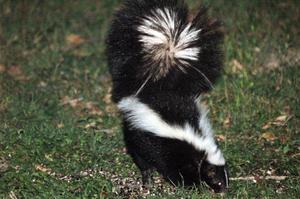
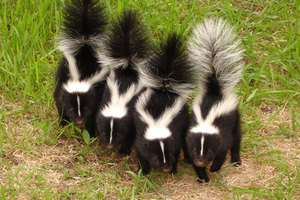 The striped skunk is small in size, the body length reaches 40 cmIt's noteworthy that the tail of some individuals is almost as long as the body. It's very fluffy. Striped skunks weigh only 1-3 kg. Males are slightly larger than females. These animals have short legs, an elongated muzzle, and a long tail. The lifespan of striped skunks is short, only 2-3 years, under normal conditions.
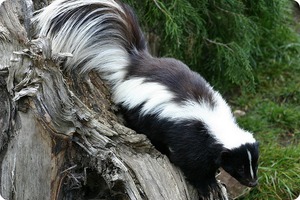
It protects itself from those who disturb its life with a special odorous liquid, so many animals try to avoid it. It obtains food using its front paws and curved claws. These body parts also used for digging holesThe claws on the hind legs are shorter. The animal is fluffy, but its fur is slightly coarse.
As its name suggests, this animal has a black and white striped coat. The stripes extend along the body, from tail to head. On the face, there is a small, slightly narrower stripe that extends from the ears to the nose. The ears are small and slightly rounded. The tail is striped, with the stripes alternating. The striped skunk has rather poor eyesight, giving the impression of being lazy and sluggish.
Despite all the above characteristics, The skunk is an excellent swimmer., and is not at all afraid of water.
A means of protection against a perceived threat
The skunk has few enemies, but they all tend to give it a wide berth. This is because of the foul-smelling fluid it shoots at its adversary with remarkable accuracy when it senses danger. Under its tail are special glands that secrete the foul-smelling fluid.
People should be wary of this small animal, and not just because of its foul odor. It can project this substance up to 5 meters away. It causes a severe burning sensation when it comes into contact with mucous membranes. While this liquid won't blind a person, it will cause considerable suffering.
Striped skunk in winter hibernatesHibernation, similar to torpor, usually occurs in December. To survive the long winter, skunks eat heavily, accumulating a lot of fat. Hibernation typically lasts until March.
How does a skunk reproduce?
 After a male finds a female and impregnates her, he begins his own life and takes no further part in the lives of the cubs or the female. This is because skunks are solitary animals by nature.
After the female finds a suitable shelter for herself and her future offspring, which is usually the burrows of other animals or pits, she lines it with a variety of debris from grass, branches and small leaves. Home improvement is necessaryTo keep the babies warm and dry even in inclement weather. Small cubs are defenseless, and sometimes even in their own shelters, they are preyed upon by small, predatory mammals, such as martens.
The female carries her cubs for over 60 days, trying to find more food during this time. When the cubs are born, they are blind, helpless, and constantly in need of their mother. The number of cubs rarely exceeds six, although there have been cases of significantly larger numbers. Such observations have typically been recorded in zoos and breeding facilities.
Raising young animals
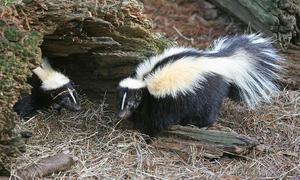 The cubs can see after 2-3 weeks, but they are still defenseless. After a month, the babies will be able to defend themselves. At a little over six months, they continue to feed on mother's milk, while gaining weight, growing and becoming physically stronger. The puppies are already able to move independently, and at this time the cubs begin their first acquaintance with the outside world.
After a short time, the mother and her offspring emerge from their shelter and set out on their first long journey. They need to feed, which often requires the cubs and their mother to travel a very long distance. During this first journey, the cubs closely observe their mother and her habits. They imitate and copy her actions, attempting to hunt with her. The cubs are very playful, jumping, rolling, and sometimes even fighting. But behind this seemingly childish game lies a very important role: the puppies gain invaluable experience through play. This experience not only contributes to their development but will also be of great use later in their independent lives.
When winter comes, the young do not leave their mother. The cubs go into a long hibernation along with her. To do this, the female again needs to find a safe and warm shelter that will serve as their home until spring. But sometimes, two or three families share the same shelter. To survive, they need to unite.
But there's a sad side to this. Much happens during hibernation, and not all cubs survive the long winter. Males survive the winter much better than females and their offspring. The male typically occupies one burrow, and on warmer days, he emerges from his hiding place in search of food.
There are several species of skunks, but they are difficult to distinguish from each other. This requires special knowledge and skills. The most well-known species are the striped skunk and the spotted skunk.