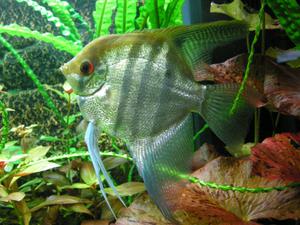
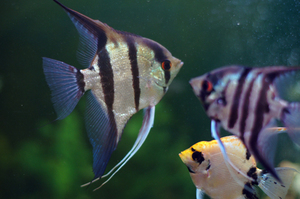
 The angelfish (Pterophyllum scalare), which literally translates as "winged leaf," is a fairly large and very attractive fish of the Perciformes order, a member of the cichlid family, that will greatly enhance your aquarium. It is popular with both experienced and novice aquarists.
In nature It lives in South America in reed beds on the coasts, as well as in secluded pools with stagnant water or lagoonsThanks to their disc-shaped, laterally flattened body, angelfish move easily through dense vegetation, finding shelter there from predators. They often stay in schools of 15–20 individuals.
Content
General information about angelfish
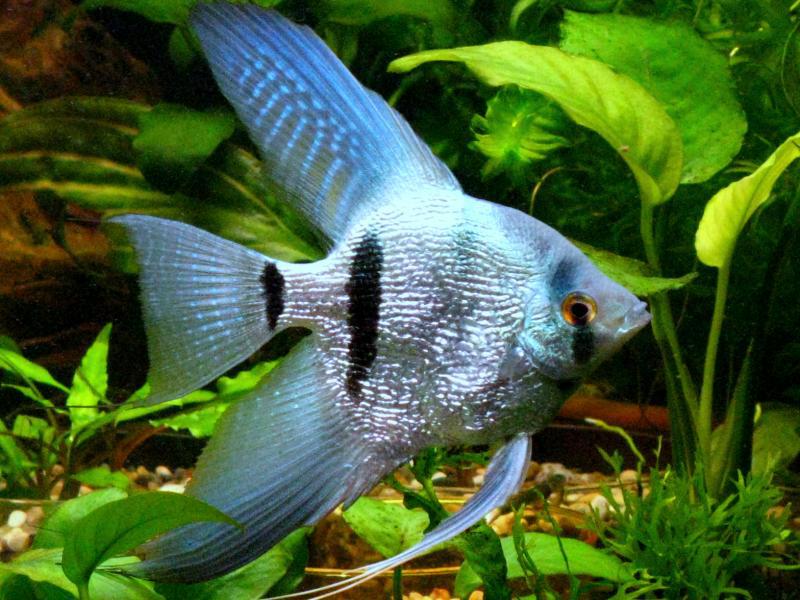
In nature, angelfish have an olive-gray color with a metallic sheen and dark vertical stripes on the body. The back is always darker than the belly.This coloring serves as camouflage. However, variations also occur in nature—fish can be pure black or silvery, without any stripes at all.
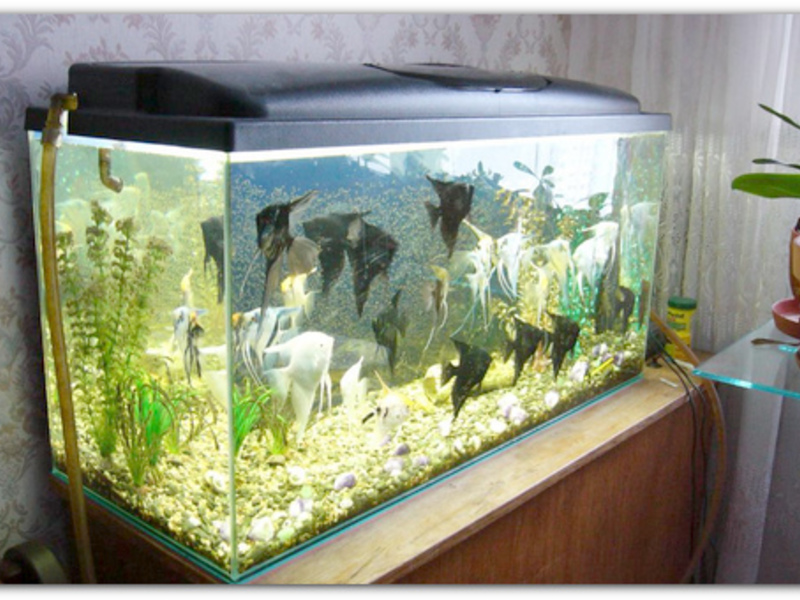
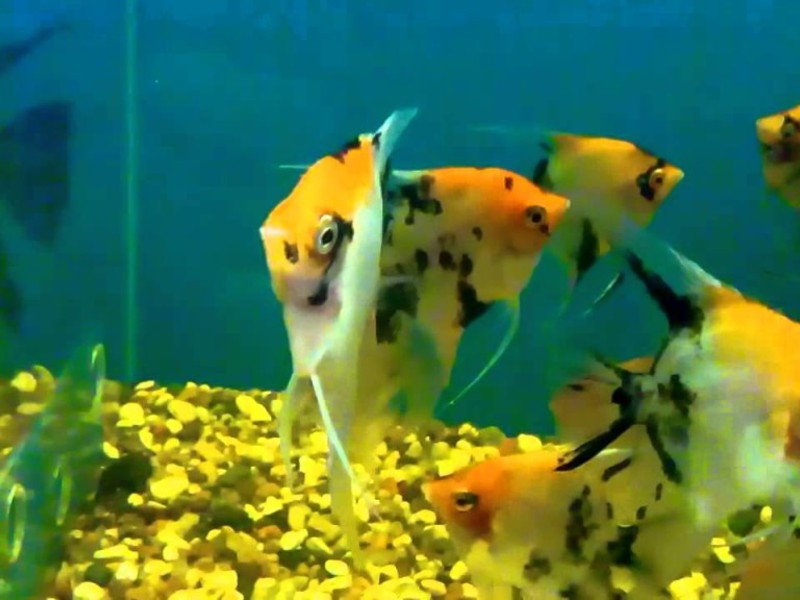
Thanks to the work of breeders, various species have been developed for aquarium keeping: marbled, black, green, and blue angelfish, diamondback, koi, and many others. Naturally colored angelfish are no longer found in aquariums.
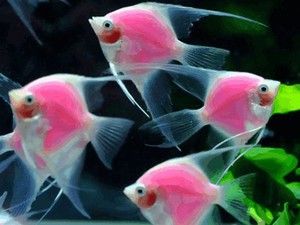 Under favorable conditions in aquariums, angelfish live up to 10 years, but there are also cases of longer lifespans. Upon reaching sexual maturity (In fish of this species, it occurs at approximately 10 months of age), they form lifelong pairs. Angelfish are monogamous, so if one mate dies, the other may jump out of the aquarium or run away and crash into the glass. Even if the widowed fish continues to live, it remains alone for the rest of its life.
How to properly keep angelfish in an aquarium?
This species of fish requires an aquarium at least 50 cm high and at least 100 liters in volume. The water should be adequately planted, as fish like to be in shelterBut at the same time, sufficient space for free swimming is necessary. You can install driftwood or make rock caves on the bottom, which will not only provide shelter for the fish but also serve as a decorative element. Sand or small pebbles can be used as substrate; angelfish are indifferent to these and will not tear them apart.
Angelfish don't care about water hardness; both soft and hard water will do. However, the water must be impeccably clean. Therefore, It is necessary to replace 20-30% of the total amount of aquarium water weeklyIt's also necessary to install a good filtration system, an aeration pump, and a lamp that provides bright light, as they require good lighting without sudden fluctuations. Water temperature is important and should be no less than 24 degrees Celsius but no more than 27 degrees Celsius. If the water isn't warm enough, the fish may catch a cold.
Feeding
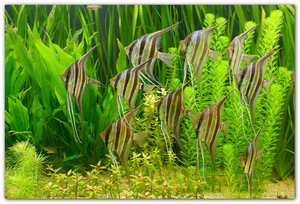 These fish are not picky eaters, so they will eat anything offered to them: dry, pelleted, flake, and live foods. They prefer live bloodworms, cyclops, and daphnia. Often They are guilty of eating plant leaves.They eat food on the surface or in the water column.
It also happens that, for no apparent reason, an angelfish may refuse food for several days. There's no cause for concern. this is a feature of their eating behaviorAfter a while, the fish will begin to feed as before. It's important to remember not to overfeed these fish. If this happens, their abdomen will swell and, losing their balance, they will flip onto their backs and most often die. The food you use must be high-quality, as angelfish are very sensitive to this.
Compatibility with other aquarium inhabitants
These cichlids are relatively docile fish. Aggression only appears during spawning season. In a large aquarium, they can have many tankmates, but not telescopefish. Due to the presence of sharp fins in angelfishThey can leave their neighbor without eyes. If juveniles are introduced to adults, they may go hungry. When kept with barbs, cichlids can lose their luxurious fins, especially veiltails, as they move slowly through the water, while barbs, with their rapid movements, can injure them. Since adult angelfish are constantly hungry, neons and guppies should not be placed in the same aquarium with them, as they risk being eaten.
How to determine gender?
It is not possible to determine gender until puberty.However, in the second year of life, sexual differences become more pronounced.
In the male:
 Larger and more prominent forehead.
- Forked anterior fin.
- The dorsal fin and body size as a whole are larger than those of the female.
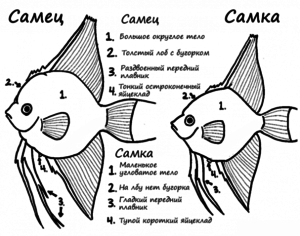 Larger and more prominent forehead.
In the female:
- The abdomen is more convex than that of the male.
- Smooth front fin.
- There is a small tubercle in the area of the genital opening.
Breeding and propagation
These fish are easy to breed, so this can be done relatively easily in a home aquarium. Black angelfish, veiltail angelfish, koi angelfish, and other species can be bred together. Due to the lack of sexual differences at an early age, it is recommended to purchase a group of 4–8 individuals, which will then form pairs upon reaching sexual maturity.
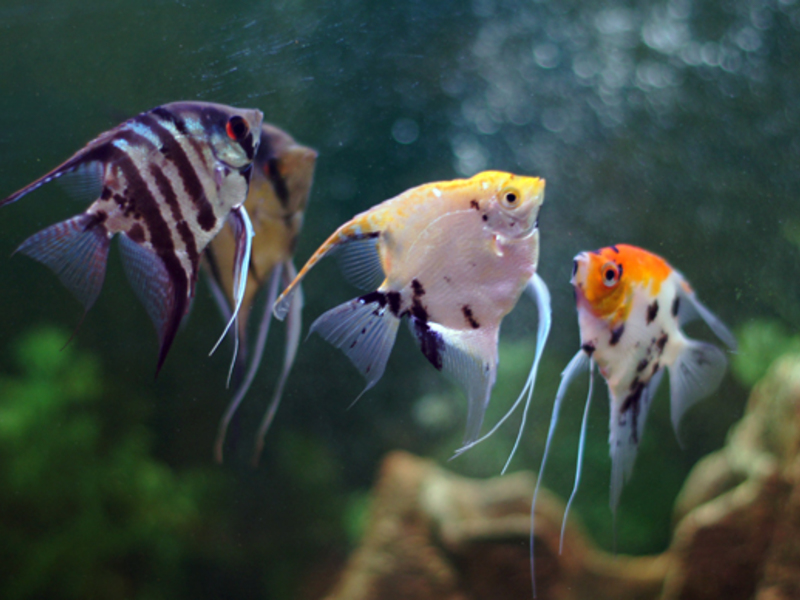
During the two weeks of preparation for spawning, the fish should not overeat, because even if the eggs are spawned, the larvae will not form in them. The onset of the spawning period can be judged by the pair's choice of surface for spawning.The fish carefully clean and guard the chosen substrate. This can include broad plant leaves, the surface of rocks and driftwood, and even aquarium glass. During this period, angelfish exhibit aggressive behavior. Spawning can be stimulated by raising the water temperature to 28–30 degrees Celsius and changing 30–40% of the water.
 If cyclid fish are kept with fish of other species, the breeding pair should be moved to a separate aquarium with suitable conditions. This is also advisable because This fish tends to eat its own eggs in times of danger.In unnatural conditions, this may be another fish approaching the spawning area, or frightening sounds outside the aquarium.
So what does the spawning process look like? The female lays a portion of her eggs on a previously chosen substrate and swims away, giving way to the male. His job is to fertilize each egg. Then the process repeats. On average, this process lasts up to two hours. The larger the female, the more eggs she produces.The pair is then separated, as keeping angelfish in the same tank with the eggs risks their consumption. The egg-laying area must be provided with a supply of fresh air.
The incubation period lasts up to 2 days. The larvae emerge from their shells and need assistance in clearing out any remaining unfertilized eggs. Over the next 4-5 days, the larvae mature and need good lighting.After this time, you can already see the fry attempting to swim independently. At temperatures below 28 degrees Celsius, this entire process will continue for up to two weeks.
Caring for fry
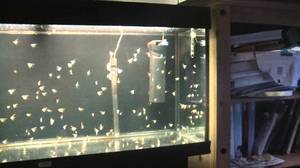 As soon as the fry begin swimming, they should be fed immediately. During the first few days, they should be fed food that has been thoroughly washed and ground to a fine powder. You need to feed 2-3 times a day, at the same timeArtemia nauplii are preferred. At one month of age, the digestive system of baby angelfish becomes more developed and they are fed adult food, continuing to chop it up slightly. They can be added to the adult aquarium once they reach two-thirds their body size.
During the fry's growth period, water purity must be impeccable to ensure healthy offspring. Therefore, careful attention to cleaning is essential.
Fish diseases
All types of angelfish are susceptible to diseases.: black, veiltail, koi, and others. The culprit is improper aquarium conditions. Disease-causing parasites can live both in the aquarium itself and enter from outside (via food).
Avoiding diseases is very difficult, but preventing them is easy. Angelfish are most often affected by:
- Hexamita are flagellated protozoans.
- Capillaria helminths.
- Heterosporis-microspores.
The presence of helminths can be suspected already at an advanced stage of the disease. 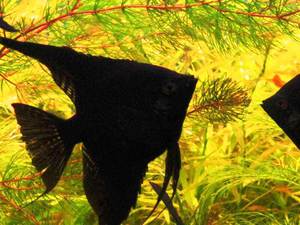 Loss of appetite and exhaustion are observed., a change in the color of the feces (it may be thin white or striped with alternating dark and white parts, regardless of the composition of the food consumed). Treatment is carried out with anthelmintic drugs.
Microsporidiosis is manifested by exhaustion, color change (gray spots are found on the bodyThis disease is incurable, but it can be prevented by purchasing high-quality, reputable brands of food. Infection occurs through eating infected fish carcasses found in low-quality food. Infected fish must be immediately isolated.
Hexamitosis manifests itself as erosions of the skin in the head area and visual changes in the fish's lateral line. Infection occurs through the feces of infected fish and through food. Hexamitosis is often caused by a weakened immune system in fish. Treatment is with antiprotozoal medications.
The main ones Signs of fish diseases include changes in their appearance and behavior. Therefore, always monitor your pets, as prevention is better than cure.