 The centipede Scolopendromorpha is a very interesting invertebrate that can often be found under rocks, in the forest floor or in the topsoil.
The sheer number of legs these animals have is particularly intriguing—hence their nickname, "centipedes." We won't see them during the day, as these creatures aren't fond of daylight, preferring humidity and complete darkness.
Who are the Scolopendras?
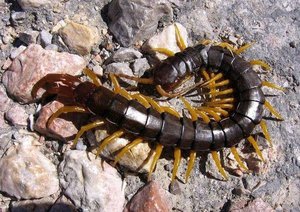
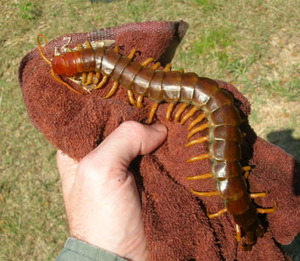 Outwardly, Scolopendras are similar and their appearance frightens many: they have a flat body, divided into segments (from 21 to 30, the common flycatcher is an exception, it has only 15 segments) which contributes to their agility.
These centipedes have greenish or brown color (less often black or dirty yellow), which helps them to camouflage themselves perfectly in the environment, jaws that strike terror into prey, and a chitinous shell, which makes them difficult to kill.
Scolopendra – from the Latin Scolopendridae – belongs to the centipede family. These animals have four pairs of eyes, from 21 pairs to 23 pairs of legs and numerous well-developed, venomous hooks. Centipedes are found in tropical and subtropical climates.
These insects are active nocturnal lifestyleDuring the day, they try to hide in any crevice, as they cannot tolerate light or dryness. If there are no crevices, millipedes burrow into loose soil, although sand is also suitable.
They sit in their shelter until dark, and then go out to hunt. Absolutely all species of these insects are predatorsThere are quite a few known species of representatives of the order Scolopendra:
- Scopendropsis bahiensis – Brazilian centipede.
- Scolopendra subspinipes – Vietnamese centipede.
- Scolopendra cingulata is a ringed insect.
- Euconybas crotalus, or the rattlesnake centipede, is so named because it makes a hissing sound similar to that of a rattlesnake when crawling. It is found in Africa.
- Scolopocryptos rufa – red centipede. Unlike other species, it has no eyes.
- Scolopendra Lukasi – Lucas's centipede. It grows up to 15 cm in length and is found in southern Europe.
- Scolopendra gigantea, or the giant centipede, is the largest centipede in this order, native to the tropics. It can sometimes reach 30 cm in length. It feeds on small vertebrates or large insects.
What danger do Scolopendras pose?
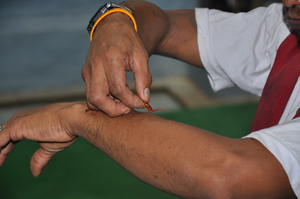 If anyone happens to encounter a centipede in the wild, remember that the centipede's venom is not very dangerous to humans, but it can cause a lot of trouble in a person's life.
A disturbed insect crawling across human skin can leave a "trail" of burns, as it has acid on each leg. If it stings, the pain will be quite severe, comparable to the sting of 20 bees.
The injection site of the poison into the blood may swell significantly, all this will be accompanied by fever, nausea, anxiety, vomiting. Symptoms usually persist for no more than two days. Cases of muscle spasms, kidney failure, or partial paralysis have been reported.
The histamine contained in the centipede's venom can exacerbate allergic reactions. Giant centipede bites are especially dangerous to humans. In some cases, soft tissue necrosis. A fatal outcome was recorded only once, when a centipede (Scolopendra subspinipes) stung the child.
The venom of these insects contains histamine, a mediator of allergic reactions; lecithin, a set of phospholipids essential for the construction of nerve cells; serotonin, a happiness hormone; and acetylcholine, a neurotransmitter. Medical attention should be sought immediately after a centipede bite.
Depending on the severity of the bite's consequences treatment is prescribed. Most often they are limited to the following manipulations:
- washing areas with damaged skin;
- apply a cold compress locally;
- anesthetize the bite site with oral analgesics and lidocaine injections;
- carry out tetanus prophylaxis.
Centipedes in people's homes and how to get rid of them
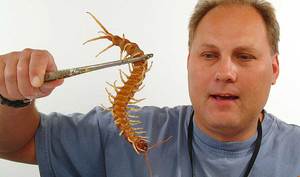 Can centipedes live in cooler climates? Can they inhabit human dwellings? The answer is yes, they can. They are more common. in houses under plaster, where it is dark and quite humid.
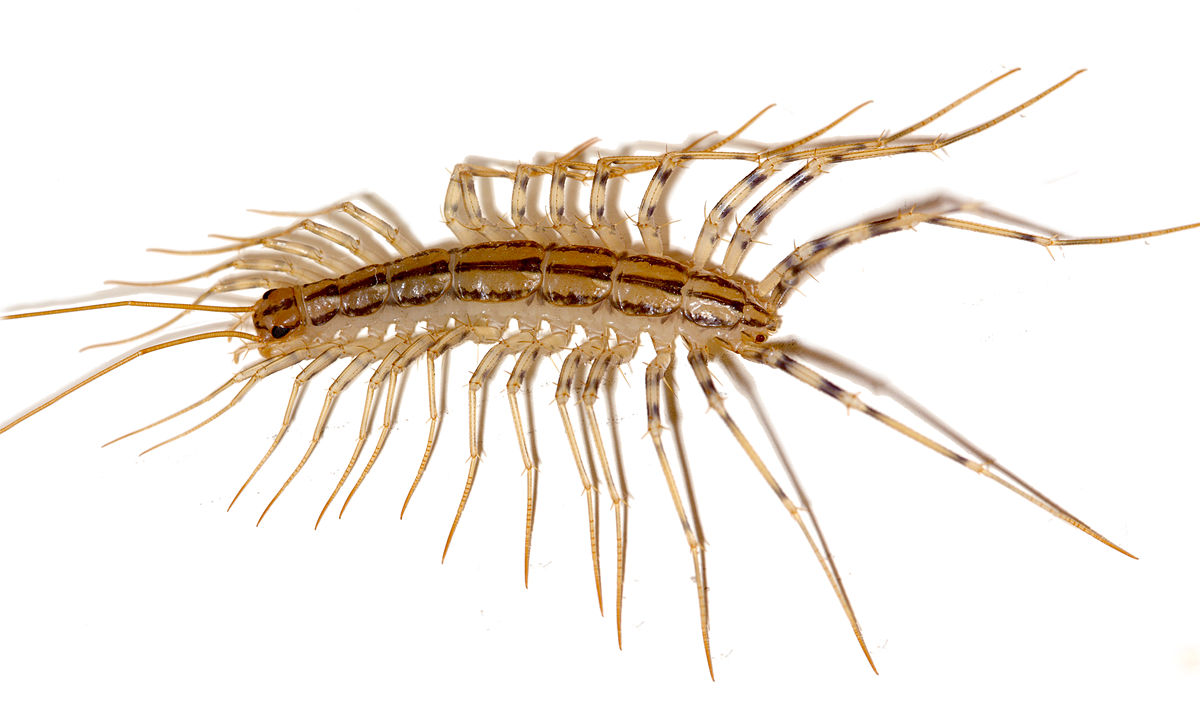
But this species has a name common flycatcherIt's no more than 6 cm long, brownish-yellow in color, and has antennae at the front that are several times shorter than its hind legs, making it difficult to tell which is front and which is back. It's completely harmless to humans. In fact, it can be beneficial by eating other insects: cockroaches, bedbugs, spiders, ants, etc.
Despite their dangerous venom, these creepy-looking insects have become popular pets for some people. Although statistics show that such exotic-loving individuals are few and far between, most find these centipedes repulsive.
If you want to get rid of these insects—and they live in the most inconvenient places, like the bathroom, basement, or toilet—regular insecticides won't do the trick. Sticky tape won't help either; the centipede will tear off its attached legs and grow new ones.
First of all, it is necessary seal all the cracks, carefully plaster the walls, reduce the humidity level in the rooms, and treat the rooms for insects, because centipedes settle where there is water and food.
In this case, the centipedes will move to another, more suitable location. You'll also need to tidy up the yard and remove piles of compost and leaves. However, there's no pressing need to exterminate these insects.