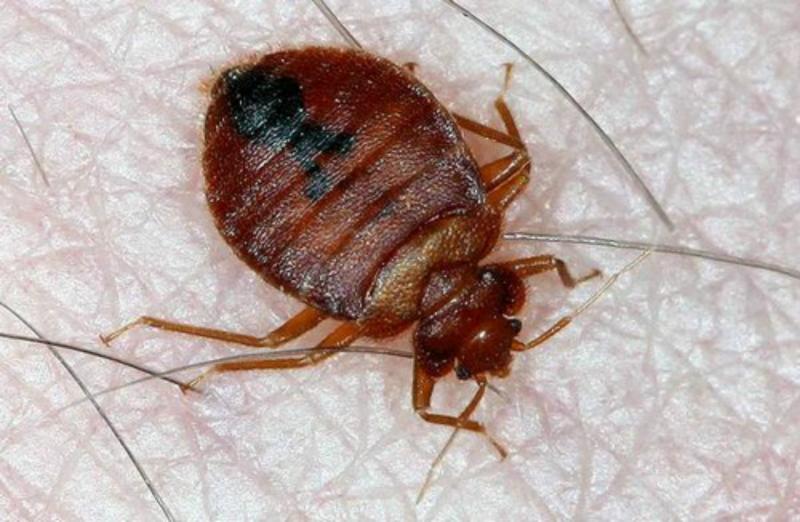
A person survives in this world thanks to knowledge, skills, and a firm determination to win. But it's difficult to win when you're faced with a similarly firm determination.
Content
Bedbugs have appeared in the house: the main reasons
Evidence shows that only three out of ten people can feel the bites of this blood-sucking insect.Find and destroy - that is our task.
The host's cleanliness has little impact on the arrival of unexpected guests. It's important to calm down and analyze the recent events in your life:
- You moved to another apartment or someone moved in with their things.
- We also bought some good furniture or office equipment.
- You live next to an apartment where the bedbug population has grown significantly, causing them to starve and migrate to uninhabited areas. Bedbugs are also very adept at moving along the exterior walls of the building.
- You stayed at a hotel in some exotic country, traveled, visited remote and unusual places, and brought back an insect in clothing, a box, a painting, a stuffed animal, or a book.
I thought bedbugs in apartments were a thing of the past, well, maybe except for old wooden barracks, prisons, etc. It turns out this problem exists, and not just in our city. And you don't have to have "special" neighbors—one of the main reasons for bedbugs in apartments these days is tourist trips, especially to Asian countries, which are favored by people from the Far East. We bring these "bloodsuckers" back from hotels and motels in Thailand, China, and elsewhere. Therefore, it's essential to wash all items from your suitcases (both dirty and clean) at a temperature above 45 degrees Celsius (I actually always do this). Another source of bedbug infestations in apartments is a summer cottage. Bedbugs live in the wild, including on summer cottages, and we usually take old furniture and other belongings to our summer cottages—these are the insects' favorite habitat. Pets can also bring bedbugs with them.
Trust the sanitary and epidemiological station, but don't be lazy yourself: home remedies
After conducting a thorough investigation, you've confirmed the presence of bedbugs. Ignoring the panic and terror, pull yourself together and create a clear plan of action to wisely allocate your resources and energy.
It is important to decide:
- What remedy should I choose to combat bedbugs?
- in what form it is produced and sold;
- How dangerous is this product?
- What poison does it contain?
Poisons come to store shelves in ready-made mixtures. They all contain poisons or a combination of them in varying percentages:
- Powder (Dust) is a dry mixture of fine grinding. The active substance is present in an amount of 1-10%The remaining portion consists of fillers—boric acid and a small amount of lubricating oil, which ensures the powder adheres to the insect. No preparation is required. Open the package and sprinkle the powder onto the targeted areas. A brush, sponge, or rubber bulb applicator are all convenient options. Wear gloves, a respirator, and protective goggles. The presence of healthy, active children and pets while we wait for the product to take effect will give the powder additional movement throughout the apartment.
- Gel/chalk is a paste-like or compressed mixture of insecticide with various fillers. It is used to mark boundaries beyond which pests are undesirable. You will have to apply the drawing frequently - most insecticides are sensitive to light.
- Emulsion or solution - a concentrate of the active substance in liquid up to 50%The active ingredient may be one or more poisons. It requires preparation of the solution and strict safety precautions when handling it. Rubber gloves, safety glasses, a respirator, and clothing you don't mind throwing away.
- Aerosol—a ready-to-use mixture under pressure. Used for visually observable specimens. Forms a dense gas-droplet cloud.
- A trap is useless against bedbugs. Bedbugs are only interested in warm, living blood.
How to determine the danger of an insecticide
All substances used to kill insects are poisonous. Herbal preparations contain the lowest concentration of poison. But such preparations won't solve a serious problem.
The more effective the drug, the more toxic it is. But forewarned is best protected. The manufacturer is obliged to indicate the hazard class of the insecticide on the packaging of its products.
Insecticide hazard classes - table
| Hazard class, GOST | Degree of danger |
| 1 | Extremely dangerous |
| 2 | Highly dangerous |
| 3 | Moderately dangerous |
| 4 | Low-hazard substances |
How to find the essential in a boundless ocean of chemicals?
Jars and bags on store shelves sweetly promise to kill all bedbugs in one fell swoop. It's overwhelming. But what's the key ingredient in those jars? There are many names, but far fewer active ingredients. We'll examine them by their main component—the poison, called an insecticide. Why? Because the direct ancestor of the bedbug was as much a pain for our direct ancestor as it was for us. And it fought it with every means possible. But bedbugs are highly adaptable. They never relax in their fight for life and food.
If the product used today doesn't completely kill the bedbug population in your home, tomorrow's young generation will be immune to this poison. Reusing a product with the same poison is a waste of time, effort, and health.
If your neighbor told you she recently successfully got rid of bedbugs, inquire about the active ingredient. After all, thinking your bugs are from Mars might not work.
Artificially produced poisons are grouped by their chemical formula and their mechanism of parasite killing. The effect of a given poison's action or inaction applies to the entire group of insecticides to which it belongs. Belonging to a particular group of insecticides can be determined by poison, indicated in the composition in the first place and its concentration.
Pyrethrin group
Pyrethrins are natural plant insecticides found in the dried flowers of perennial herbs: Dalmatian chamomile, chamomile, and tansy.
This chemical has a long history of use. The dried flowers of these plants were used as a chemical defense against parasites by soldiers in Alexander the Great's army. This method can still be used today. Dried chamomile and tansy flowers are sold in pharmacies. Dalmatian chamomile (Persian chamomile powder) is also available. It is sold under the name Pyrethrum.
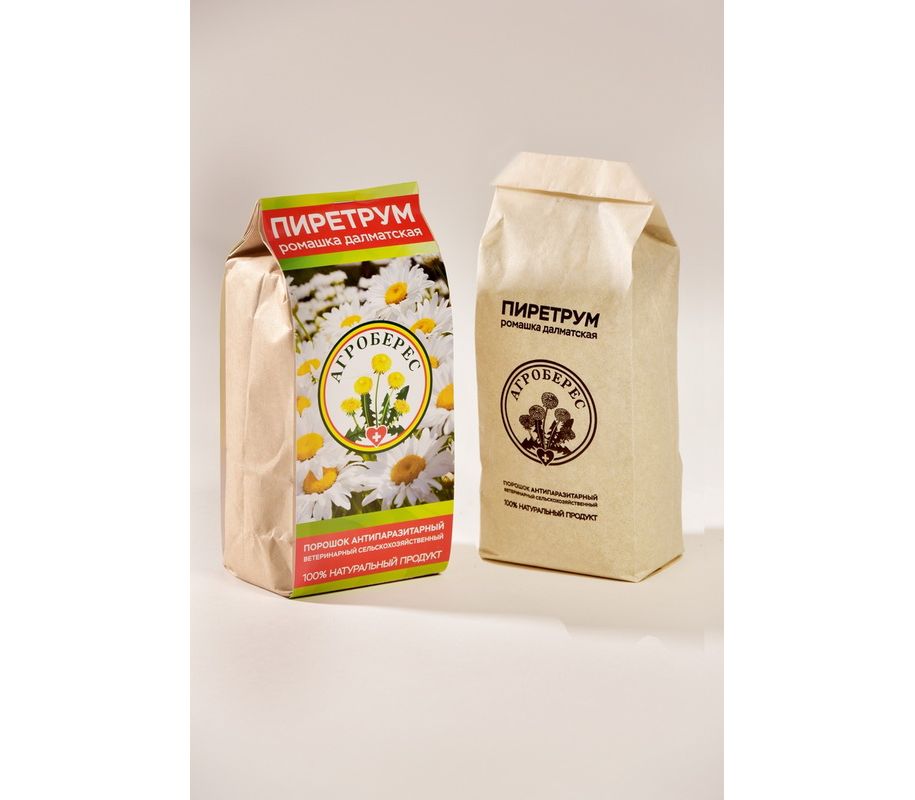
Alexander the Great knew him.
The drug is convenient to use; it is ready for use. The low concentration of poison allows these herbs to be used in areas with children and pets.
The contents of the package are scattered over all insect infestations. The bedbug must touch the product with its legs or body, as it won't taste it. This is true, as with all other bedbug control products. It's currently impossible to force the bedbug to eat anything other than blood.
If you have large numbers of insects, don't rely on pyrethrins. These plant-based poisons are essential compounds and quickly evaporate when exposed to sunlight. This treatment will need to be repeated daily and for quite some time.
They are unlikely to be effective in bedbug control as a primary treatment. Rather, they are more likely to be used as an adjunct to a comprehensive or preventative treatment.
But we must not forget that even these products belong to the 3rd hazard class for humans.
Pros:
- They act on insects by repelling them with their smell.
- Can be used without restrictions in beds, closets and personal belongings.
- Do not require special security measures.
Cons:
- They are not valid for a long period of time and require renewal every 1–2 days.
- Does not kill bedbug eggs and larvae.
- They decompose during storage and exposure to sunlight.
...As for Pyrethrum—sorry, it's just crushed chamomile. It's good that it helped someone once. But bedbugs usually don't get rid of with folk remedies, especially when the insect population is already large. But you can try it—probably. Chamomile definitely won't make things worse.
Back in the Soviet era, my mother completely eradicated them (at least in a single apartment) using tansy flowers. She placed them under mattresses (for example, on the bed), and if the bed was against the wall, she also placed them on the floor near the baseboard, under the sofa and armchair cushions, and so on. No smell, no bugs. She changed the plants once a year, in summer and fall. She even placed whole plants, rootless, in the beds. Good luck! Try it! It will 100% help.
A group of diatomite-based products
Diatomaceous earth is a natural mineral mined industrially from sedimentary rocks. It was used in China for pest control 4,000 years ago. Chemically, it is silicon dioxide. It is an abrasive, dense, and highly porous absorbent. Small particles of diatomite have sharp edges that literally bite into the insect's body. It actively absorbs liquid substances, from water to mercury. This is the basis for the mechanism of killing bedbugs in this group.
Diatomite-based preparations - Ecokiller, Silica gel.
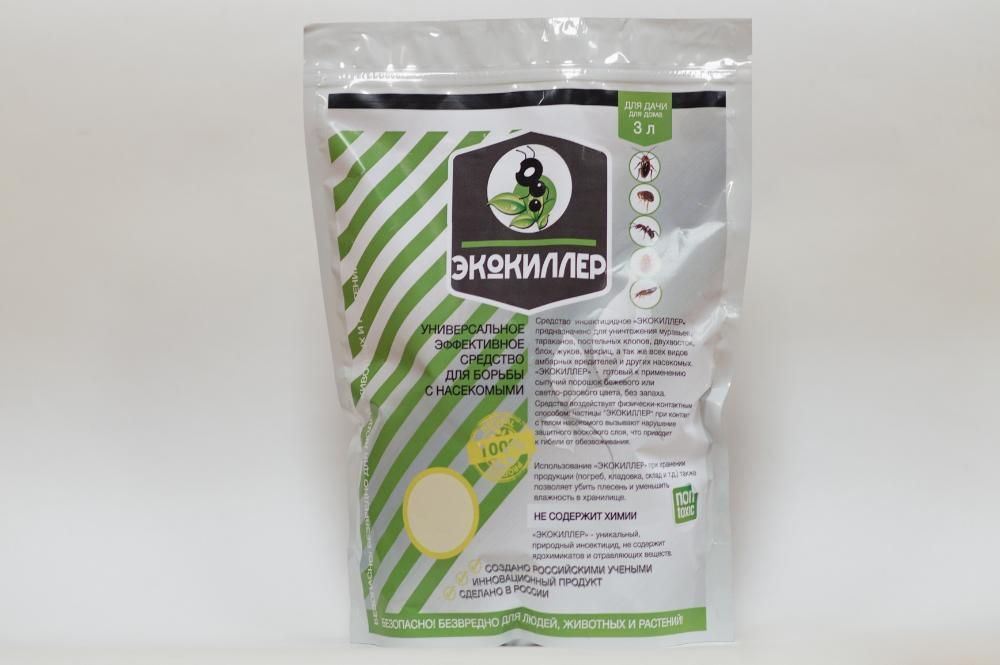
It sticks, it hurts, it dries
The silicon dioxide-based powder is odorless and sun-resistant. It acts on insects upon direct contact. It adheres, wounds, and dries. It can be applied directly to bedbug habitats without any additional preparation. It takes time for the product to effectively act on insects contaminated with it.
If you choose this product, remember that when working with this powder product, you should wear gloves, safety glasses, and a respirator moistened with water.
Although silicon dioxide is widely used in medicine, this insecticide is classified as hazard class 3 for humans. It is dangerous if inhaled or comes into contact with the eyes.
Pros:
- Does not decompose.
- There is no smell.
- Bed bugs have no ability to develop desiccation tolerance.
Cons:
- Does not kill bed bug eggs or larvae.
- The duration of the active phase of the drug's effect depends on the humidity of the room.
Those who have used this remedy in their practice have different opinions about its effectiveness.
Utter disappointment. It didn't help at all. Even though we followed the instructions. And the powder wasn't just sitting there for a day, it's still there (a month now). The bedbugs are still there. It seems they even liked the powder. The result: wasted time (not at all wasted, as I bought the largest kilogram package and paid for shipping, as this miracle product is only available online) – several hours of treatment. And the dust from this powder, plus I was up to my ears in it. I'm completely upset right now, because I'll have to resort to the old, toxic, cheap Malathion. I don't recommend it; it doesn't work at all. I only bought it because I read rave reviews online that it was a super product and non-toxic. Utter disappointment.
Our neighbors gave us bedbugs. We were furious. New, expensive furniture bought just five months ago became a home for bedbugs. It was terrible. I tried everything. It was impossible to breathe in from all the sprays in the apartment. Neither chalk nor dichlorvos helped. So I went to the hardware store for another product. The saleswoman recommended Ecokiller, and we bought two bottles and a bag for spare parts. I treated everything I could. Behind baseboards, under carpets, we moved all the furniture apart and treated the inside, as well as the sides of sofas and armchairs. Yes, it was dusty, but there was no smell, and we didn't have to take the cat out of the house. Everything worked in about a week. No large bedbugs or nymphs were visible. I haven't removed the product yet, in case there are any larvae left. We've been sleeping soundly for two weeks now. Ecokiller really does work! And so, I'm adding my review. Several months have passed. Bedbugs have appeared again. These aren't small, but large specimens. This means they've come back from the neighbors. I made the mistake of thinking there weren't any bedbugs and vacuuming up all the stuff from the backs of the furniture and the baseboards. Now I'll treat them and leave them there for a while. Better dusty baseboards than these tiny bloodsuckers.
Pyrethroid group
Pyrethroids are artificially produced ether insecticides similar to plant poisons. 1,000 times more powerful and active than Persian powder. The slightest contact with these substances blocks the bedbug's nervous system. However, with the increased exposure to pests comes the clear danger of poisoning humans and their pets.
They are toxic and dangerous to fish, bees, and other cold-blooded animals. Surprisingly, cats are sensitive to this poison. When treating a room, remove children and animals from the area and protect aquariums.
Substances in this group are chemically unstable and decompose under the influence of light, and their most effective period of action is while the treated surface is drying.
Most often, products in this group are sold in concentrated form for preparing a working solution. When preparing the solution and treating the area, ensure you are fully protected: wear old clothes, rubber gloves, safety glasses, and a respirator.
Cypermethrin and alpha-cypermethrin are insecticides in this group. They are found in the following products:
- Cypermethrin - emulsion (25% cypermethrin);
- Cyfox 25 - emulsion (25% cypermethrin);
- Cucaracha - emulsion (20% cypermethrin);
- Breeze 25 - emulsion (25% cypermethrin);
- Tetrix - emulsion (25% cypermethrin);
- Medilis Cyper - emulsion (25% cypermethrin);
- Arrivo-cyperus - emulsion (cypermethrin, 50 g/l);
- Inta Vir - tablets (3.75% cypermethrin);
- Cypermethrin and permethrin - emulsion, powder (15% cypermethrin, 15% permethrin);
- Clean house - emulsion, powder, aerosol (13% cypermethrin, 2.5% permethrin);
- Blockbuster XXI - aerosol (0.2% cypermethrin, 0.18% tetramethrin, 0.8% piperonyl butoxide);
- Ivanhoe - emulsion (10% alpha-cypermethrin);
- Bassoon - emulsion (alpha-cypermethrin, 100 g/l);
- Chalk "Mashenka".
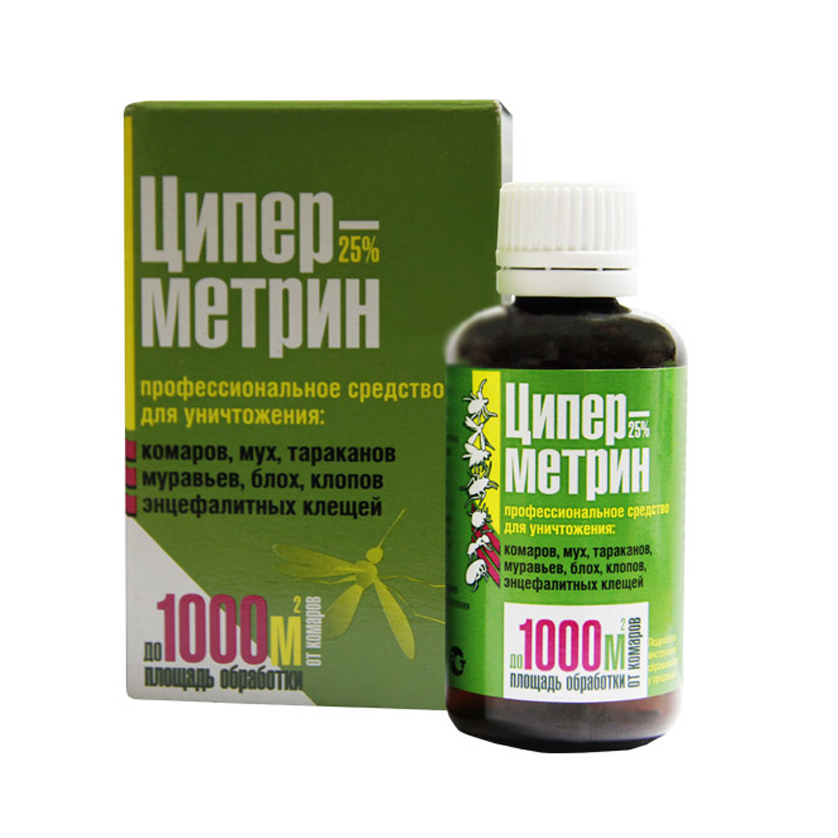
The active ingredient is cypermethrin
Fenvalerate is contained in the drug Fenaxin - powder (0.35% fenvalerate)
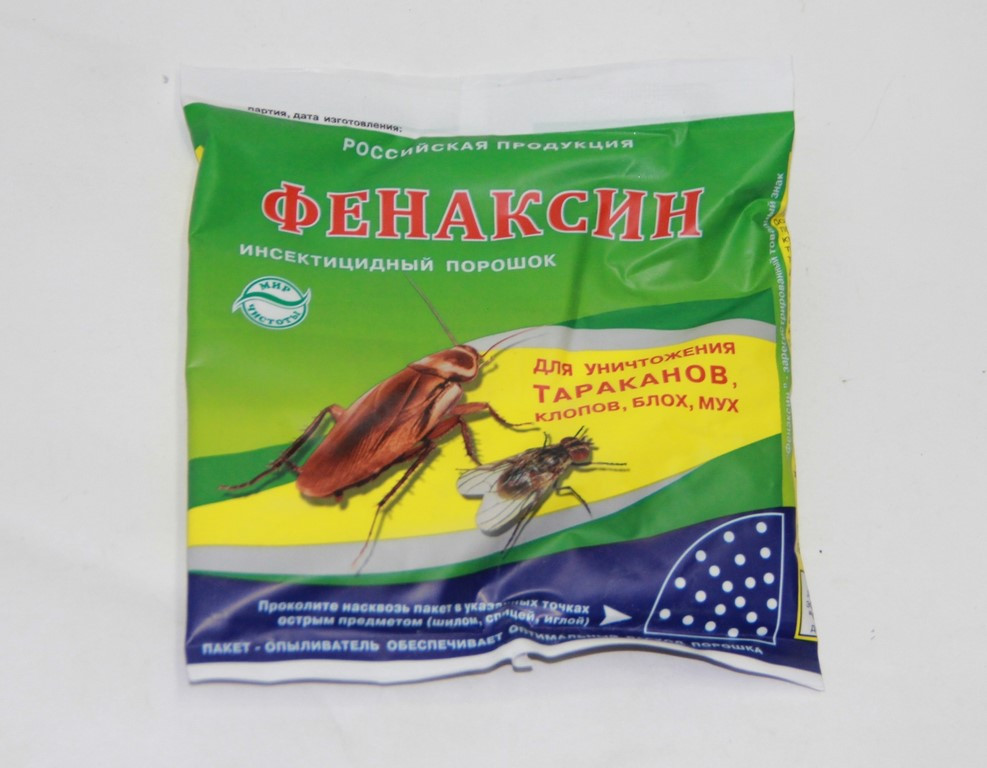
The active ingredient is fenvalerate
Pyrethroid insecticides are effective and effective bedbug control agents. They have a long-lasting effect on the parasites. These insecticides are used 2-3 times per treatment cycle to allow the hatching eggs time to come into contact with the poison. They are neutralized by adding baking soda to the water used for washing.
The same mechanism of destruction operates within the group; if this poison doesn't work, look for an insecticide in a different action group.
Pyrethroids are assigned hazard class 3 for humans.
Pros:
- They take effect 10 minutes after contact with the bedbug.
- They are active for 10–14 days.
- They remain valid for another 1–1.5 months.
- They are less toxic than poisons of other groups.
- Used when there is a large number of insects.
Cons:
- Does not kill bed bug eggs.
- If treated frequently, they cause bed bugs to become insensitive.
- Most ethers in this group have a pungent odor.
- It is necessary to prepare the solution in accordance with the manufacturer’s recommended proportions.
I'm a big expert at getting rid of bedbugs. Cucaracha wears off after two days, but there will definitely be no bedbugs afterwards. It's the only product that actually works.
We managed to deal with it ourselves, maybe it wasn't a very serious case. Throughout the fall, I treated EVERYTHING weekly with cypermethrin (there are instructions on the bottle for diluting it, it's very toxic), bedbug sprays, and dichlorvos. I alternated everything. Of course, it's a nightmare; remembering it makes me shudder. Follow safety rules: wear a mask, gloves, and definitely wash your clothes. I closed the room for a day, then aired it out. Keep animals out of the house. Overall, it was tough, but maybe someone will find this information useful.
Group of organophosphorus compounds (OPC)
Organophosphorus insecticides were synthesized in the first half of the 20th century. Fast and deadly to parasites. They paralyze insects upon the slightest contact with the poison. They are not degraded by light or water. Phosphorus, as a chemical compound, produces a burning effect. More often than other groups, they are the basis for combination formulations.
However, they are also highly dangerous and toxic to humans. When treating a room, nothing alive except bedbugs should remain. Flowers and plants should be removed or protected. A working solution is prepared and applied to the infested areas with the windows open. Eggs, larvae, and adult insects die within a few hours of exposure to this poison.
The use of dense personal protective equipment is mandatory. Organophosphorus compounds can penetrate the body through inhalation, skin, and eyes.
This group includes fenthion, malathion, and chlorpyrifos.
Fenthion is found in the following medications:
- Medilis-Super - emulsion (24% fenthion);
- Dobrokhim FOS - emulsion (20% fenthion);
- Sulfox is an emulsion (20% fenthion);
- Medilis-PERMIFEN - emulsion (16% fenthion, 4% permethrin);
- Acarocide - emulsion (40% fenthion, 10% cypermethrin);
- BAF, dust - powder (0.05% fenthion, alpha-cypermethrin);
Malathion (malathion). Contained in the following medications:
- Blockbuster XXI concentrate - emulsion (58% malathion);
- Karbofos - emulsion (50% malathion);
- Karbofos, dust - powder (10% malathion);
- Carbosol is an aerosol (malathion).
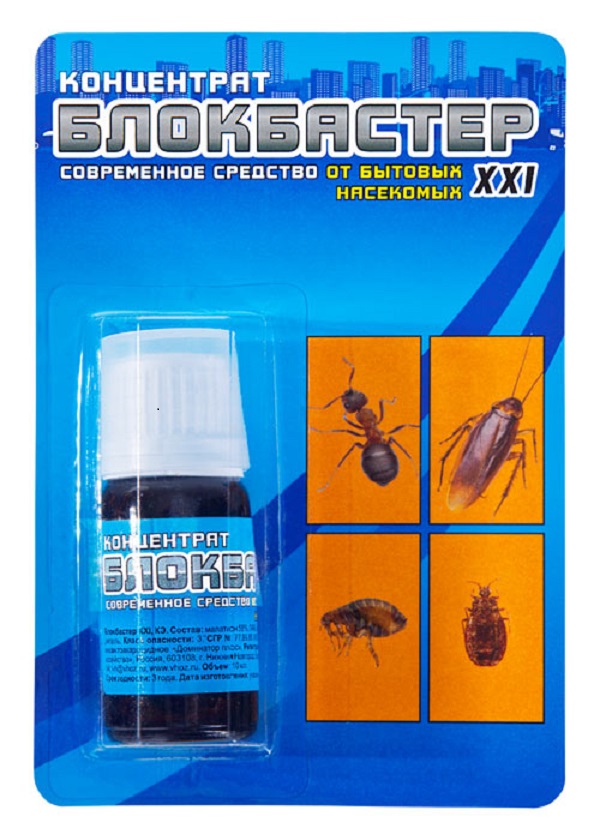
The active ingredient is malathion
Chlorpyrifos is found in the following preparations:
- Chlorpyrifos - emulsion (48% chlorpyrifos);
- Sinuzan - emulsion (48% chlorpyrifos);
- Sichlor - emulsion (20% chlorpyrifos, 10% cypermethrin);
- Cyclops - emulsion (20% chlorpyrifos, 10% cypermethrin);
- Agran is an emulsion (50% chlorpyrifos, 5% cypermethrin).
These poisons are effective in killing parasites. They are among the most toxic compounds. But even this deadly poison can cause bedbugs to develop a tolerance.
Organophosphorus compounds are assigned hazard class 2 for humans.
Pros:
- Kills parasites instantly on contact.
- Effective on adult insects, eggs and larvae of bedbugs.
- They kill a significant part of the population within 3-4 days.
- They act, performing a protective function, for 1–1.5 months.
- Used when there are a large number of pests.
Cons:
- Single-component products have a strong odor.
- They make bedbugs insensitive to the drug.
- Accumulate in the environment.
REVIEW: We used to use malathion, which came in a bottle and a spray. The smell lingers for a while, but it works 100%. We even added it to wallpaper paste to keep them from running away from the neighbors.
Group of neonicotinoid compounds
Neonicotinoids are a small group of artificial nicotines. Our great-great-grandfathers used makhorka and tobacco to protect themselves from harmful insects. These substances, greatly enhanced, have once again come to our defense. Their mechanism of action differs from that of the previous groups. And there is no evidence yet of bed bugs developing resistance to this group of poisons.
They are dangerous and merciless to bedbugs upon direct contact and moderately dangerous to humans. You can trade in your heavy protective gear for a lighter suit. But remember that they are poisonous.
This group includes: imidacloprid, thiamethoxam, acetamiprid:
- Confidant - emulsion (20% imidacloprid);
- Super Fas - powder, tablets (4% thiamethoxam, 1% zeta-cypermethrin);
- Antiklop blockade - emulsion (5% acetamiprid).
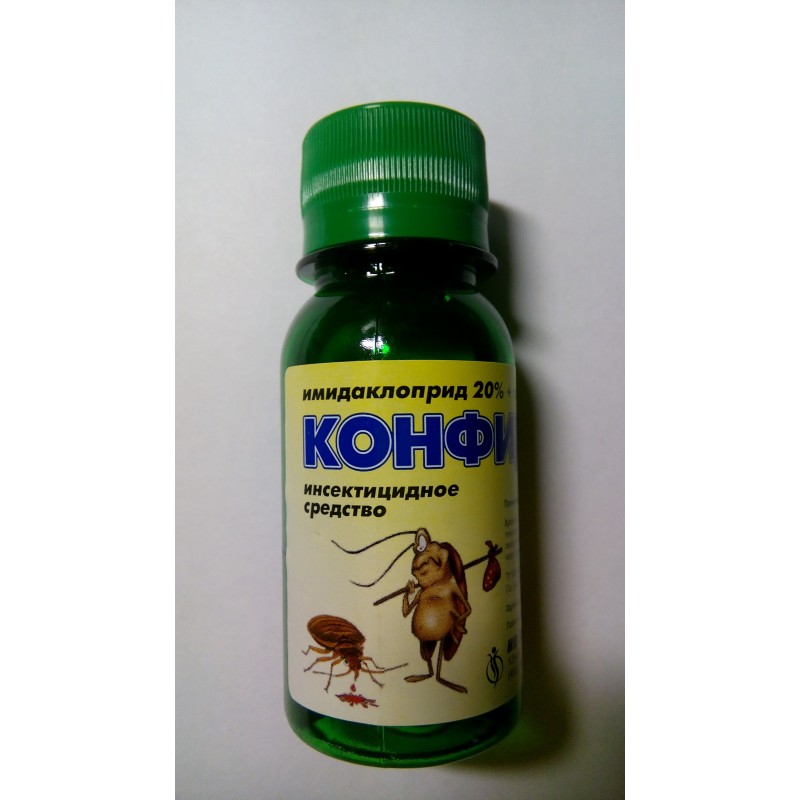
The active ingredient is imidacloprid
Pros:
- They have no smell.
- They are resistant to environmental influences.
- They are used when bedbugs are resistant to previously used products.
- They form an invisible, durable film, which kills bedbugs upon contact.
- They act, performing a protective function, for 1–1.5 months;
- Used when there is a large number of pests.
Cons:
- Does not kill bed bug eggs.
- Require preliminary preparation of the solution.
Neonicotine compounds are toxic and are assigned hazard class 3.
REVIEW: After three years of fruitless bedbug control, friends recommended Fas-Dubl, which helped them eradicate bedbugs that had been ineffective for four years. The seller marketed the product as "Old, Soviet, and reliable." Considering the main active ingredient is a synthetic pyrethroid, I would say it's a cutting-edge product. The difficulty is that the powder product is difficult to apply to every small crack, so it wasn't able to eradicate all the insects immediately. After treating the room, some remaining insects continued to appear on the walls for two months. It was easier to kill them with Combat+, an instant-release synthetic pyrethroid. After that, I didn't see any bedbugs in the house for four months.
Phenylpyrazole group
FIPRONIL. It belongs to the phenylpyrazole group. Its mechanism of action is different from that of other groups, making it attractive for systemic use. Chemically stable. Resistant to sunlight and moisture.
A phenylpyrazole-based product allows for a single treatment of the room. This saves considerable time and effort. Another difference from other insecticides is that salt and detergent are added to the water to neutralize surfaces treated with fipronil.
Regent 800 - water-dispersible granules, emulsion (0.03% fipronil, 0.5% imidacloprid).
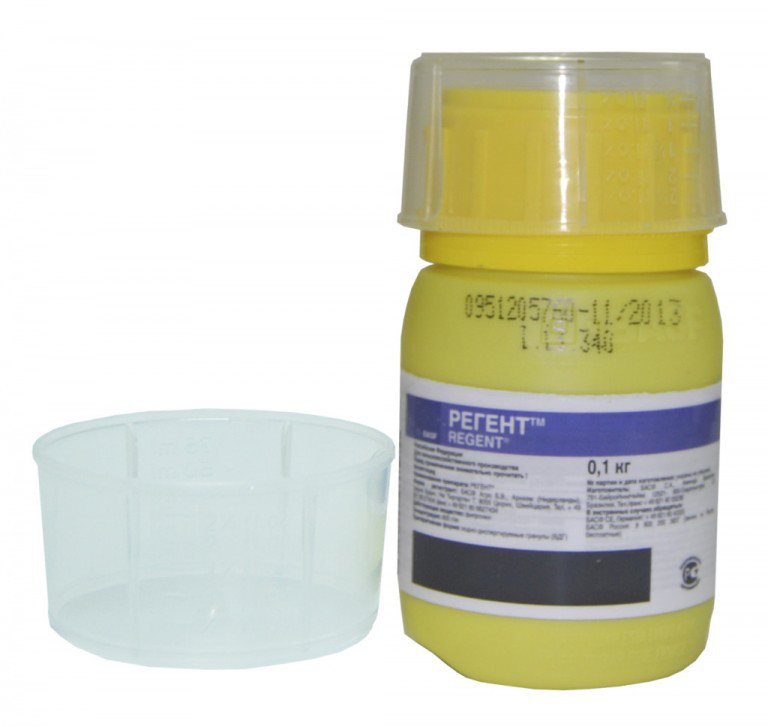
Insecticide with the addition of fipronil
Pros:
- Works in high humidity and temperature conditions.
- Causes up to 90% death of parasites within 24 hours.
- Kills adults and larvae.
- It acts for 1–1.5 months, performing a protective function.
- Used when there are a large number of pests.
Cons:
- Requires preliminary preparation of the solution.
- Should not be used for a long time, as insects may become accustomed to it.
Phenylpyrazole compound belongs to hazard class 3.
A group of microencapsulated drugs
Insecticides encapsulated in gelatin or polymer microcapsules. To increase the duration of action on pests and the residual concentration of the poison. Thanks to this, the protective duration of insecticides has increased from 1 month to six months. They are available as emulsions containing concentrated poison and in microcapsules. The capsules contain known poisons or their compositions.
Microencapsulated drugs:
- Dobrokhim Micro (25% chlorpyrifos) is a group of organophosphorus compounds (OPC);
- Get (5% chlorpyrifos) is a group of organophosphorus compounds (OPCs);
- Delta Zone (2.5% deltamethrin) is a group of pyrethroids;
- Lambda Zone (2.5% lambda-cyhalothrin) is a group of pyrethroids;
- Micro xulate (10% cypermethrin, 2.2% tetramethrin, 10% piperonyl butoxide) is a group of pyrethroids.
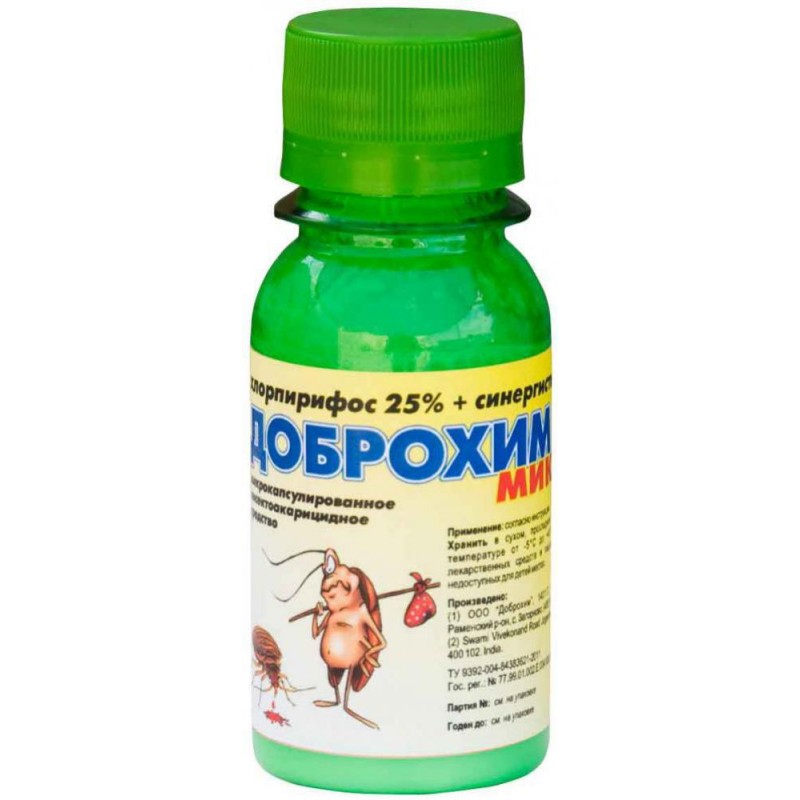
A group of microencapsulated drugs
Microencapsulated insecticides are classified as moderately and low-hazard, which is good news for us as indirect consumers of these products. The poison contained in the capsules is released in concentrations less hazardous to humans. These products are classified as hazard classes 3 and 4.
REVIEW: Microencapsulated products are much better. They're cheaper, and the effect lasts for a year—even if a critter crawls in from the neighbors even three months after treatment, it will run through the microencapsulation and die.
"Animal cells" in the composition
What should you do if you come across a drug with an unknown composition?
When poisons are not named, but only their groups:
- an insecticide from the pyrethroid group;
- insecticide from the group of organophosphorus compounds;
- a synergist substance that enhances the action of both of the above insecticides, while being an independent pesticide with intestinal-contact action.
The manufacturer indicated the groups of insecticides present in the product, but it is not possible to determine their concentration.
In this case, the thoughts may be as follows:
- If the drug Sichlor (20% chlorpyrifos, 10% cypermethrin), which is a mixture of a pyrethroid (cypermethrin) and an organophosphorus compound (chlorpyrifos), has been used without success, then such a drug will not help and you need to move on to drugs with a different mechanism of killing insects.
- The manufacturer is hiding important information. Why?
- I haven't gotten around to these groups of poisons yet. Maybe I should give it a try? Maybe it will work.
You might also come across a composition like this:
- Bio-reagents.
- Animal cells.
- A poison with the gross formula C51H32N2O8 (distinguished by its action, which paralyzes the muscular system of insects).
It may be a well-functioning drug in its class or a combination of these classes. But how to use it correctly? The manufacturer's marketers have clearly overdone it.
Overview of the main insecticides - table
| Group of poisons (active substance) | Hazard class | Destroys | Reprocessing |
| Pyrethrin group: PERENNIAL HERBS | 3 | Adult insects | Yes |
| Group of diatomite-based products: DIATOMITE | 3 | Adult insects | Yes |
| Pyrethroid group: CYPERMETRIN ALPHA-CYPERMETRIN Fenvalerate | 3 | Adult insects Insect larvae | Yes |
| Group of organophosphorus compounds: FENTHION MALATHIONE CHLORPYRIFOS | 2 | Adult insects Insect larvae Insect eggs | No |
| Group of neonicotinoid compounds: imidacloprid THIAMETOXAM ACETAMIPRIDE | 3 | Adult insects Insect larvae | Yes |
| Phenylpyrazole group: FIPRONIL | 3 | Adult insects Insect larvae Insect eggs | No |
| A group of microencapsulated drugs | 3–4 | Adult insects Insect larvae Insect eggs* *Depends on the poison in the capsule | No |
PRACTICAL ADVICE: Basically, catch a couple of them in a box or jar. Experiment with what works—use whatever kills them. We caught them by spraying them with a strong solution of chlorine sept and bleach. An hour or two later, they're gone. These creatures come in all shapes and sizes: those that have been around for a while are well-adapted, while those just passing through quickly give up. Good luck.
Chemistry is chemistry, but what else can be done?
Bedbugs have natural enemies. These include cockroaches, centipedes, ticks, spiders, and ants. But no one would dream of keeping cockroaches with ticks to eat bedbugs in their home.
Bed bugs have a keen sense of smell and cannot tolerate strong-smelling substances. These include Persian chamomile, wild chamomile, and tansy. You can also add wormwood and wild rosemary infusion.
And also: turpentine, kerosene, denatured alcohol, naphthalene, vinegar and valerian tincture.
The most common folk remedy is a valerian solution; simply apply it with a cotton swab to the cracks of the bed and the bedbugs will begin to crawl out. However, it is ineffective due to the bedbug eggs left behind, and is generally useless if there are pets (cats, dogs) in the apartment.
Hot steam was used to combat insects back in the palaces of Versailles. A hair dryer works well for this purpose.
However, when exposed to cold, practitioners obtained different results.
In the army, they experimented by putting a few in a matchbox and exposing them to -30 degrees Celsius. Then they thawed out as if nothing had happened. Freezing out an apartment is pointless. The insects will find a place to hide and then come back.
I also discovered a bedbug in my house once. It was just before New Year's. Without thinking twice, I took the bedding and mattress out onto the balcony, where they sat for three days in the -35–40°C cold. They never bothered us again.
General plan of action for apartment treatment
If bedbugs are already in the house, you will have to act decisively and uncompromisingly.
- Move furniture away from the walls. Clear the areas where the walls meet the ceiling and floor. Fill any cracks you find with sealant or putty.
- Remove all outlets and switches and disinfect them. Fit the air duct grilles with fine mesh, disinfect them, and replace them, sealing all cracks.
- Wash items from closets at 90°C. Pack them tightly in plastic bags.
- Seal food supplies tightly.
- Remove children, animals and birds from the premises.
- Take care to use personal protective equipment in accordance with the manufacturer's instructions and the hazard class of the drug.
- Prepare the insecticide for use, following the instructions.
- Treat your apartment in one go, including furniture.
- Do not eat, drink or smoke during treatment.
- If you have treated the area with a liquid product, leave the area after treatment until the solution has dried.
- When you return, ventilate the home, wash the floors, leaving a sanitary zone along the walls.
When you pick up a beautiful jar in the store, its façade promising marketing wonders, don't forget to look at the back, where the main information is concentrated. And may your home be warm, bright, and cozy.