When we buy a garden plot, we usually expect a small but pleasant addition to our diet in the form of fresh vegetables from the garden and fruit from the trees. And we certainly don't plan on sharing the harvest with just anyone. However, most gardeners have to deal with some brazen invaders who encroach on the fruits of their labor. Of course, you've already figured out that we're talking about mice. Where do these parasites come from, and how do you get rid of them from your garden?
Content
Where do mice come from on the property?
In fact, the vast majority of summer residents and villagers encounter mice. These rodents roam our gardens as if nothing had happened, and we're constantly searching for new ways to get rid of them. But first, it's worth considering where they come from.
- From neighbors. The simplest explanation is that your neighbors' property is infested with mice, and they, eager to explore new territory, are moving to yours.
- From the forest. More precisely, from the fields near your property. Many wood and field mice raid nearby gardens and vegetable plots in search of warmth and food.
- From garbage. Even if a wild forest or open field doesn't start right behind your fence, mice can still come to your summer cottage or village. And they'll most likely start from the garbage dump, and from there, they'll spread out to other properties.
Why are mice so attracted to human settlements? Probably because mice are generally considered synanthropic animals—that is, those that gravitate toward humans. This is largely explained by the fact that there is always something around a person to profit from, be it fresh food or old scraps, and in a pinch, even soap and candle stubs will do. And here we come close to the question of how mice actually harm us.
- Food spoilage. As mentioned above, these virtually omnivorous rodents share the same table with humans. Therefore, your harvest is at great risk—grains, root vegetables, potatoes… anything stored in sacks in your barn can be gnawed by mice. And if you keep supplies of cereals, flour, nuts and dried fruits in your summer house, rest assured: rodents will try to get to them too.

Cucumbers, corn, peaches - mice will eat everything!
- Damage to property. If mice have entered a country house or country home, nothing will stop them from chewing holes and burrows right under the floorboards, in the walls, and in the baseboards. Furthermore, rodents are not shy about leaving their droppings everywhere. As a result, not only does the house become dirtier, but a persistent, unpleasant “mouse” smell also appears.
- Damage to the garden. If the animals decide to dig holes right in your garden, the beds and plants will suffer, especially root vegetables—you've probably pulled up a carrot only to find half of it mercilessly eaten. Flower beds (especially the bulbs and plant roots), paths (they will be riddled with mouse holes), and garden trees, which will inevitably be nibbled from below and under the roots, are also at risk.
- Health risks. But even if you don't really grow anything in your garden and don't mind leaving bread crumbs for these cute-looking creatures, that doesn't mean you're safe. Mice, like other rodents, carry many dangerous parasites (e.g. ticks, worms, salmonella) and diseases such as tularemia, Omsk hemorrhagic fever, leptospirosis and others on their paws.
How to deal with rodents
Now that the damage caused by these impudent rodents is clear, it's time to think about how to get rid of them. Mice have been around for a long time, so there are several proven methods.
Mice repellent
For starters, you can make a drastic and inhumane decision: poison all the mice in your area. To do this, simply go to the nearest hardware store and purchase specialized chemicals—usually universal rodenticides, or, less commonly, those specifically targeted at mice. The poison is mixed with bait (or sold already mixed) and placed in the rodent's habitats; it can even be placed directly in their burrows. Unsuspecting mice eat the poisonous treat and die—all you have to do is collect their lifeless bodies.
Review: Ital Tiger "Mouse Death" rat and mouse poison—this poison works. It's a very effective and worthwhile mouse and rat poison, tested personally. Rodents react immediately to its smell and eat everything available. It not only kills them, but also repels them, so they never come back.
This, by the way, is one of the most serious drawbacks—you never know exactly where and when a poisoned animal will die, and rodents can hide in such secluded corners that they'll be difficult to find and remove. However, the cadaverous fumes from there will certainly reach your sense of smell. Additionally, if you have a pet, it may eat the bait instead of the mouse, or it may catch and eat the poisoned mouse. In both cases, it could end badly for your pet.
Folk methods
If the nearest hardware store is far away, but you need to get rid of mice right away, you can use the extensive experience accumulated by our ancestors in pest control.
- Ash. One popular, old-fashioned method is to sprinkle ash or crushed charcoal where you've seen rodents. In a basement, shed, or attic, you can safely sprinkle ash over the entire floor, and in a garden, over all the beds. Ash is also considered a good fertilizer. When mice lick their ash-covered paws and faces, they will experience irritation of the mucous membranes and indigestion, which will force them to change their habitat.
- Household chemicals. Tar, ammonia, kerosene, turpentine, and formalin—all of these can be used to coat baseboards and corners in a country house, or even soaked in wood shavings. Sawdust is then scattered in rodent-friendly areas—in the yard and along walkways between garden beds. Some gardeners even pour toxic liquids directly into mouse holes in their gardens. However, some of these substances are flammable or toxic to humans, so they should be used with extreme caution.
- Herbs. It's believed that mice tend to avoid areas where plants they find unpleasant are planted. For example, it's recommended to plant elderberry and castor oil plant bushes around the house, and lily of the valley, monkshood, calendula, and foxglove in the flowerbed. If you want to protect your root vegetable beds from rodents, plant onions, garlic, coriander, and legumes around them. Black root, commonly known as "rat repellent," will also help protect your property from mice.

Rat-catcher, black elderberry, wormwood and tansy - mice don't approve of these plants!
Physical destruction
Of course, you can fight mice mechanically—that is, by catching them all. For this, you can use traps, either store-bought or homemade. Store-bought traps are usually either classic mousetraps with bait, houses with poisoned treats, or glue sticks.

A glue trap for rodents in action
Thus, the mouse dies either from interaction with the trap mechanism, or from poisoning, or from exhaustion.
Of the many I've tried, I prefer glue traps. I tried poison, but after it died somewhere inaccessible, a terrible stench would start <…> The instructions for use are described in great detail. The precautions are also very detailed, including what to do if the glue gets on your hands, eyes, or if it gets into your stomach <…> We place the trap where the mice most often run and leave. I just left it for the weekend. And this is what I saw when I came home from the weekend. My beauty was caught. I hope she's the only one I have and the mice won't bother me for the time being.
These methods are absolutely inhumane, especially glue traps, but if you don’t feel sorry for the animals, go ahead.
We tried glue... I burst into tears watching the rodents die painfully...
Homemade traps often help catch rodents alive and drive them off the property. One of the most popular is a trap made from a plastic bottle or glass jar, the walls of which are greased with oil, and something tasty and strong-smelling is placed inside (for example, bread soaked in unrefined sunflower oil).
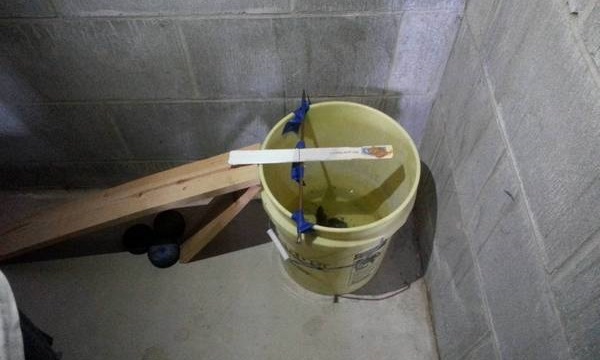
This is what a homemade mouse trap might look like.
The mice, attracted by the smell, climb inside and are no longer able to climb back out along the slippery walls.
Details: Plastic Mouse Trap
In addition to artificial mousetraps, you can also use "natural" ones—that is, a cat, ferret, or dog. Predators are usually excellent at catching mice in your yard, especially if they aren't too lazy or spoiled.
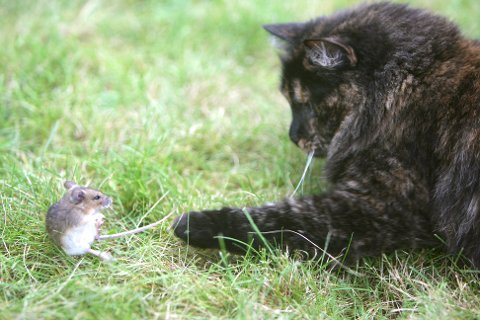
A trained cat can catch mice on your property.
As a last resort, you can “rent” a mouser cat from your neighbors for a couple of weeks.
As soon as we got the cat, the mice disappeared. She wasn't catching them then. Apparently, they just smelled the cat and ran away.
Mouse prevention
The best thing, however, is for the rodents to simply circle your property, searching for the best territory to settle in. How can you show mice they're not welcome? It's not that difficult.
- Herbs again. Plants that mice don't tolerate are good not only for control but also for prevention. Elderberry, arborvitaes, and castor oil plant bushes should be planted along the property's borders. Henbane, datura, black nightshade, and tobacco will not only decorate the garden but also protect it from pests. The flowerbed should still include aconite, foxglove, lily of the valley, calendula, and chamomile. And vegetable beds should be alternated with beds of onions, garlic, legumes, and herbs such as coriander and peppermint. Essential oils of these plants will also help.
You know, my grandmother used to do this: she'd drip peppermint oil wherever possible: on windowsills, in corners, baseboards, into questionable cracks in the baseboards and attic. The key is to do it generously—not just pour it, but drip it generously. But this only works for those who leave home for the winter and return in the spring to open the new dacha season. So, there are no mice after using this product <…> But the best part is when you first walk into your dacha in the spring after winter—the smell is simply amazing!!!
- Cleanliness and order. Garbage dumps, if necessary, should be located far from the home. The plot itself should be kept neat and tidy. Specifically, harvest crops on time, remove fallen fruit and leaves, weed, and discard the tops of harvested root vegetables. It is better to arrange compost heaps outside the site in specially fenced areas, or better yet, place the compost in a separate closed wooden box.
- The right mulch. As we already know, mice love sunflower oil, so don't use sunflower seed husks for mulching your garden beds. Wormwood leaves, tomato tops, and birch sawdust are much better choices.
- Predators. If you have a cat, let it roam the property—mice will smell the predator and be wary of entering your area. You can even sprinkle cat litter to deter rodents. It would also be a good idea to attract an owl to your property, especially a barn owl - they catch mice just as well as cats.
- Ultrasound. There are now a variety of so-called ultrasonic repellents available for various pests. Their effectiveness hasn't yet been scientifically proven, but many villagers and summer residents claim that these devices are effective in repelling mice from their plots. Therefore, if you have the extra money, it might be worth giving them a try.
Review: Electrokot Ultrasonic Mouse and Rat Repeller – It Really Works! <…> I saw an ad for a portable ultrasonic repeller and decided to buy one. The results exceeded my expectations – within a couple of weeks, the rodents were gone. Most importantly, this device is convenient, compact, and requires little power. Overall, it's very easy to use and truly deserves the title of innovation. It can be used anywhere, as it's also waterproof. If you're having trouble with rodents, I recommend purchasing an ultrasonic repeller.
- Proper storage. Harvested produce must be removed from the dacha in a timely manner. Before storing fruits and vegetables, carefully sort them to ensure no rotten fruit gets into the bag—the smell of rot can also attract rodents. It's best not to leave produce at the dacha over the winter, but if you can't transport it, be sure to pack everything in airtight glass containers.
Although mice may seem like harmless, furry creatures, don't let their cute appearance fool you. These rodents are truly dangerous to humans and must be controlled—or, better yet, preventative measures taken. Only then can you truly consider your garden and vegetable patches healthy and safe.

 Svetlana
1 comment