Little kittens, like children, require special attention. However, kittens left without a mother cat are so helpless that without human support, they will likely die. In this case, the responsibility for saving the little animal falls to a caring person willing to take on this responsibility. In our article, we'll explain how to feed an orphaned kitten.
Is it possible to "convince" a nursing cat to accept a stranger's kitten?
Unlike human relationships, which are more emotionally driven, relationships with animals are much simpler. Therefore, a mother cat who has recently given birth is more likely to accept an orphaned kitten. This is due to the cat's highly developed maternal instinct. The younger the kittens, the easier it will be for them to bond with their new mother. Animals should be placed near the mother and rubbed with the bedding the mother cat once occupied. A cat that has not given birth or has not had kittens is more difficult to accept foster kittens, but a positive outcome is also possible.
How to feed an abandoned kitten yourself
Raising an abandoned kitten yourself is not difficult if you prepare for the process and anticipate all potential challenges. To ensure the kitten survives and grows up healthy, three key points must be followed:
- Organize a "nest" or a permanent place for the kittens to sleep. A spacious box lined with a clean baby blanket is suitable. The nest must provide warmth for the kittens, so cover it with a woolen blanket. It is also recommended to use small heating pads or a heater to provide an additional source of constant heat. This will help ensure a comfortable temperature for the kittens, whose body temperature is 38°C.
- Hygiene of the kittens' habitat. The kittens' fragile bodies are susceptible to all sorts of illnesses, so keeping the "nest" clean is a top priority. A regular plastic basin is recommended over a box, as it doesn't absorb odors and is more hygienic than a box. It's also important to provide a sufficient supply of cloth diapers to ensure the nest is always clean.
- Proper feeding. This point requires further consideration.
How to make a formula that will replace mother's milk for cats
Even the most nutritious and high-quality formula cannot replace mother's milk for kittens, so before preparing formula for feeding, it's best to try to find a new "mother" for the kittens. If this is not possible, the following formula recipes are recommended:
| Prescription number | Ingredients | Cooking procedure |
| 1 |
| Bring the milk to a boil and mix with the remaining ingredients. Strain the mixture and cool. |
| 2 |
| Mix the ingredients. |
| 3 |
| Beat the ingredients in a 4:1 ratio. This recipe is only suitable for kittens aged two months and older. |
| 4 |
| Bring half the milk to a boil and cool. Add the remaining milk and the remaining ingredients. |
| 5 |
| Mix the ingredients until smooth. |
| 6 |
| Dilute the ingredients in a 1:2 ratio. |
| 7 |
| Mix the ingredients (the recipe is recommended for feeding weak kittens). |
The temperature of the mixture should be within 35-36˚C, which can be easily checked with a thermometer.
What can you feed a kitten with?
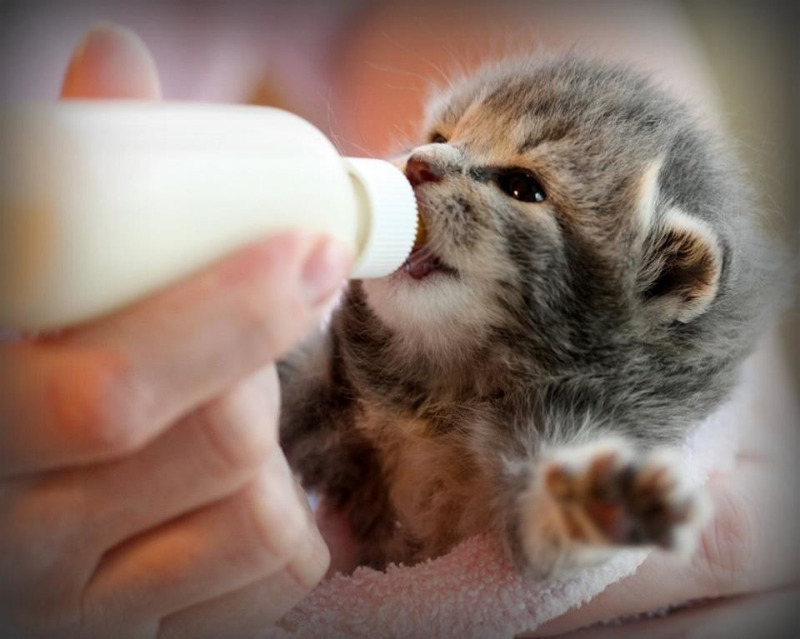
The modern pet supply industry offers a variety of special bottles for self-feeding kittens. These bottles can be replaced with a regular syringe without a needle. It's important to sterilize any bottle, syringe, or other container before each feeding. This will help prevent dangerous illnesses in your kitten.
Sterilization of feeding containers can be done in the following ways:
- in a steam bath;
- in the microwave;
- in a special sterilizer.
How to properly hold a kitten while feeding
Proper positioning of a kitten's body during bottle feeding will help to approximate natural litter as closely as possible and prevent the risk of choking. Be sure to position the kitten so that it lies horizontally on its tummy, with its head slightly elevated. Before feeding, it's recommended to reward it with gentle strokes on its forehead or back.
How much food does a kitten need and how to tell when it's full?
When feeding a kitten, it's important to recognize when the kitten is full and when it's still hungry. A kitten that doesn't seek a nipple or bottle is already full. However, a kitten that completely refuses to eat should be a warning sign and warrant an urgent visit to the veterinarian.
The amount of food a small kitten needs depends directly on the baby's age and weight:
| Age of the kitten | Volume of mixture per 100 g of animal weight |
| 1 week | 30 ml |
| 2 weeks | 35 ml |
| 3 weeks | 40 ml |
| 4 weeks and older | 48-53 ml |
After feeding the kitten, it is recommended to carefully place it on its back and gently massage its tummy until it burps.
How often should kittens of different ages be fed?
To ensure that the kitten gains weight and does not become weak, it is necessary to feed the baby at equal intervals during the day and night.
| Age of the kitten | Frequency of feeding |
| up to 2 weeks | Once every 2-3 hours |
| 3-4 weeks | Once every 3-4 hours |
| from 4 weeks | Once every 6 hours |
Feeding an orphaned kitten is within the capabilities of anyone willing to take on the responsibility of a new little life. This process, if followed correctly, usually doesn't present any significant problems.