 Small dogs love to be carried by their owners. But constantly being carried, even if the dog weighs 1.5 kg, can be very tiring and uncomfortable. That's why a carrier is essential, as it solves a number of problems when transporting your beloved pet.
Of course, not all small dog breeds require such an accessory. For example, pugs, cocker spaniels, and Jack Russell terriers only need a carrier for public transportation. A carrier is needed for breeds that enjoy being held, are fearful of people, vehicles, and other animals, and are sensitive to stress.
Recently, dog bags have entered the market, as a fashion attribute, and many have begun using them for decorative purposes. But if a bag is thoughtfully designed, it can serve several functions at once.
Basic functions of a small dog carrier
 A trip to the hospital is the best reason to have this accessory in the house, even if the owner does not plan to use it constantly.
- Companionship - if the dog is always with its owner, then sitting in a bag, it will not cause any trouble to anyone.
- For a dog, "ustavaki" means that it runs for a walk, but when it comes back, it must be placed in a carrier.
- Show - a combed, well-groomed dog feels more comfortable in a bag, as here it can remain in a shiny appearance.
- A weak nervous system is when a dog immediately jumps into someone's arms or runs away when it sees another dog or a small child. In this case, it should be kept in a carrier and only let out when needed.
- Travel - on a bus or plane, it is better for a dog to be in a bag (with a muzzle on) than to be placed in the luggage compartment.
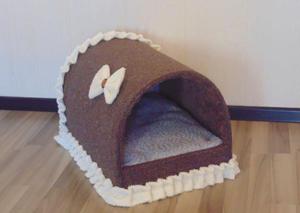
- Sleeping area - house-shaped carriers can be used for sleeping
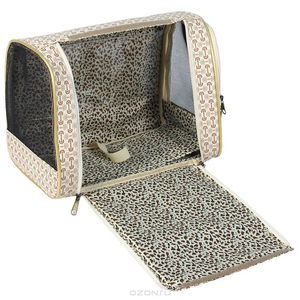 A trip to the hospital is the best reason to have this accessory in the house, even if the owner does not plan to use it constantly.
Dogs (like people) are prone to phobias. And it's not uncommon for them to be afraid of enclosed spaces. Before buying or sewing a bag, you should ask your pet put in a regular bagIf the dog shows anxiety, whines, or howls, you should either give up the carrier or begin the process of getting used to it.
How to sew a baby carrier yourself?
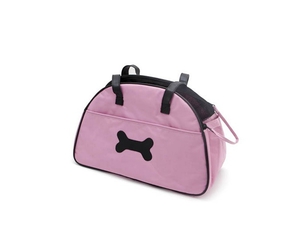 Stores offer a wide selection of dog accessories, from small boots to carriers. Choosing the right carrier can be challenging: the carrier needs to be the perfect size for your pet. So, it's best to sew one yourself.
To do this you will need:
- textile;
- cardboard;
- threads;
- scissors;
- needle;
- sewing machine.
How to sew?
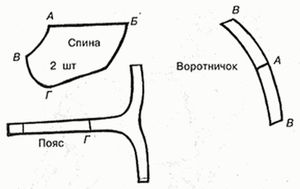
- First, you need to take your pet's measurements—the chest height (from the muzzle to the base of the paws), then the length from the neck to the tail. When creating a pattern, the first measurement is designated by the letter B, the second by D.
- Create a pattern on paper: draw a rectangle. To determine the long side, multiply the B value by 2, and the L x 2, then add the resulting numbers. Add 20 cm to the result. The short side should correspond to the length from the neck to the tail.
- Place the rectangle with the long side facing you, and divide the shape in half vertically. The right and left sides of the rectangle will form the sides of the carrier.
- To create a hole for the dog's head, measure a distance marked with the letter B from the bottom of the rectangle along a vertical line. Then, measure half the length of B to the left and right of the vertical line along the top of the rectangle. Draw an oval line along these three lines, which will serve as a notch for the head.
- The bottom of the bag is a rectangle with equal sides - the large side (L + 10 cm), the small side (B + 5 cm).
- Transfer all the patterns onto fabric. It's best to choose a waterproof material for the outside of the carrier to protect it from rain. The inside fabric should be very durable to prevent the dog from tearing it with its claws. If desired, you can insulate the bag by making side panels out of foam. The bottom can be reinforced with stiff cardboard.
- Assemble all the bag components, machine-stitch the handles (they should be sturdy enough), and attach them to the inside of the side panel. Sew the zipper on top. Place the outer bag and lining facing each other, then place the foam padding on top. Stitch around the perimeter of the bag, leaving a small opening for easy turning. Then, blind-stitch this opening.
- Connect the sides and sew the bottom to the top.
Types of dog bags
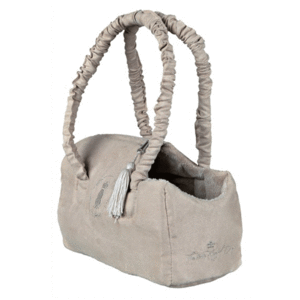 All bags vary in size, and there's a wide selection for small dog breeds. For fashionistas, there are stylish models featuring the logo of a renowned brand, straps, rhinestones, and other details.
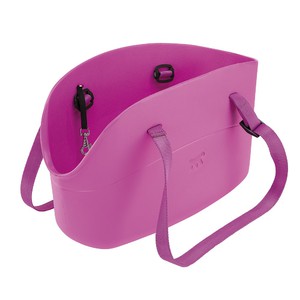
Shoulder bag — The most standard carrier with an opening for the pet's head. When carried, the dog is carried under the arm, as this bag has short straps and closes with a zipper. This carrier isn't very comfortable for dogs; they can't roll over, change position, or breathe freely, as they're constantly in a prone position. A more convenient option is a beach-style bag.
Box bag It is made with or without a frame, its walls are made of light transparent fabric so that the dog can observe everything that is happening around it and can breathe fresh air.
Sling bag For timid dogs who constantly seek protection from their owners. The pet is always secure at chest level. The product is very convenient, as it keeps your hands free and distributes the load evenly across the spine.
Backpack bag. Backpacks come in open and closed varieties. Open ones have openings for the paws and head, while closed ones only allow for a sitting position. A sling is more comfortable for a dog, as it can lie down, while a backpack is more comfortable for the owner, as the two straps distribute the weight evenly. A backpack is uncomfortable for dogs, as they are naturally active creatures and shouldn't hang or sit in one position for hours.
Most importantly, every owner should know that they shouldn't borrow another dog's carrier "just to try it out." Even a washed carrier will smell like another dog. If it was bought used or given as a gift, wash it several times and dry it in the sun, treat it with antiparasitic medication, put your dog's favorite toys in it, or rub it with a clump of their fur. Never use perfume—it will frighten your pet.