 Unfortunately, our four-legged friends have a shorter lifespan than humans. Why is this? Many dog owners are accustomed to comparing their pet's age to their own using standard measures and the formula: the dog's age multiplied by seven. It's generally accepted that dogs age in 12 months, just as humans age in seven years. Is this true?
Simple doesn't mean right
This approach to calculating a dog's age is considered simplistic, but in fact it's incorrect. If a child under two years old can do practically nothing, then a dog at this age is completely independent, can perform guard, hunting, or herding functions. No matter how hard a person tries, they will reach this level of development at 15 or 16 years of age, at best.
This is explained by the fact that developmental processes in humans and dogs occur at different rates and at different times. But this doesn't mean any stage can be skipped. Both will go through adolescence, maturity, and old age. Therefore, comparing the years lived is entirely appropriate. However, the relationship will not be linear. It is a more complex quantity.
Plus, to bring out the most accurate age matching coefficient between a dog and a human, you also need to consider the dog's breed. Larger dogs develop much faster than smaller ones. A German Shepherd or Labrador will have a shorter lifespan than smaller dogs like Pekingese and Yorkies. Even larger dogs, such as Alabai and St. Bernards, have very short lifespans.
Periods of life
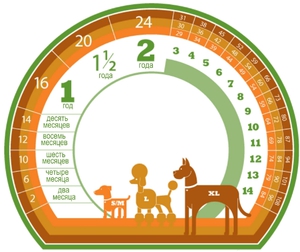
Puppies develop extremely quickly. A month of a dog's life is equivalent to several human years. Until they reach one year of age, dogs experience accelerated physical development. At two years of age, animals show almost no physical development, but they are actively developing mentally. At two years old, a dog can be compared to a mature human of approximately 25–30 years of age.
Then, When a dog reaches 3 years of age, development begins to slow down.Only then can a dog year be equated to seven human years. To give a clearer idea of a dog's age in human years, let's use a table as an example:
| Dog | Human | Coefficient |
| 3 months | 21 months | 7.0 |
| 7 months | 5 years 10 months | 10.0 |
| 10 months | 10 years | 12.5 |
| 13 months | 15 years | 14.0 |
| 19 months | 21 years old | 13.3 |
| 24 months | 24 years old | 12.0 |
| 36 months | 30 years old | 10.0 |
| 48 months | 36 years old | 9.0 |
| 60 months | 40 years old | 8.0 |
| 72 months | 42 years old | 7.0 |
On average, dogs live to be 10, rarely 12–15.
Determining age
 For many people, their pets become part of the family. They are loved and cared for, and even have birthday parties for their four-legged friends. In such cases, age is never an issue; the owner knows the month, and sometimes even the hour, of their pet's birth.
But sometimes a dog is adopted from a shelter or a puppy is found on the street. How old is he? The accuracy of age calculation in such cases is low, but it's possible to at least get an approximate lifespan estimate for your new friend. Of course, you can avoid the hassle and simply take your pet to a veterinarian, who can help you with this issue. But it's also entirely possible to do it yourself.
Examination of the jaw
- The first clue to determining a dog's age is its teeth.
- All teeth are replaced by seven months.
- If they are still white and clean, then the animal is no more than 12 months old.
- If the teeth are slightly yellow, it is about 24 months.
- Dental plaque is present in individuals who have passed the three-year mark.
- Worn or broken teeth, or even the absence of teeth, indicate that the dog is already old.
Pay attention to the body
The second thing that won’t deceive you is the muscles.
- Well-developed, toned muscles indicate activity, indicating a young, energetic individual.
- With age, activity declines, and muscles become much less palpable. Older dogs move very little, so they accumulate fat.
 A person's age can be determined by the condition and color of their hair; the condition of dogs' fur can also tell a lot. And they also have gray hair.After maturity, the active pigment that colors the coat is lost. Clean, soft, and shiny coats are found exclusively in young dogs. As they age, the coat becomes coarser and begins to shine. At 8–9 years of age, dogs begin to turn gray, starting from the muzzle.
Face to face
A dog's age can be easily determined by its eyes. Bright, clear eyes are typical of young dogs. After about five years, the sparkle fades and the eyes become dull.
A loving owner simply must know how to measure their pet's age. A dog may seem young by human standards, but now you know that in dogs, age is determined differentlyYou need to take this seriously, because the dog's food, daily routine, and exercise should be adjusted according to their age. Love your pets and take care of them. Believe me, they will never be indebted. They will be devoted to you like no other and will be ready to give their lives for you.