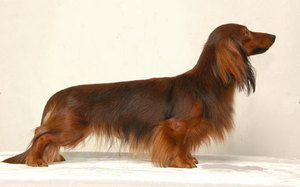
With the onset of winter, it's not just humans who need to put on warm clothes. Pets also need winter attire, which can be purchased at specialty stores. But homemade dachshund clothing looks much more original. Patterns for warm blankets or overalls are easy to draw on regular graph paper, and old coats or fur coats can be used for sewing.
Content
How to sew clothes for a dachshund yourself: patterns
The first step in creating fashionable and warm dachshund clothing is taking your dog's measurements. In principle, you can use a ready-made pattern, as similar breeds are fairly standard. However, for best results, it's best to take measurements from a specific individual.
To take measurements correctly, the dog must be standing on a flat surface. If the dachshund is not very calm, it is better to place it on the table - this way the animal will not spin around and interfere with the measurements.
To take measurements, you'll need a regular measuring tape and a piece of paper to write them down. Making a dog clothing pattern requires the following measurements:
- DL (length of back) - the distance from the base of the neck (withers) to the beginning of the tail;
- OG (chest circumference) - measured at the widest point of the chest, just under the front legs;
- Neck circumference (NC) - you can record this measurement based on the volume of your everyday collar;
- OT (waist circumference) - measured at the narrowest point in the lower abdomen;
- DL (length of paws) - the front and back paws are measured from the base to the beginning of the pastern.
All girth measurements are recorded in half size.
If you plan to sew clothes for a dachshund with a hood or hat, then the circumference of the head and the distance between the ears are additionally measured.
The pattern should be drawn on graph paper, using a square with sides equal to 5 cm as a basis. Accordingly, we draw the pattern based on the measurements taken for our dog.
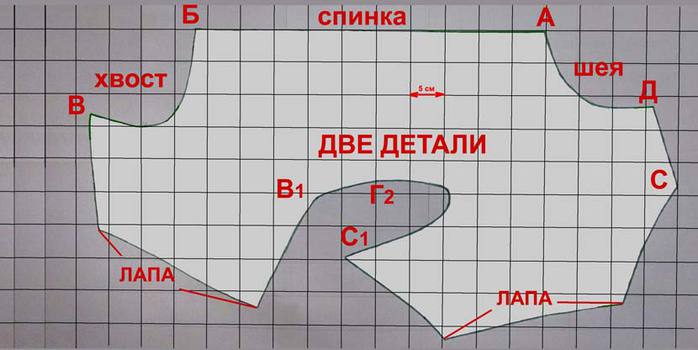
To make the pattern more accurate in calculations, it must be done on graph paper.
Additionally, we draw a sketch of the dog's belly. For females, the distance G-D should be longer.
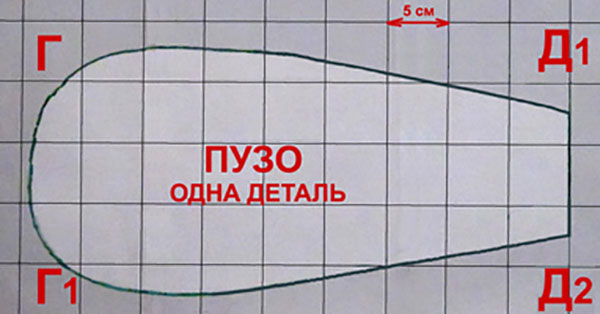
It is worth noting that the G-D distance differs in males and females.
We cut out three pieces using the patterns provided, allowing 3–4 cm on all edges. This will ensure that the finished garment fits the dog loosely.
To sew the jumpsuit you will need:
- a piece of water-repellent fabric - raincoat fabric, bologna, microfiber;
- insulated lining fabric or fur for lining;
- Velcro tape.
The demi-season model is sewn without lining - just cut out the details on the main fabric. You can combine materials with different textures and colors.
If you're sewing a jumpsuit for the first time, it's best to lay out the pattern on a piece of old sheet and cut out a rough draft. After joining all the seams (except the back), try the garment on your dog and make any necessary adjustments.
After this, you can begin sewing the overalls from the main fabric. The pieces are joined with the right sides facing inward, then turned inside out. The center of the garment is finished, and Velcro is sewn along the edges. It's a good idea to sew a hook near the neck for fastening. A loose elastic band should be inserted into the cuffs of the feet.
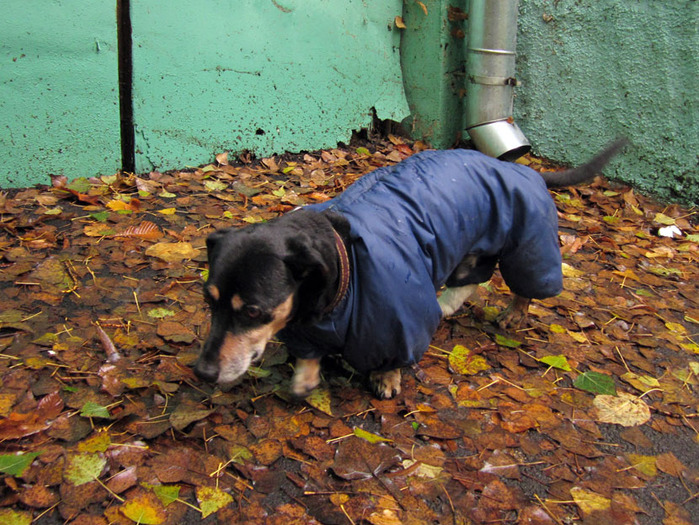
For one product, you can make a lining that can be removed in warm weather.
A dog can run around in this jumpsuit all winter long—the pet will be kept warm inside by a warm lining, and the raincoat will protect it from snow and rain. For damp autumn weather, you can use a sheer oilcloth fabric, and your dog will look great in a raincoat. A lining is not needed in this case, but the hat will have to be sewn separately.
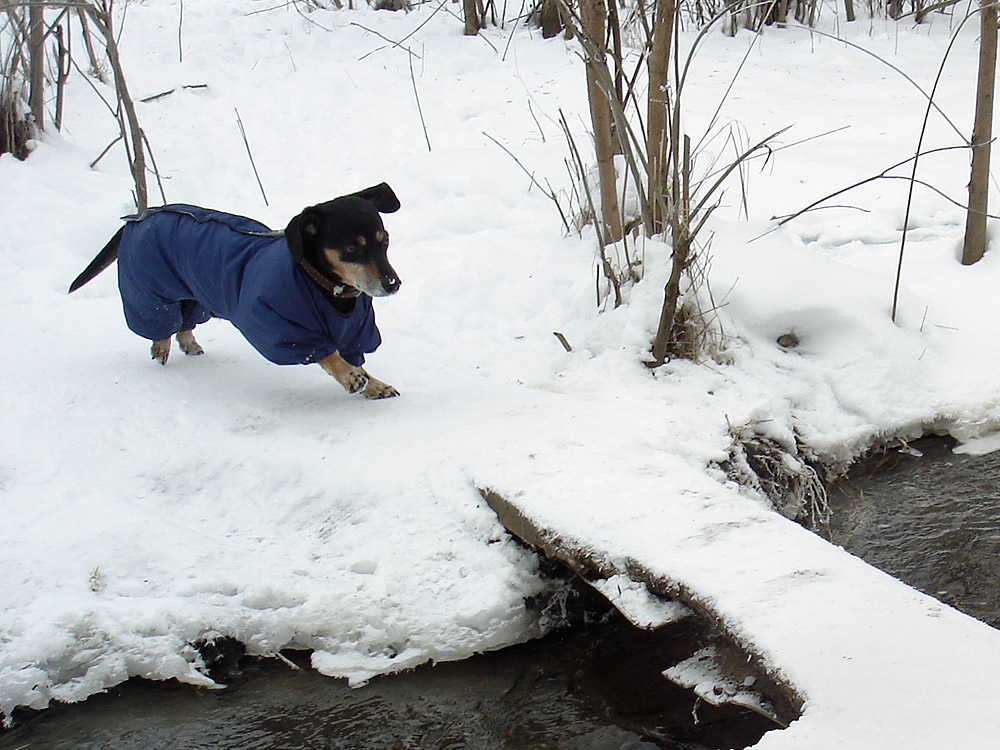
It is better to make a jumpsuit for a pet from raincoat material, which will protect it from moisture.
For mild winters or late fall, you can dress your dachshund in a blanket. It takes two to three hours to make, and it will keep your dog comfortable in cool, damp weather.
The simplest blanket, which even the most inexperienced dog owner can make, is sewn on the basis of a triangle.
How to sew a blanket:
- On a sheet of paper, mark the starting point A, from which set aside a distance equal to the measurement DS (the length from the collar to the base of the tail) and put point B.
- Measure half the waist circumference on either side and mark points C1 and C2. The resulting triangle AC1C2 is the blanket.
- At the top A, cut out a semicircle equal to half the neck circumference - this will be the hole for the tail.
- Place the drawn paper triangle on a warm fabric and cut out the blanket.
- Process the hole for the tail, fold the sides and hem.
- Now you can dress your dachshund in a brand new blanket. Place the fabric on the dog's back, thread the tail through the opening, pull the loose ends under the chest, and secure them to the back. The long ends can be simply tied or sewn on a pretty decorative button.
More advanced dog owners can sew a blanket using a pattern, complete with a collar and belt.
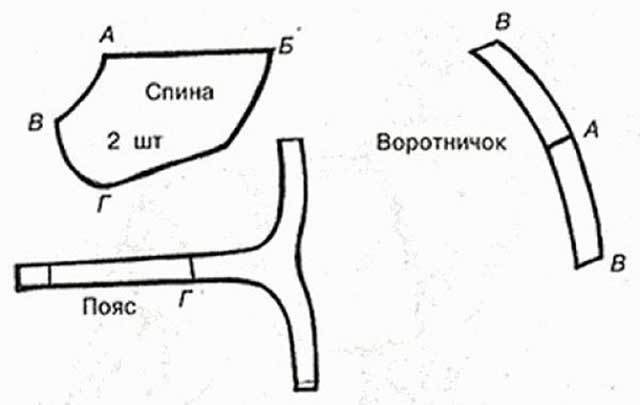
A blanket with a collar will protect the dachshund's respiratory system from the cold.
Knitted version
If a dachshund's owner is more comfortable with knitting needles or a crochet hook than with a sewing machine, then it will be quite easy for her to knit warm knitted clothes for her pet.
The simplest option is to make a cape in the shape of a triangle or rectangle. The long side should be equal to the back measurement (DL), and the short side should be equal to the chest measurement (CG).
The cape can be knitted in different patterns - for warmth, it is better to use vertical "braids", a lighter version can be made with openwork.
To secure the cape, use beautiful buttons, Velcro, and ties.
A beautiful and original sweater for a dachshund can be knitted using a special pattern.
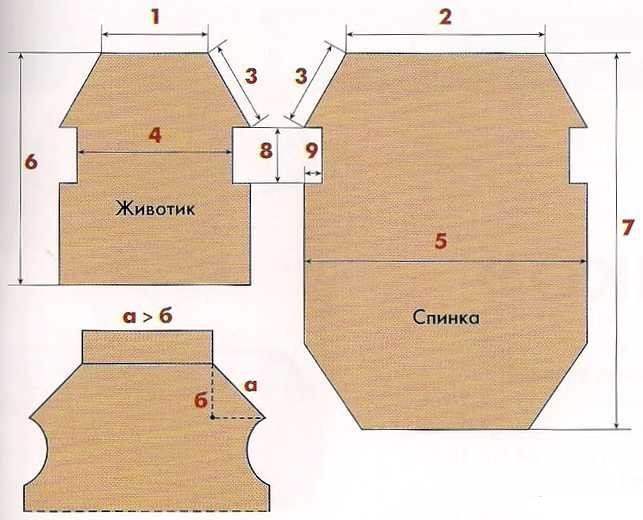
It should be taken into account that the length of the abdomen of females is usually several centimeters longer than that of males.
Here you need to take a piece of paper with your measurements and draw a diagram of your future warm sweater on graph paper:
- number 1 – 1/3 of the neck circumference measurement;
- 2 on the back - 2/3 of the neck circumference;
- 3 - chest length from collar to front paw;
- 4 - width of chest between legs;
- 5 - back width;
- 6 — length of the abdomen (in males it is made shorter by 4–5 cm);
- 7 - back length;
- 8 - fixed size 6 cm (armhole height);
- 9 – 3 cm.
Knitting a sweater always begins with the ribbing on the back. For a better fit, make it 4-5 cm wide. After that, you can let your imagination run wild and create any pattern you like. Once all the pieces of the future sweater are knitted, they are sewn together. At the neckline, stitches are picked up on circular knitting needles and a collar is knitted 7-10 cm high. It's best to crochet the armholes.
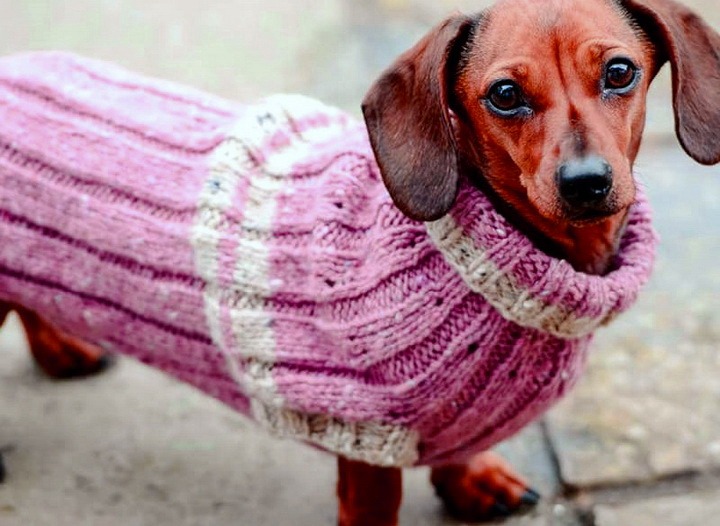
For seamless knitting, use the raglan sweater pattern.
When making clothes for a dachshund yourself, you should keep in mind the characteristics of this breed:
- Dachshunds are prone to respiratory problems, so when making their clothing, it's important to include a high collar. If your dog frequently wears a blanket or vest outside, you can add a knitted collar or a detachable collar.
- The skin under a dog's tail is extremely sensitive, so the opening for the tail shouldn't be too tight. A small opening can lead to irritation and inflammation.
- Due to the dachshund's elongated body, its clothing should be loose—on the back, it should extend from the neck to the tail, and on the sides, it should partially cover the paws. When using ready-made patterns, allow for additional allowances on the sides of the future garment.
A common option is to knit a dachshund sweater with a raglan pattern starting from the collar. First, calculate the knitting density and the number of stitches for the first row. After 10–12 cm of ribbing (the stand-up collar), begin the main knitting—divide the number of stitches into 4 parts and knit each separately. For the back, use short rows to prevent the finished garment from bunching up at the neck.
Raglan knitting is convenient because you can try the sweater on your dog at every step and add or subtract stitches as needed. Furthermore, the sweater's length is perfect for a dachshund, and the finished product won't require any sewing.
No sewing
Even if a dachshund's owner doesn't know how to sew or knit, that's no reason to leave her pet without fashionable clothes. Children's clothes, an old sweater, or a sock can all be used to create a unique outfit.
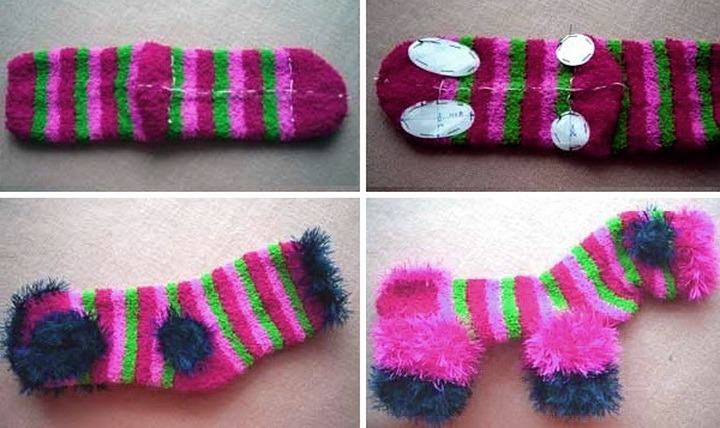
A terry sock or stocking is quite suitable for making warm clothes for a small dachshund.
Simply mark the puppy's paws and tail on the unfolded sock, poke holes, and cut off the heel—and you're halfway done. All that's left is to finish the edges and decorate the resulting sweater as desired.
The sleeve of a warm jumper can be used to make a wonderful outfit for a dachshund, which can be made in one or two hours. Cut off the sleeve, trimming off the excess based on the dog's length and 7-10 cm for the collar. The process is simple: cut out the paw holes, crochet them, and you're ready to dress your dog. For a winter version, sew on additional paw sleeves.
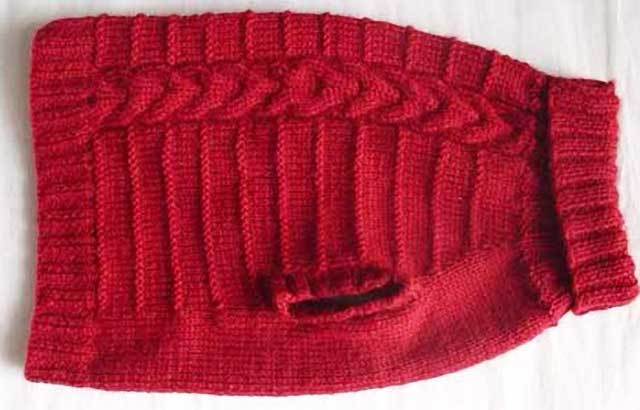
Knitted clothes for your little pet can be made from an old sweater, hat, or even a scarf.
If you pre-wash the sleeve several times in the washing machine at a hot temperature, it will shrink and resemble felted fabric. A sweater made from such a sleeve is suitable even for severe frosts.
Since dachshunds have a relatively short coat that is unable to protect them from the cold, clothing for them is not a mere luxury, but a necessary attribute of everyday life.
You can make a sweater from an old hat in a similar way—the main thing is that it's long enough for the dachshund. Just like before, cut out the holes for the paws and head. To prevent unraveling, the edges are finished—and that's it, a great vest. Now you can try on your dachshund's new outfit.
Warm outfits
For winter weather, you can sew a jumpsuit using the universal pattern above. If it's freezing outside, it's a good idea to add a detachable hood. This garment will keep your dachshund warm, and its tummy will stay clean even in slushy weather. This jumpsuit is considered universal—it should be worn from October to March.
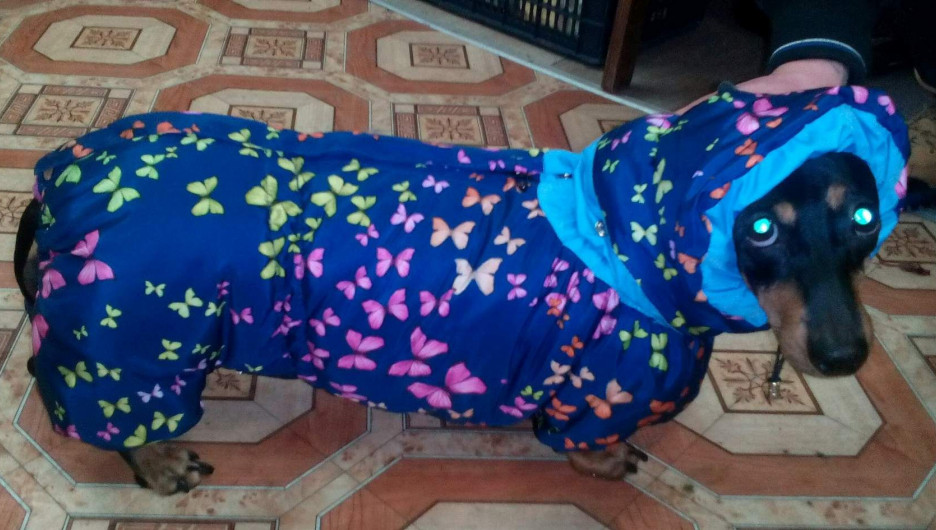
For walks in frosty or rainy weather, you can make an additional detachable hood that will protect from cold and moisture.
With basic sewing skills, you can even dress a dachshund in a mink coat—it'll be ready for any weather. It's best to fasten the coat at the tummy, using buttons with loops or a zipper. A product made from remnants of natural fur or an old fur coat will have to be sewn by hand - a sewing machine will not work here. The lining for such a warm vest is best made from knitwear or cotton fabric.
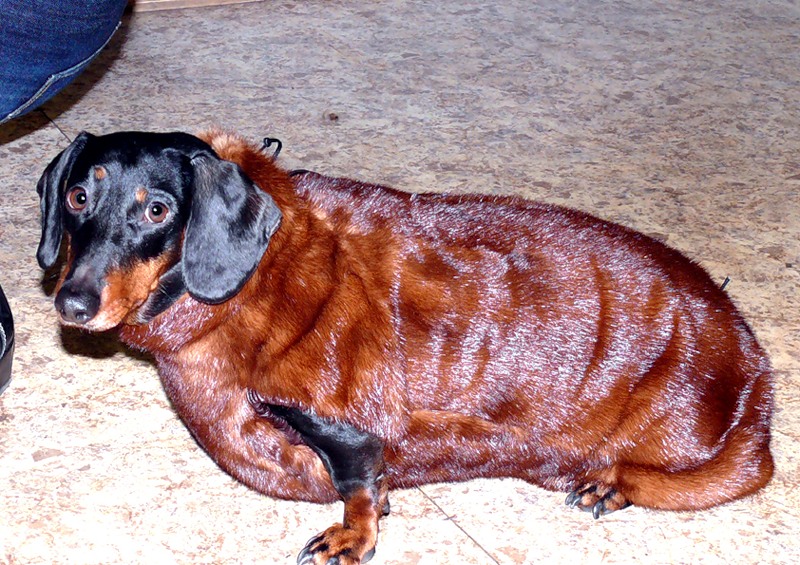
To prevent the fur product from slipping or falling off under its own weight, it is advisable to make the buttons on the belly side.
You can buy small scraps of faux fur at craft stores—you'll only need about a meter—and sew a real winter jumpsuit with a hood. Decorative ears will add an extra touch and highlight the dachshund's charm.
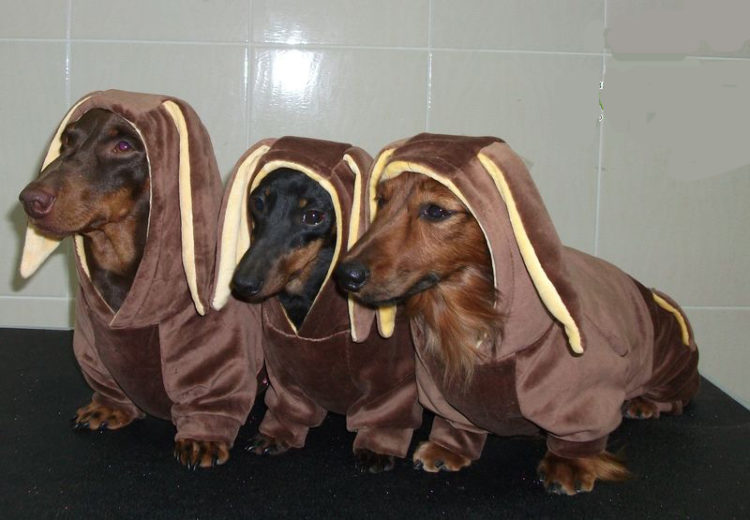
For each pet, you can come up with an interesting and unique design that will distinguish it on walks.
During the cold season, a dachshund's wardrobe should include at least two outfits so that there is always a change of clean clothes.
It is recommended to have a separate jumpsuit made of raincoat or microfiber for autumn and spring, which does not necessarily have to be lined.
The number of knitted winter items is limited only by the imagination and free time of the dachshund owner. A basic pattern can be used to make a multitude of sweaters and blankets, embellishing them to your liking. Girls will appreciate an abundance of bows and knitted ruffles, while boys can benefit from top hats and individually knitted suspenders.
For severe frosts, it's easy to knit boots for your dog—either use a crochet hook or sew a wool rectangle into a tube. Sew leather pieces to the soles to keep the paws dry.
In winter, your dog will need a hat. To make one, measure the circumference of your dachshund's head and begin knitting in the round. Use a crochet hook or circular knitting needles. Due to the unique structure of their head, their ears are a real sore spot. To prevent your dachshund from catching a cold, it's best to knit or sew him a helmet hat or a spacious sock hat. When casting on stitches, add 1–2 cm for ease of fit so that the dog’s ears fit freely inside the hat.
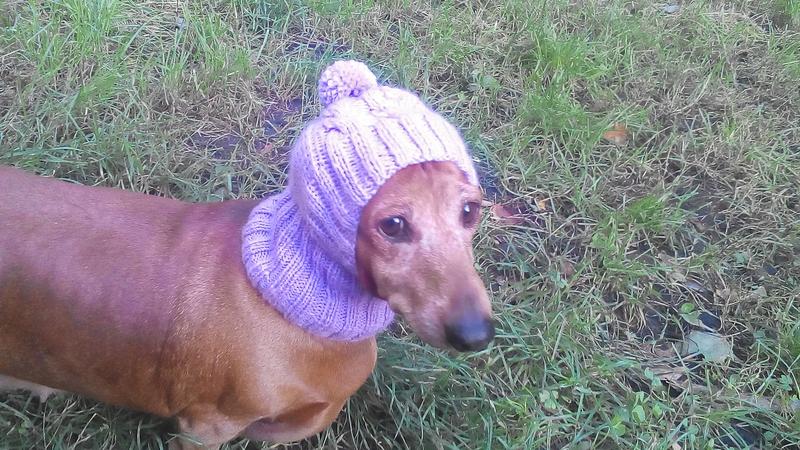
A knitted helmet or sock hat can also serve as a replacement for a hood on your pet's clothes.
When decorating a finished dog hat, follow the same principles as with small children: no small beads, rhinestones, sequins, or pearls. Brooches are also not recommended, as the dog could be injured by the sharp clasp. Otherwise, decorating a dog hat and making it unique is up to the owner's imagination.
Making your own dachshund clothes isn't particularly difficult or time-consuming. Of course, you can always buy a ready-made jumpsuit or order any outfit online. But sewing or knitting clothes for your pet is a true pleasure for its owner. What's more, you can create a costume unlike any other. A dog dressed in a handmade costume is a source of pride for its owner, both for their pet and for their handiwork.