 An illness in a four-legged friend is a very unpleasant experience for a dog owner. Pets can pick up an infection while out on walks, where ticks and various objects and organisms can be sources of infection. Contact with sick animals also leads to infections.
At the first sign of illness, it's essential to take your dog to the veterinarian. The doctor will examine the dog, take tests, and prescribe treatment in the form of pills or injections. To avoid taking your sick pet to the vet for daily injections, you can learn to administer the injections yourself. All you need to do is learn some simple rules, have courage, and be patient.
Types of injections and syringes
There are two ways to give an injection to a dog: intramuscularly and subcutaneouslyThe injection is administered with a sterile syringe, which is individually selected for each animal. For intramuscular injections, the syringe is selected based on the pet's size:
 For larger dogs, the medication is administered using syringes of 2 ml or larger. The needle length allows for easy access to muscle tissue. However, if 5 ml of medication is required, a needle from a smaller syringe can be used with a larger syringe.
- For small dogs, an insulin syringe is the preferred choice. However, it is only suitable if the dose does not exceed 1 ml. When treating small adult dogs, the needle from such a syringe can be inserted to its full depth. If the injection is given to a puppy, the injection depth must be monitored.
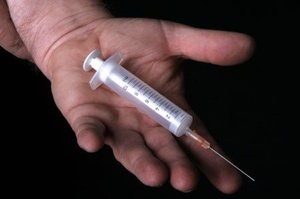 For larger dogs, the medication is administered using syringes of 2 ml or larger. The needle length allows for easy access to muscle tissue. However, if 5 ml of medication is required, a needle from a smaller syringe can be used with a larger syringe.
But when choosing a syringe, you should consider not only the size of your pet, but also drug flowabilitySome of them are oil-based, making it difficult to administer the medication through an insulin syringe needle. In this case, it is recommended to use a larger-diameter needle.
For subcutaneous injections administered into the dog's scruff, almost any syringe can be used. It all depends on the amount of medication being administered. Preference should only be given to small needle, since it will be inserted shallowly. For oily medications, needles from syringes with a capacity of 2-3 ml or larger are selected.
Intramuscular injections – video instructions
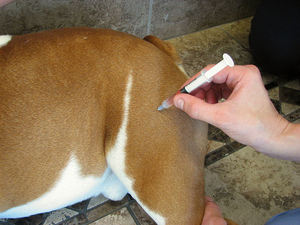 An intramuscular injection can be given to an animal in several places, but the safest area is the one that is to the right of the femur left paw and vice versa. The needle is inserted into the most massive part of the dog's thigh muscle.
It's easily palpated and feels like it's rolling under your fingers. Higher or lower, the muscle becomes firmer, tighter, and thinner. Injections in these areas are not recommended, as there's a risk of damage nerve fibers, joint or bone, and cause pain to the pet.
Preparing for injection
The syringe selected for an intramuscular injection must be filled correctly. To do this:
- Wash your hands with soap.
- Study the name of the drug on the ampoule to avoid accidentally injecting another medicine.
- Wipe the ampoule with an alcohol-containing solution.
- Use the special tool included with the medication to file down the thinnest part of the ampoule. Some medications come with a pre-notched neck, so simply breaking them off is sufficient.
- Remove the syringe from the packaging and draw up the medication so that your hands do not touch the needle.
- Raise the syringe with the needle up and flick it with your fingers to release the air bubbles.
- Remove air using a piston.
The medicine is ready and can now be administered to the chosen injection site on the dog's body.
Intramuscular injection technique
Since a dog's skin has a strong antibacterial layer, there's no need to apply alcohol-based solutions. The injection site should be relaxed, which can be done by bending the animal's paw or massaging it.
If your pet is very active or overexcited, then to avoid injury during the injection It is recommended to fix itIn this case, you can invite an assistant.
Technique of introduction:
- the injection into the muscle is made at a right angle;
- the needle is inserted to 2/3 of its length;
- carefully press the plunger and slowly inject the drug;
- we pull out the needle;
- To relieve pain and improve distribution of the medication, we massage the injection site.
During the injection, it is recommended to use the needle hold it at the base with your fingerThis is necessary in case of unforeseen situations. The appearance of blood indicates damage to the vessel, so the needle should be pulled out, the blood should be wiped away with a cotton swab soaked in alcohol, and the injection site should be changed. If you hit bone during the injection, the needle should be pulled back slightly.
You can watch the video for a more visual and detailed description of the intramuscular injection technique for a dog.
Subcutaneous injection
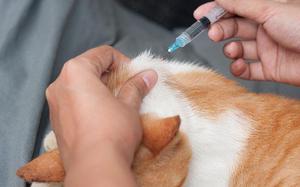 If a subcutaneous injection is required, the optimal area is the dog's withers. Active muscle activity and loose skin in this area will allow the medication to be quickly absorbed.
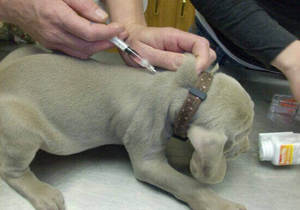
When giving an injection, the skin in the withers area must be lifted and insert the needle under the collected skin at an angle of 45 degrees relative to the pet's body.
After the injection, the needle is pulled out and the injection site is replaced cotton wool is appliedTo prevent a lump from forming, it is recommended to massage the injection site.
If a lump does form on your dog's withers, there's no need to worry. It should resolve on its own within one to two weeks. However, larger lumps often bother your pet and resolve very slowly.
To help your dog, you need to do it every day. give a massage injection site. This is painless for the animal, so there's no need to be afraid. However, don't apply too much pressure to the lump. Within just a few days, the lump will begin to dissolve and soon disappear completely.
Helpful tips from veterinarians
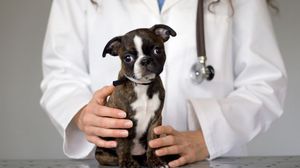 Before the procedure, it's recommended to feed the dog and give it a good walk. The animal should be in a sleepy state, which is considered the best time to receive the injection.
However, some medications need to be administered at a specific time, such as before meals. In this case, it's best to:
- Invite an assistant familiar to your pet. While you prepare the medication and syringe, they should lull your pet into a false sense of security by stroking its belly, chest, and behind the ear.
- With some dogs, you have to take safety measures by putting a muzzle on them or tying a belt or bandage around their muzzle.
If you need more than one injection, select a new site for each injection, leaving a 4 to 8 mm distance from the previous one.
Do not mix multiple medications in the same syringe. Some are chemically incompatible. Administering these medications together may cause toxicity or local irritation. If your doctor has authorized mixing medications, and the mixture changes color or forms a precipitate while drawing them up, do not administer the injection.
After the injection, the animal may become restless. However, this is not due to the injection being administered in the wrong place, but rather to the irritant of the medication. Some medications are painful to administer, so they are mixed with non-irritating medications. Consult your doctor or refer to the instructions for compatibility information.
After administering irritating medications, your dog may tuck its paw in for a while. This is nothing to worry about. But if the paw drags, you've likely hit a nerve bundle and you'll need to... you need to see a doctor.
After reading the instructions and watching the video, you now know theoretically how to give intramuscular and subcutaneous injections to your dog. Now you can treat your pet yourself. Don't forget to reward your four-legged friend with a treat after the injection.