 Puppies, like any other animal, are helpless in their early stages of development. They require constant care and attention from their mother and breeder. That's why it's important to understand all the stages of puppy development and the basic rules for monitoring their health.
Puppies are often separated from their mothers too early, leaving many owners with questions about developmental milestones. When do their eyes open? How many weeks do puppies begin to hear? What's the best food to feed them? Knowing the answers to all these questions is essential to raising a strong and healthy dog.
Development of newborn puppies
It's worth noting that the development of each puppy is unique, even if they share the same mother. There are simply no strict timeframes for development.
After birth after 2-3 weeks the umbilical cord falls offHowever, to avoid infection, the puppy should be kept in a sterile and warm environment. This not only prevents illness but also helps develop healthy muscles and a healthy nervous system.
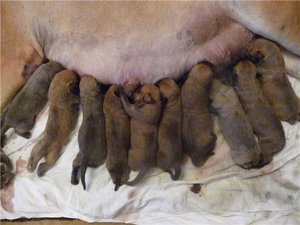
After 1-2 weeks, puppies show the first signs of movement. They are still moving slowly, but are already trying to move their limbs blindly and crawl. This period begins differently for each pet. Some may remain completely motionless, and then immediately begin to crawl confidently. When moving, young dogs navigate solely by smell, as their vision and hearing are not yet developed. On the 16th day, puppies begin to try to stand on their feet. No assistance is given. If a baby cannot stand on its paws, its muscles are not yet ready for such exertion. It is recommended only prepare a place, line the enclosureso that it is hard and non-slip.
By the third week, all babies should be able to stand on their feet and move around confidently. If their paws continue to slide apart, it's the flooring of the enclosure that's at fault. Simply lay down a drop cloth and secure it.
At 4 weeks of age, all puppies begin to explore the world. They play, begin to develop their character, and get to know people. At this stage of development, you can see what the dog will be like in the future. Playful pets grow up to be restless, energetic dogs. Quiet puppies become true family pets who easy to train, sit quietly and do not behave aggressively.
During these four weeks of growth, owners will have to deal with another challenge: teeth. Puppies teethe just like humans. Baby teeth emerge first, followed by permanent teeth. During teething, it's especially important to monitor your pet's health and behavior. To reduce the pressure on their gums, small toys are often purchased. Dogs use these to scratch their teeth and alleviate the discomfort.
Dogs begin to see at 12–15 days. In exceptional cases, puppies begin to see later, but this is not an indication of weakness or illness. Dogs begin to perceive their first sounds on the 14th–17th day., but they don't fully hear until after four weeks. Hearing problems are common, but they're difficult to detect early, especially if the puppies are all together. Hearing problems usually become apparent after moving to a new home.
Health
Responsible breeders should treat puppies with care and attention. Particular attention should be paid to their health. In the early stages of development, little pets they can get sick even from a breath of wind.
 The first step is to examine the puppies for congenital defects a few weeks after birth. It's best not to handle them after birth, as this can cause injury to their fragile bodies. If serious defects are detected, the puppies are usually euthanized.
- Tail docking should also be considered in some dog breeds. Tail docking can be performed at any age, but the older the dog, the more painful it is. Docking is typically performed between 2 and 4 days of age. Their tails are still weak and the puppies have no sensation. Tail docking is performed at home.
- Vaccinations for dogs begin at the age of 6–7 weeks, but individual cases should be taken into account.
- We must not forget about worms, which can often be contracted not only by puppies, but also by their mother.
 The first step is to examine the puppies for congenital defects a few weeks after birth. It's best not to handle them after birth, as this can cause injury to their fragile bodies. If serious defects are detected, the puppies are usually euthanized.
When do puppies open their eyes?
 Baby dogs are born absolutely helpless In the first days of their lives, they rely solely on their mother's help and their own sense of smell. Vision begins to develop 10-16 days after birth. They begin to open their eyes gradually or immediately. Typically, puppies gain full vision within 3-4 days, as soon as they open their eyes, but sometimes vision appears within a single day.
It's important to remember that each puppy's development is unique. Therefore, if some puppies are still unable to see, they should not be allowed to open their eyes on their own. Puppies typically begin to see by the 20th day after birth, and if this doesn't happen, you can be sure there's a problem, such as a congenital defect.
Open your eyes on your own only possible on the 18th day, but this must be done extremely carefully, using warm water. In some cases, vision returns, but the puppy's eyes become so stuck together that the pain prevents them from opening them.
If the owners or breeders open the baby's eyes themselves, there are a few rules to remember.
- Only one swab is used per eye.
- The water must be boiled and filtered.
- All equipment and rags must be sterile, and hands must be clean.
As soon as puppies develop full vision, you can immediately see them exploring the world around them. Socialization occurs. This is when puppies become accustomed to their surroundings, develop individual interests, and meet new people. It is at this stage that their character is formed.
A veterinarian should be consulted only after 21 days from birth or in cases where the eyes appear swollen and have red swellingAfter the eyes open, pay attention to their color. If they are bright blue or have a white haze, this is cause for concern.
Conclusion
 Caring for puppies is not only challenging but also a responsible task. Their early health determines their future development. Particular attention should be paid to vision and hearing, as these senses are essential for a dog to thrive. Advice from professional breeders can help monitor each stage of development after birth and address any issues immediately.