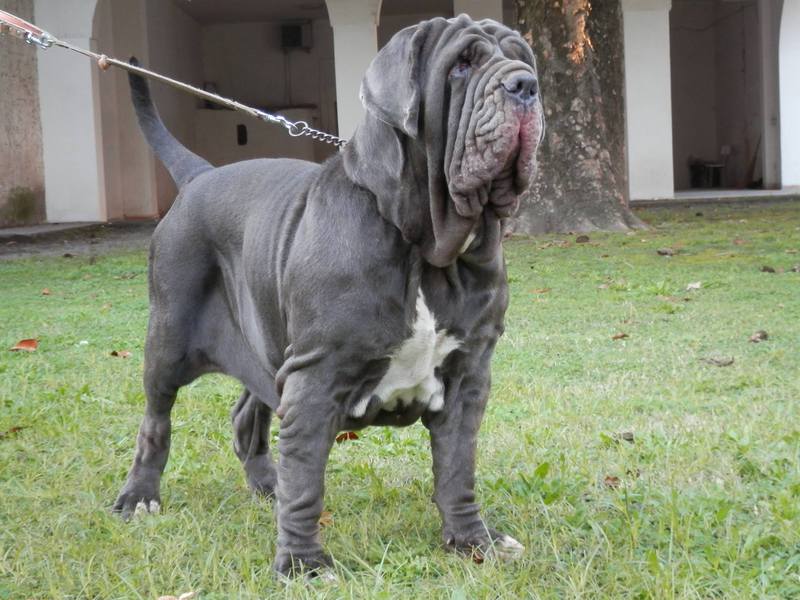
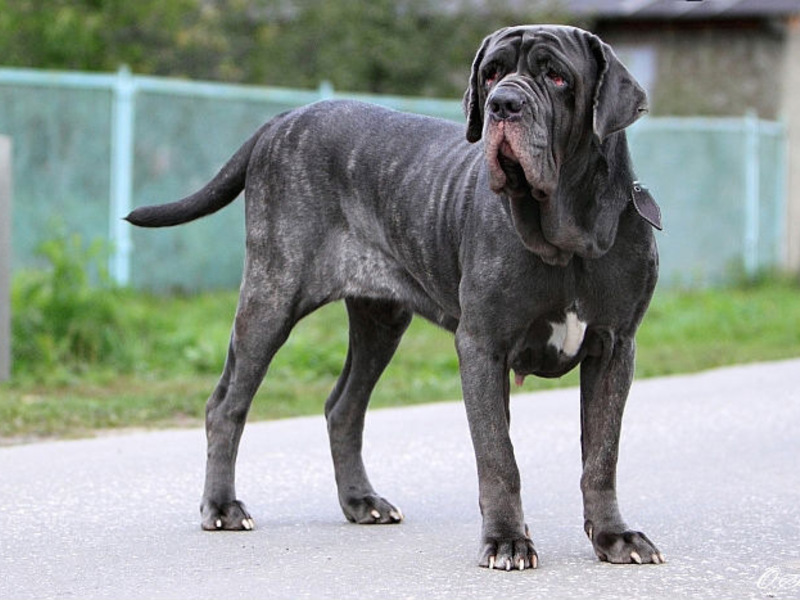
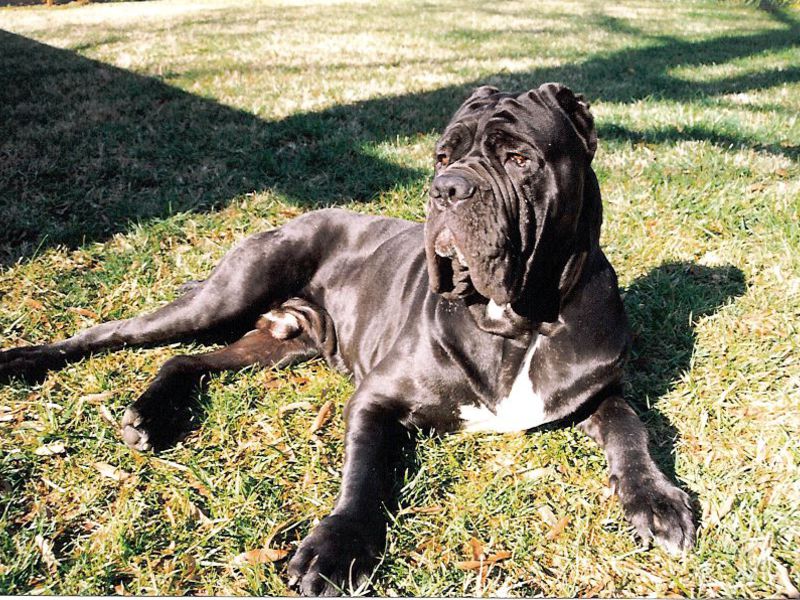
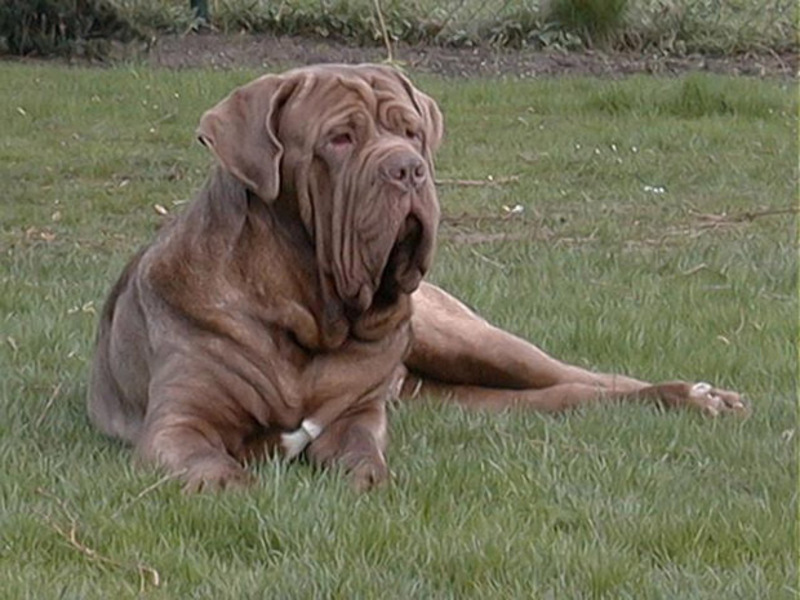
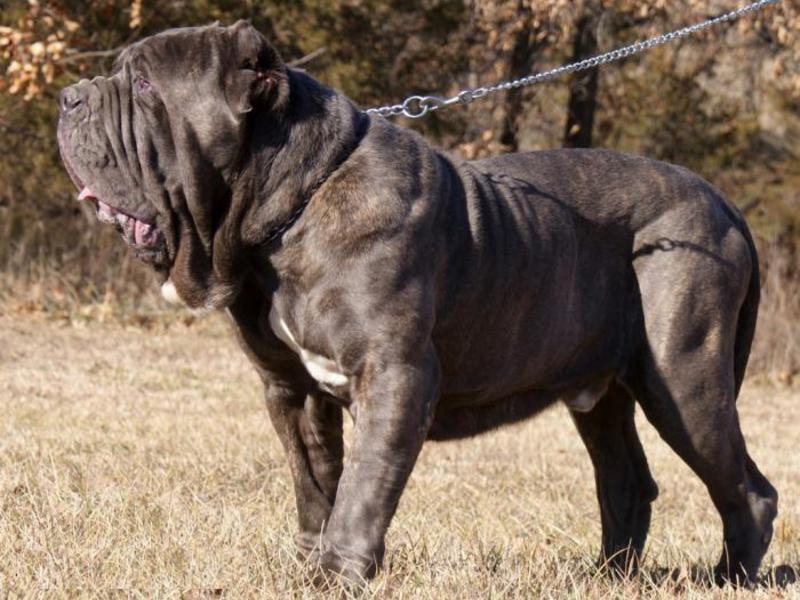
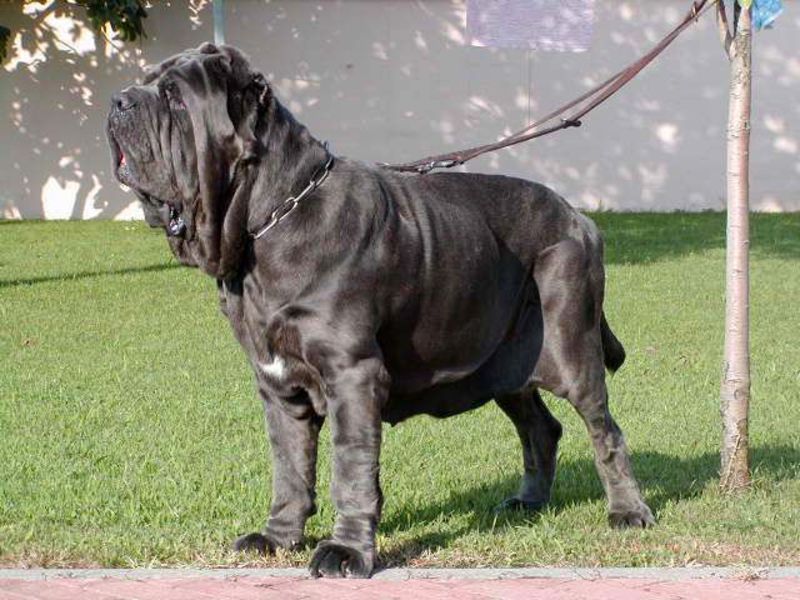
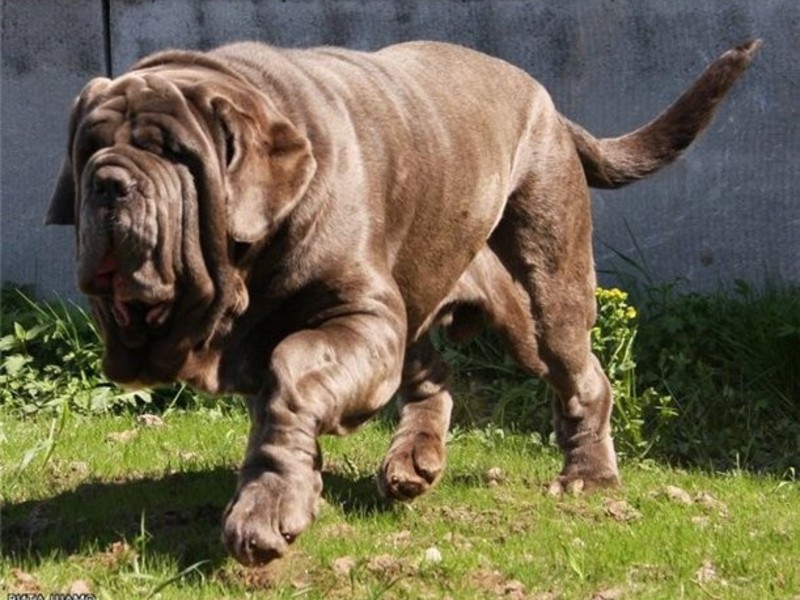
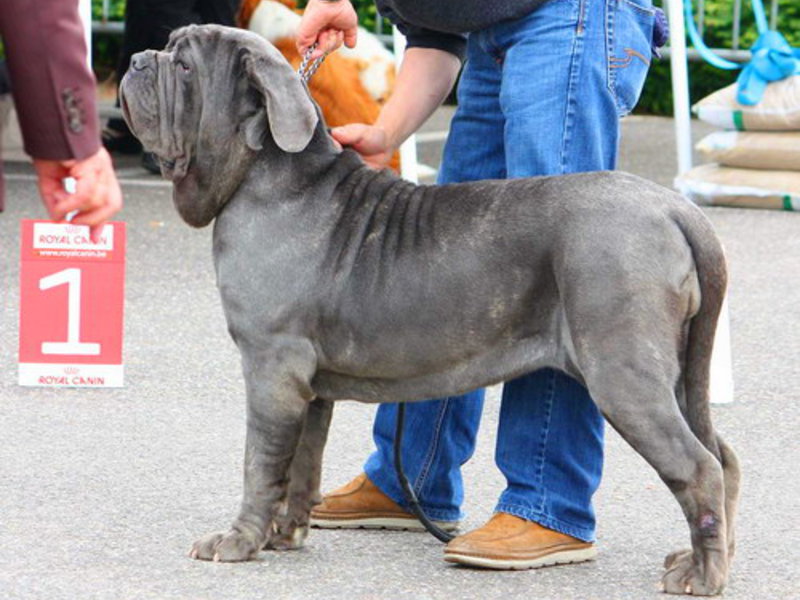
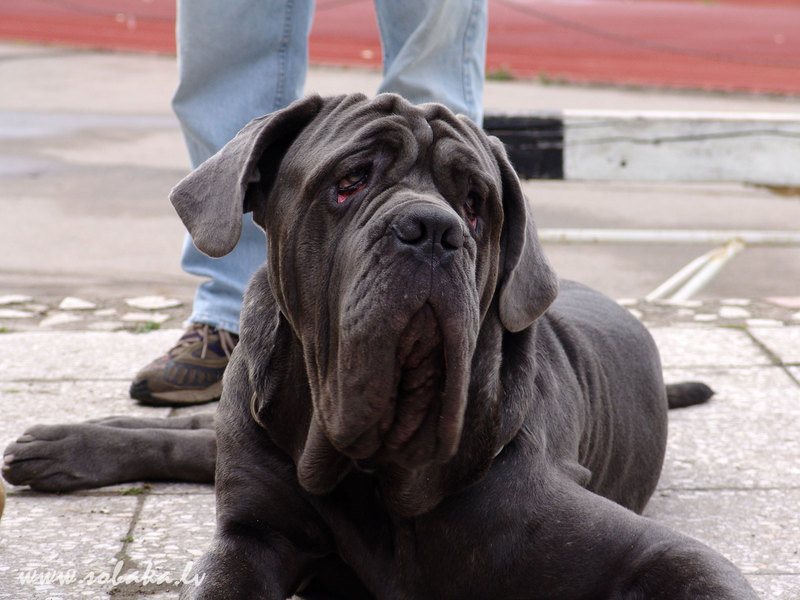
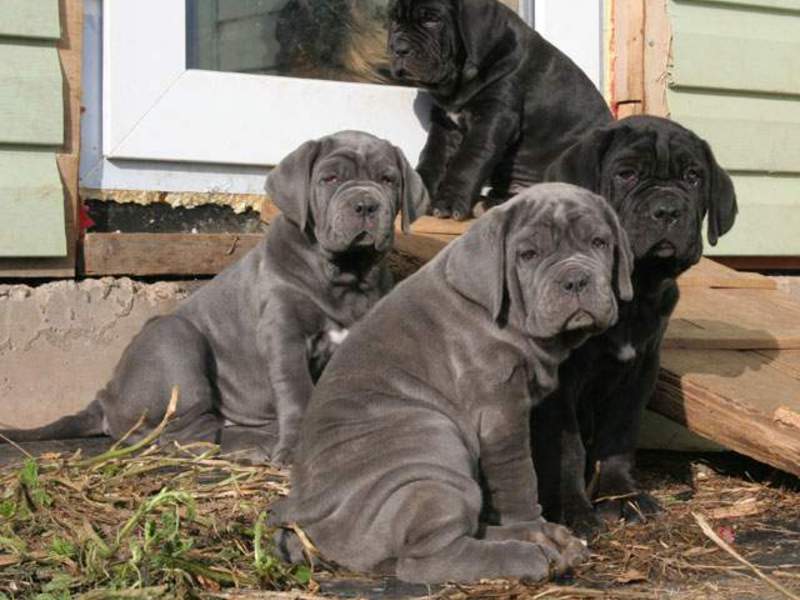
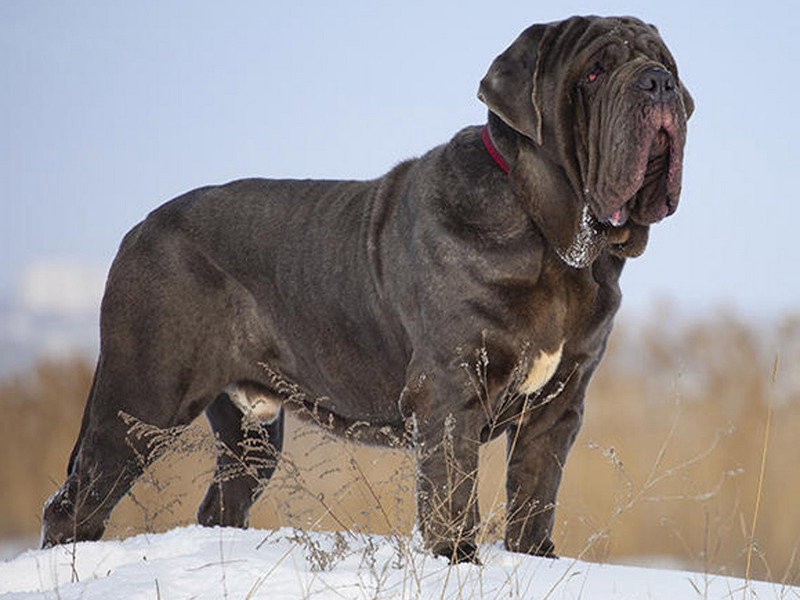
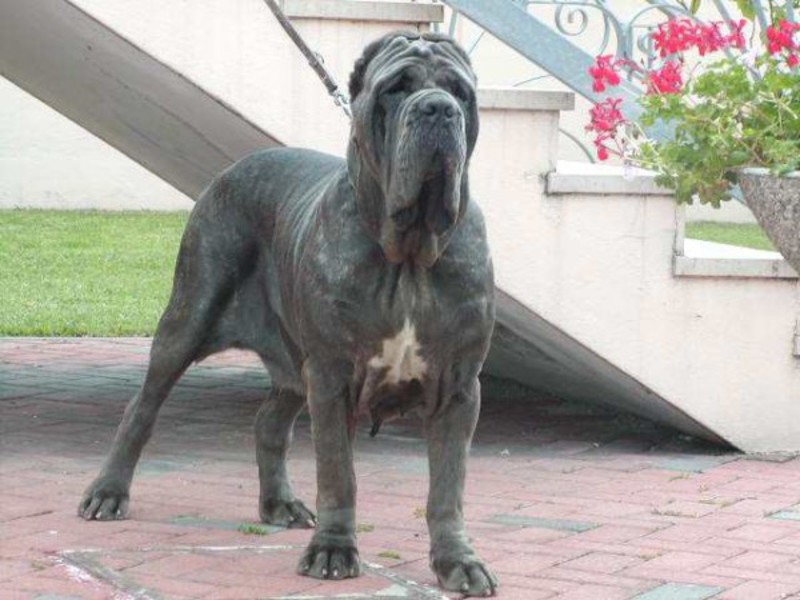
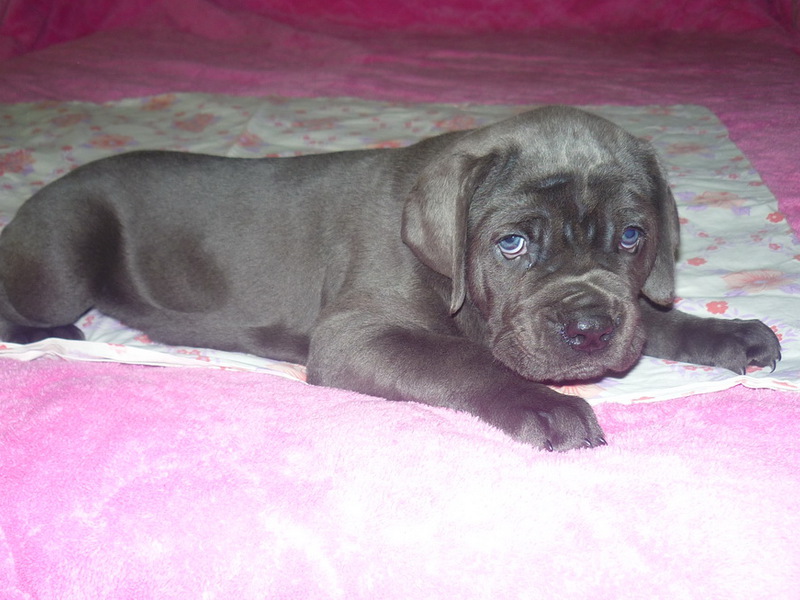
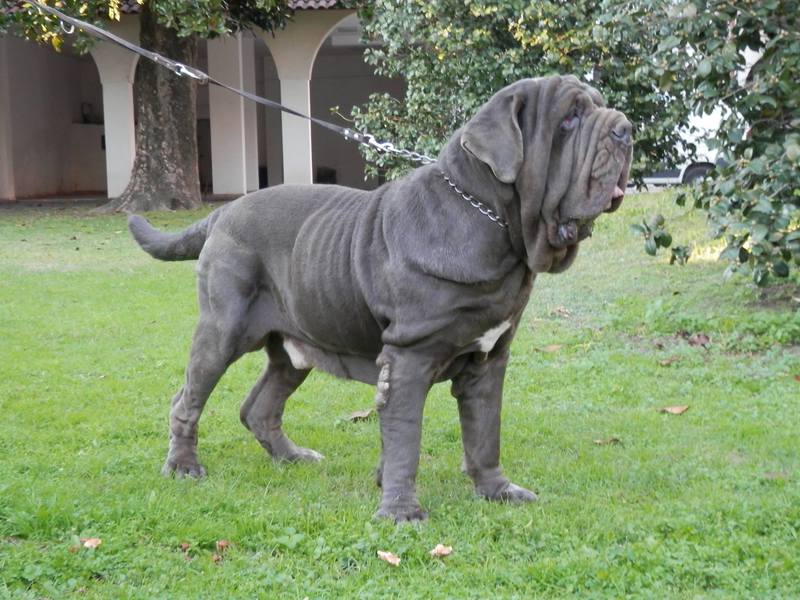
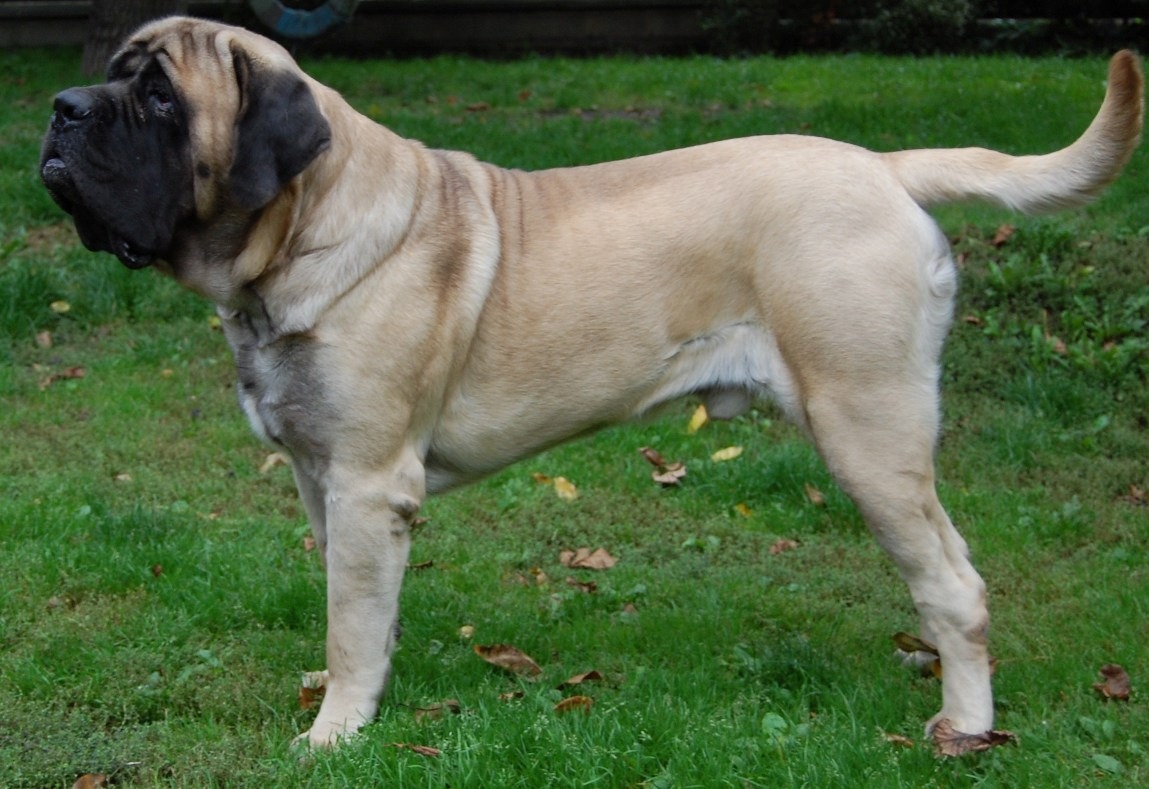
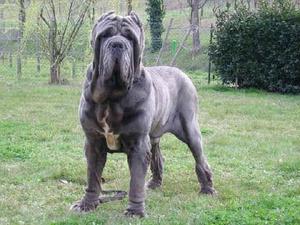
 The Neapolitan Mastiff (Italian Great Dane) is an Italian dog breed that has long been used for guarding and hunting. This surprisingly calm dog, with its strong character and nerves of steel, will become a reliable companion, devoted friend, and home guard for you and your family.
Content
Neapolitan Mastiff – photo, description, and breed standard
The standard of the modern Neapolitan Mastiff was developed in 1946 based on eight mastiffs that participated in an international exhibition.
- Weight: female 50-60 kg, male 6-70 kg;
- Height: female 60-68 cm, male 65-75 cm.
Colour: brindle, brown, black and grey, with small white patches permitted.
Additional Mastino breed characteristics:
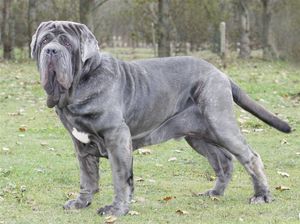
- The characteristic folds form a unique pattern on the animal's head and muzzle.
- The dog has well-developed muscles, strong bones and impressive dimensions.
- The dog has a fairly massive head with a thick neck and a wide skull.
- The dog looks rough and brutal in appearance.
- When properly developed, the animal has thick, high-set, hanging ears, which must be cropped.
History of the Neapolitan Mastiff breed
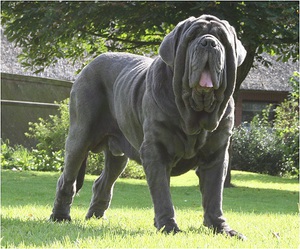 The origins of the mastiff begin over two thousand years ago in the southern Italian Peninsula. The dog's ancestors are believed to be Molossian dogs—ancient war dogs used to hunt wild animals. Keeping Molossians was a fashionable pastime among the ancient Roman nobility of the time, and commoners often used dogs of this breed as guard dogs for their homes.
Today, the Neapolitan Mastiff used as a protector of property, a bodyguard, and also a police service dog.
Neapolitan Mastiff Character
The Neapolitan Mastiff is ideal for apartment living, provided it receives long daily walks (twice a day) and has a sufficiently large living space. This breed doesn't necessarily require constant play and active time; quite the contrary, it's quite happy to lounge on the couch or its favorite bed. For this reason, mastiffs are often called philosophers and contemplatives.
The dog gets along well with children., is quite sociable and always maintains smooth relationships with all family members. However, of all family members, he prefers to choose only one owner, to whom he will be infinitely loyal and obedient.
Long separation from its owner has a negative effect on the dog's mood - it begins to feel very sad and may even become depressed.
Despite their intimidating appearance, these are quite good-natured creatures with a docile nature. They are friendly, non-aggressive, and even-tempered. The Neapolitan Mastiff retains a childlike personality into old age and remains gentle, loving affection, play, and attention. Families with small children (under 12 years old) or other pets are not recommended to own a dog of this breed. has a very jealous temperament and often expresses his jealousy through aggression.
The Neapolitan typically bonds exclusively with family members and does not tolerate outside interference in these relationships. This simple, reserved, intelligent, and observant dog has an excellent memory and will do everything possible to understand your wishes and earn your owner's approval.
Never use physical force against a Neapolitan Mastiff! Raising your voice is enough to express your displeasure with the dog's behavior. In extreme cases, you can lightly hit the pet on the back with a rolled-up newspaper. The Mastiff will immediately understand that it has acted incorrectly and will try to resolve the conflict.
In their character, representatives of this breed are more reminiscent of humans, so when communicating with them, you get the feeling that next to you is not an animal, but a good, long-familiar friend.
Unfortunately, the lifespan of the Mastino is much shorter than that of smaller breeds and is 8-9 years old (sometimes a little more).
Walking your puppy may be a bit of a challenge at first: he'll constantly tug on the leash. Breaking this habit will require a little patience and a special compression collar, which can later be replaced with a regular one.
Never chain a Mastiff. This can hurt his pride and make him angry, and such confinement will deprive him of the free range he so desperately needs.
Psychology of the Neapolitan Mastiff
Like any other dog, the Neapolitan has its pros and cons, the main ones of which are the following:
 Socialization is mandatory. This breed is characterized by stubbornness and shyness, so puppies need to be taught proper behavior and interaction with other animals from an early age.
- Laziness. Large size makes the animal clumsy and lazy;
- sloppiness. The dog may be drooling and clumsy;
- Loyalty. However, excessive closeness with family members can lead to jealousy towards other apartment residents or guests;
- Balance. With proper training, a mastiff will never show aggression and will behave reasonably and quite calmly;
- Friendliness. At first glance, it's hard to recognize this formidable giant as a good-natured, affectionate creature, loyal to children and other four-legged friends.
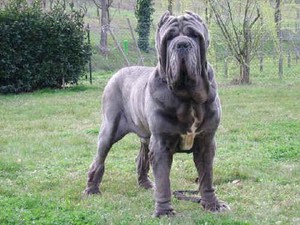 Socialization is mandatory. This breed is characterized by stubbornness and shyness, so puppies need to be taught proper behavior and interaction with other animals from an early age.
Mastino nutrition
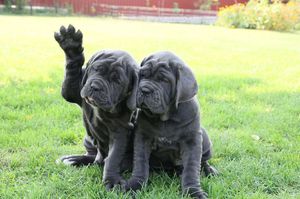 Since the Neapolitan Mastiff is a fairly large dog, it requires high-quality, nutritious, but moderate nutrition. The diet of puppies and adults differs significantly.
During the first year of life, a young Neapolitan should be given vitamins (especially B) and minerals to strengthen the body's nervous and immune systems, as well as for proper joint development.
In addition, the development of a dog largely depends on the amount of protein it consumes, which should make up 50% of the animal’s total diet.
Babies under three months old should be fed at least 4 times a day, gradually moving to two meals a day as the Neapolitan grows.
It is better to feed adult mastinos with professional food, which already contains all the nutrients the animal needs.
Mastiff you can feed them natural foodHowever, only a professional can prescribe the appropriate diet. Make sure your pet has plenty of water to drink at all times.
Health
Like other large Molossian breeds, Neapolitan Mastiffs are prone to a number of health conditions, including hereditary ones. A puppy's health should be considered from the moment you purchase it—be sure to ask the breeder for all documentation on the parents, including, of course, certificates confirming all health tests have been completed.
Upon reaching two months of age, the baby must be vaccinated against leptospirosis, hepatitis, and glanders, which must then be repeated and, if necessary, supplemented with other vaccines, in particular, against parvovirus and rabies.
One of the most common ailments in the Neopolitan Mastiff is considered to be elbow or hip dysplasiaThe disease can arise from poor husbandry practices or congenital genetic defects. To raise a strong and healthy pet, future owners should thoroughly familiarize themselves with all the information on this topic.
Cardiopulmonary filariasis, which is most common in humid regions, is a particularly dangerous disease for dogs of this breed. The disease is primarily transmitted by mosquitoes. Signs of infection often appear somewhat late and are characterized by a significant reduction in the pet's activity level.
There are also diseases unique to mastiffs and related to their unique structure. For example, due to their wrinkled, flat muzzle, the dogs often suffer from various skin infections, retinal atrophy, and entropion. To prevent dermatological diseases, skin folds on the animal's body and face should be regularly treated with a special lotion.
In hot weather, be especially careful with your pet. Never leave it indoors in direct sunlight—this can be fatal for a mastiff.
Bathing a baby Neopolitan is prohibited until they reach one year of age. Even an adult should only be washed when they become dirty. Washing removes the fatty layer of the coat, thereby reducing the animal's protection from insect bites.
When purchasing a puppy, you should inquire about its parents and make sure that they do not have any serious defects or health problems.
It's better to take a pet at the age of two months, towhen he can already manage without his mother.
Training and education of Mastino dogs
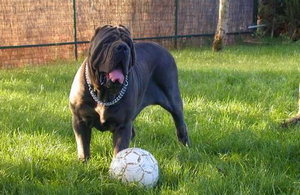 Neapolitan Mastiffs are calm, balanced, and highly intelligent animals, so training them is easy. They easily memorize everything they learn and are happy to demonstrate their newfound knowledge to their owners.
Lack of proper training can lead to the dog becoming uncontrollable, which is quite dangerous given its size.
To avoid any further suspicion, the mastiff must undergo socialization At an early age, a mastiff should be able to interact not only with its family but also with strangers. This is usually not a problem; the main thing is to monitor the behavior of strangers and avoid excessive gesticulation. A mastiff may be wary of a stranger appearing on the threshold of its apartment, but once it's assured that the visitor is completely harmless, the dog calms down and stops paying attention.
The stranger, in turn, should also ignore the dog and not pester him with compliments and affection.
Neapolitan Mastiff far from being a house dogHe needs space to walk and rest, to bask in the sun and contemplate the world around him. When teaching your dog various commands, be mindful of his difficult nature and be careful not to let any hint of anger creep into your voice. However, your tone should be firm and not tolerate refusal.
 Ensure immediate compliance with commands, otherwise the mastiff will think it can disobey its owner with impunity. Don't get angry with your pet when it starts barking. It doesn't do this out of boredom, but rather to warn its owner of something or as part of its guarding duties.
The opinions of all family members regarding the training of the Neapolitan Mastiff should be the same, that is, if one of you has imposed certain prohibitions, it is undesirable for the other to violate them.
Neapolitan Mastiff is ferocious guard dog, scaring away strangers with just their menacing appearance. However, at the same time, they are extremely loyal and devoted family friends, always ready to help. If you take the time to provide the pet with the proper care and living conditions, you will receive in return a loving companion and an indispensable guard dog.