The Irish Setter is a hunting breed and is not recommended for apartment living. This larger-than-average dog requires outdoor exercise. Improper care and maintenance can lead to heart disease. It makes an excellent companion for an active person or hunter. Setters are very sociable and do not tolerate being without their owner or the family raising them for long periods of time.
Content
Description of the standard
The Irish Setter was developed in Ireland in the early 18th century. Breeders crossed the red-and-white setter with pointers, setters, and spaniels. After several unsuccessful experiments, the scientists succeeded in producing a new breed of setter suitable for hunting. The breed was officially recognized in 1876.

Standards:
- height - male 58-74 cm, female 55-62;
- weight 27-32 kg;
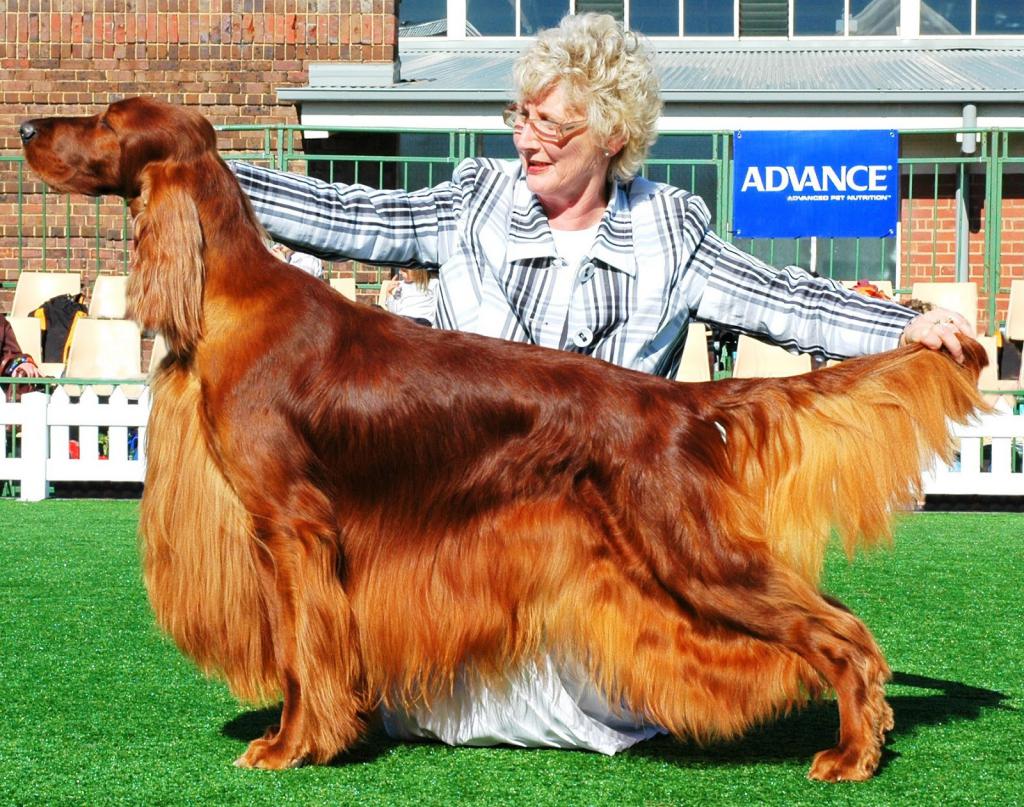
- the head is small;
- eyes set close together;
- the body is elongated;
- paws are straight, high, strong;
- The coat is long, thick, wavy.
In total, 3 main colors are recognized:
- light red;
- dark red;
- chestnut (white spots are allowed).
The standard allows for a white stripe or star on the forehead.
Main character traits
The Irish Setter has a fairly easy-going personality. This is a companion dog, friendly, patient, and hardy. The breed is easy to train and quickly learns commands.
Setters have a lot of energy, so they need long, active walks. Parks, training grounds, forests, and fields are ideal for this. The dog enjoys hunting, fishing, or hiking.

The breed is suitable for keeping with other animals and children. The Setter is friendly with its family. A properly trained dog can be an excellent babysitter for small children. You can be sure that the dog will never show aggression towards children, even if they are actively playing and bothering it.
This is absolutely not a guard dog, and it's not advisable to keep one as a home guard. It will welcome strangers and let them in. It will happily take an active part in all family activities.
Pros and cons

Diet:
- Up to 3 months, only liquid milk dishes and pureed food up to 6 times a day.
- After 3 - feeding puree 5 times a day.
- From 4 to 6 - transition to whole grain food 4 times a day.
- From 6 to 12 years old - feeding 3 times a day with adult food.
The basis of the baby's diet includes:
- raw meat;
- hearts;
- liver;
- raw chicken or quail eggs;
- cottage cheese;
- kefir;
- buckwheat;
- rice.
The breed doesn't require much variety in its diet. The main thing is to adhere to the daily calorie intake to prevent obesity.
Grooming
Grooming a setter's coat requires special attention. Dogs shed almost unnoticeably when they're healthy. Only the body fur sheds; the fringe on the legs remains intact.
She is brushed daily with a special natural bristle brush. This removes loose hair and prevents tangles.
Bathing is recommended no more than once every 10 days, and shampooing is recommended once a month. A major advantage is that, despite their long coat, they have virtually no odor. No grooming is required.
Once a month, nails should be trimmed with a special nail clipper or at a dog groomer. After a walk, the pads should be gently wiped with a damp cloth and inspected for wounds and cracks. If any are present, treat them with hydrogen peroxide and any antiseptic.
Education and training
If you don't devote enough time to raising and training your pet, its docile nature can be seriously damaged. The dog will become uncontrollable and destructive.
You can train the dog yourself, send it to a special school, or hire a private trainer. The approach to training should be specific. Training should be very firm, but without harshness, as the setter does not tolerate it. This will ensure the puppy grows into an excellent helper, ready to overcome any difficulties and assist in any situation.
Dogs can begin training after six months. They begin by learning basic commands, such as sit, stay, lie down, heel, and come. Dogs pick up on these quickly and show initial results within just a few days of training. After completing training at a dog school, pets can participate in shows.
Breeding

Setters are usually bred in kennels, but an experienced breeder can do this at home. The most important thing in breeding is the choice of a pair, since the mating of related dogs will not produce offspring or it will be defective.
To choose a partner, it's important to evaluate their appearance; they should meet breeding standards. Review their pedigree and any genetic conditions they may have. If possible, examine the quality of their previous offspring.
The mating is performed in the presence of a specialist who will help the animals do everything correctly. The mating is repeated 28-48 hours later.
Caring for puppies and the bitch
After the puppies are born, they and their mother require special care. They must be kept in sterile conditions. For the first few weeks, they are kept close to their mother; she cares for the puppies and feeds them milk. To ensure adequate milk production, the mother requires increased food and water intake.
If there is not enough milk, you can find a wet nurse or use a special formula. The veterinarian will advise you on the best way to feed the puppies.
Once the puppies begin to walk, you can separate them from the adult dog by creating a play pen. This will help the dog get more rest, and the puppies will not wander all over the room and hurt themselves.
It's best to raise young animals for the first three months under the supervision of a veterinarian, who will ensure they receive timely vaccinations and deworming. The offspring can be sold from three to four months of age, when they become more independent and transition to adult food.
Diseases and treatment

An Irish Setter's lifespan is directly dependent on its health. Only proper care and regular exercise can help extend it.
The breed is prone to the diseases listed in the table:
| Disease | Treatment |
| Otitis | Using special ear drops |
| Allergic dermatitis | Nutritional adjustments |
| Hip dysplasia | Massage, therapeutic exercise |
| Purulent inflammation of the uterus | Inpatient treatment with surgery or antibiotics |
| Bloating | Nutritional adjustments |
| Laryngeal paralysis | Inpatient treatment |
| Epilepsy | Treatment with anticonvulsant medications, consultation with a neurologist |
| Thyroid insufficiency | Hormone therapy |
| Congenital dilation of the esophagus | Nutritional adjustments |
| Oncology | Chemotherapy, surgery |
| Inflammation of bone tissue | Taking anti-inflammatory drugs, surgery |
Dogs can be affected by parasites such as worms, ticks, and fleas. To prevent infection, regularly treat the animal with special drops and keep records in the passport. Any illness should be treated only by a veterinarian; self-medication can be fatal. Healthy setters live on average about 12-15 years.
Choosing a nickname

A short and catchy name is appropriate for this breed. The name should reflect the puppy's personality and appearance. Avoid choosing a name that's too long, as it will be inconvenient during training.
Girls are given the following nicknames:
- Agatha;
- Bonita;
- Vira;
- Hermie;
- Gloria;
- Lorna;
- Letty;
- Mia;
- Sima;
- Ramilda;
- Rufa;
- Tina;
- Tiffany;
- Femina.
Boys can get the following names:
- Agathon;
- Bryce;
- Gordon;
- Hamilton;
- Gaston;
- Morgan;
- House;
- Brian;
- Ron;
- Rem;
- Remus;
- Gordey;
- Sardar;
- Talent;
- Florence;
- Just.
Many nurseries sell puppies with ready-made names.
The Irish Setter is a wonderful companion and a true family member, capable of hiking, camping, and hunting. It's the perfect pet for families with children. With proper care and upkeep, it will live a long and happy life.