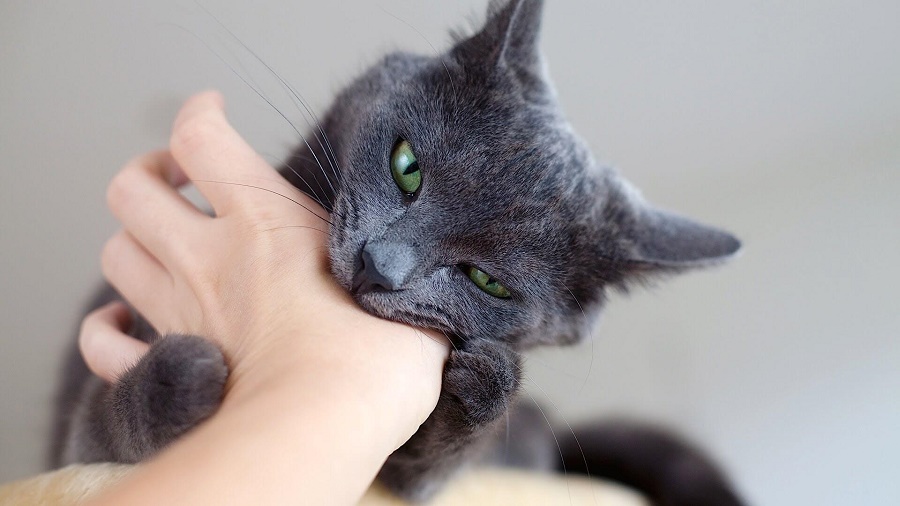
Cats are expressive and unpredictable animals. Just because she allowed you to pet her five minutes ago doesn't mean she won't scratch or bite you a moment later. Let's explore why this happens and whether all cats respond this way to affection.
Incorrect socialization
Most owners of such sweet, proud, and affectionate animals as cats don't even try to understand their pets' psychology. After all, they never do anything without a reason, including attacking.
And if the purring bundle of joy suddenly freezes, its pupils dilate, and its ears or tail twitch, it means the animal is unhappy about something. What can trigger a pet's "anger"?
- exceeding the required level of physical contact;
- unpleasant or even painful sensations;
- the desire to regain a leading position.
In addition, cats can react aggressively to affection if they were not properly socialized as kittens.
For example, if you bring an adult cat into your home that has lived outside its entire life, it will almost certainly be rather "cool" towards its owners.
This problem can be corrected through training. The animal is lured with a favorite treat, gently stroked (at least a few times on the back), and released into the wild after the meal.
After repeating this procedure several times, your pet will develop a reflex: tasty food = affection from the owner. They will become much more accepting of touch, and perhaps even love it.
Even the smallest kittens need at least 10 minutes of human contact per day. Otherwise, by the time they reach 7-9 months, they may become fearful, aggressive, and unsuitable for indoor living.
Sensitivity threshold
Cats have excellent short-term and powerful long-term memory. For example, a dog's short-term memory allows it to retain information for no more than 5 minutes.
And some members of the feline family remember a previous event until 4 p.m.
Accordingly, if a cat has recently received verbal or physical punishment, it may react quite negatively to its owner's affection, even if the owner decides to pet the animal several hours after the incident.
A cat can have a negative experience with a petting human hand and the resulting unpleasantness both outdoors and at the veterinarian's office. It's possible that this memory is what causes the pet to unexpectedly scratch and bite its owner.
A pet may also abruptly end evening petting due to overindulgence. A cat simply gets bored of being petted in the same spot. A bite, in this case, is the equivalent of saying, "Enough, stop."
The cat is in pain
All animals, just like humans, are capable of feeling pain. But how do humans react to touching, say, a sore arm? They emit a so-called "pain cry," pull away, and in some cases even swear.
Felids may bite their owners' hands for the same reason. What might bother a cat?
- ear infections;
- toothache;
- cervical arthritis;
- joint pain and much more.
Accordingly, if the animal tolerates stroking of some parts of the body calmly, but touching others causes a sharp, negative reaction, then it is time to contact a veterinarian.
Pain isn't the only reason a cat bites its owner's hand. Another factor that can trigger aggression in a pet is static electricity, which builds up between the hand and the fur.
Sudden awakening of a pet
It's easy to tell if a cat enjoys petting. If your pet starts purring loudly, closing their eyes, and snuggling closer, it's a sign they're happy. So why do felines enjoy being petted so much?
According to one version, the mother cat’s rough tongue, which she uses to clean her kittens, is to blame.
The human hand imitates this type of fur grooming quite well. And when the adult specimen decides it's had enough of this "washing," it bites its owner and runs away.
Another reason that can provoke aggression in a cat is simple fear. Just imagine: the animal enjoys gentle petting and scratching, closes its eyes, and seems to enter a state of "nirvana."
At a certain point, the pet wakes up and spots something large and potentially threatening out of the corner of his eye. Naturally, the cat turns sharply and attacks the threat.
After this, the mischievous animal (as its owner believes) suddenly takes off and hides in the depths of the living space. But the pet does this not because it's bad, but because its self-preservation instinct kicks in.
If a cat has a weak nervous system, is afraid of loud sounds, shows signs of anxiety even when clapping, then it is better not to touch it while it is sleeping.
Control over the owner
Female cats are much less likely than male cats to respond aggressively to their owner's affection. After all, males constantly strive to take the lead in any "group," even if it consists primarily of humans. Females, on the other hand, are naturally more gentle and docile.
Accordingly, a sharp bite on the owner's hand, immediately following a warm "hug," can be interpreted as the pet's unwillingness to obey a specific person.
In this way, the individual demonstrates that she is the boss, and it is she who decides who, when, and how much can be petted.
In addition, a pet may refuse prolonged petting due to its temperament.
After all, not all cats want to be held constantly. Some are content to simply lie nearby for a few hours, while others only need a single rub against their leg or arm.
Pets can scratch and bite even when they're in a good mood. This can be observed in young, overly playful animals.
So, a sensitive, understanding and loving owner will accept his whiskered and tailed pet as nature created him.
And if the animal suddenly begins to tense up, change its position, or press its ears back, the owner will simply leave it alone. In this case, both the pet's psyche and the owner's hands will remain unharmed, meaning no one will be offended.


 Yurych
1 comment