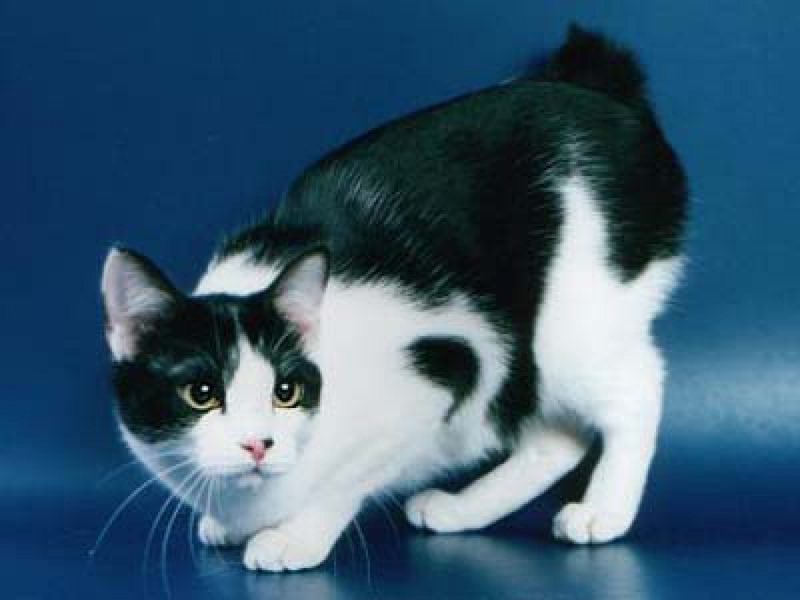
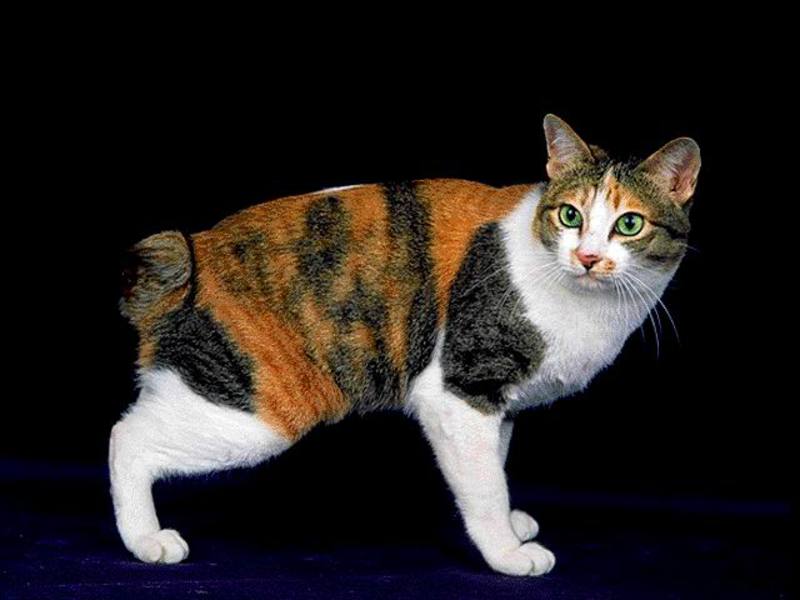
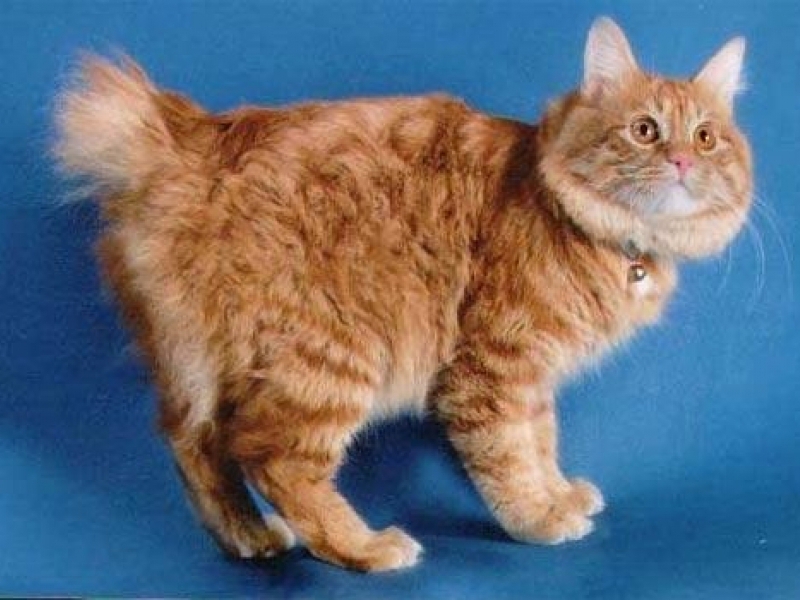
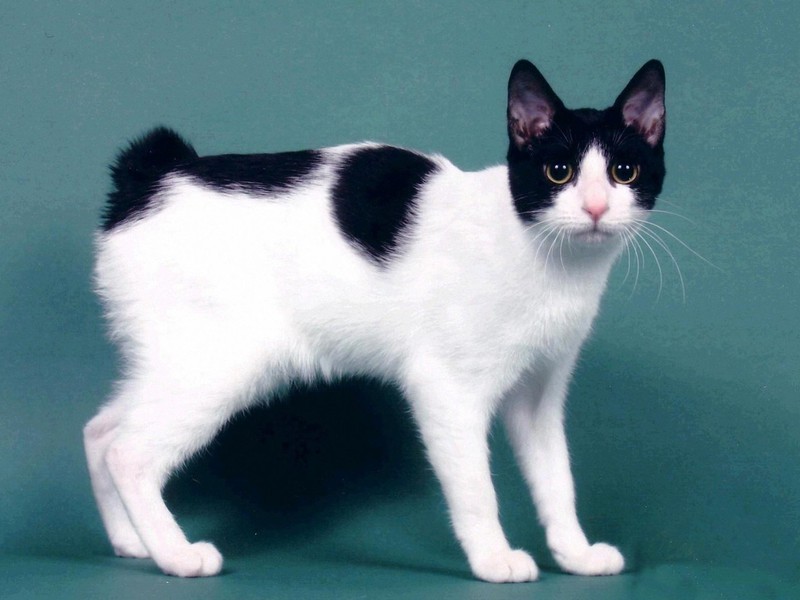
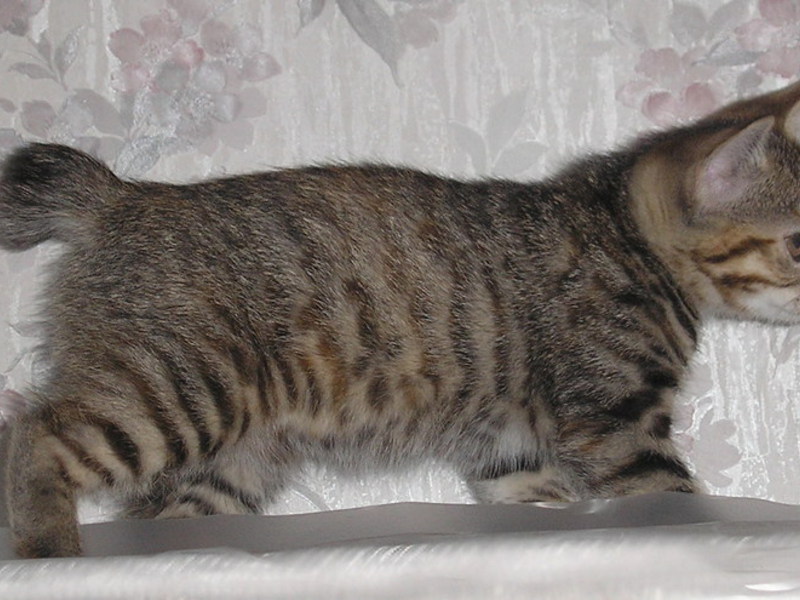
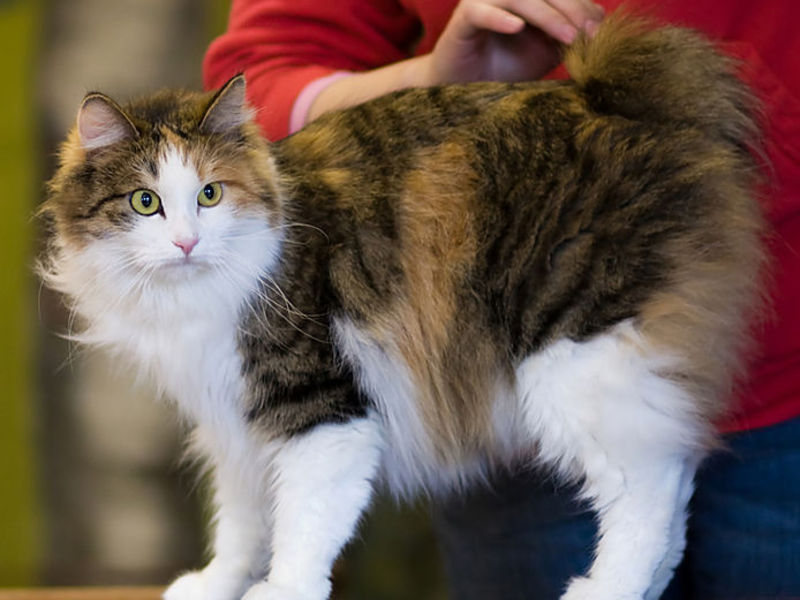
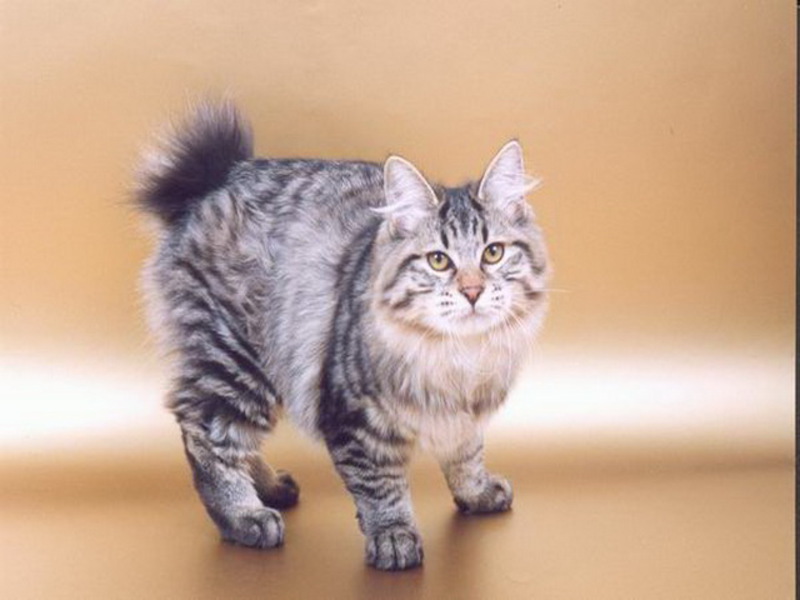
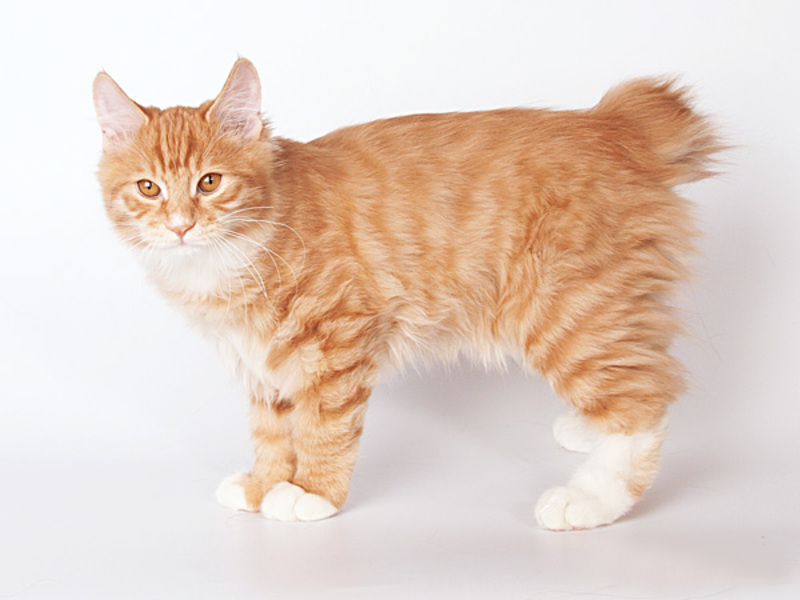
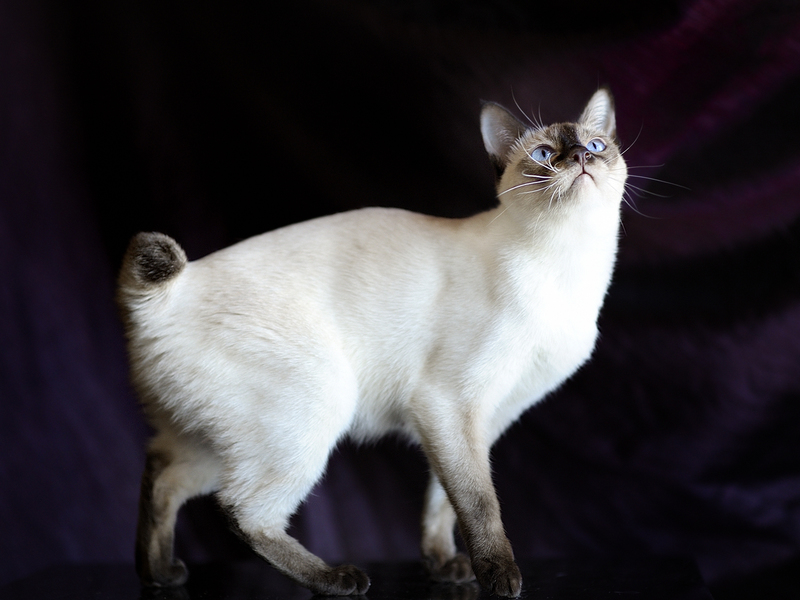
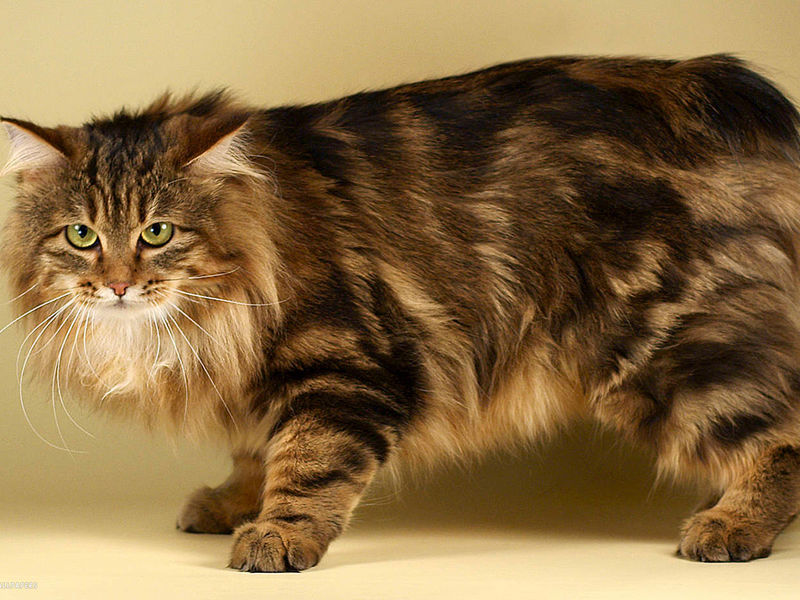
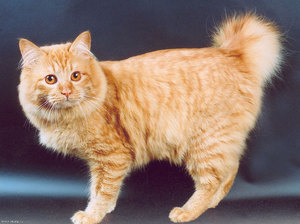
 Bobtails are quite strong and powerful animals, weighing quite a bit. An adult cat can weigh around 10 kg, but the average weight is typically 5-8 kg. The breed is gaining popularity not only in its native land, but also in Russia, Ukraine, and other European countries.
Content
Bobtail cats: description and photos
The wool of representatives of this breed is distinguished by its unique properties:
- Since bobtails are native to regions with humid climates, their fur has developed the ability to not get wet while bathing.
- There are practically no tangles.
The bobtail's tail attracts special attention at cat shows; it is distinguished by its uniqueness and is an individual feature of each individual.
The following types of tails are distinguished:
 The "stump" is the smallest type (2 to 5 cm). The intervertebral joints are immobile, the fractures are at an obtuse angle, and the vertebrae (2 to 8 in number) appear to be stacked on top of each other.
- "Spiral"—the visible length of the tail is 5–10 cm. The intervertebral joints are semi-mobile or mobile. The vertebrae, numbering 3–15, have numerous fractures, often at very acute angles.
- "Retracted bobtail"—the tail is similar at the base to other cats, but after 5-7 vertebrae, it begins to actively bend in all sorts of ways. The intervertebral joints can be either flexible or fixed.
- The "broom" tail (5-15 cm) consists of 5-10 vertebrae, the fractures are located at right angles, the joints are semi-mobile.
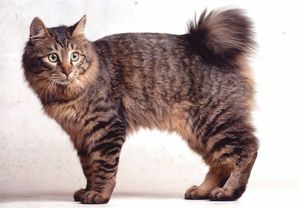 The "stump" is the smallest type (2 to 5 cm). The intervertebral joints are immobile, the fractures are at an obtuse angle, and the vertebrae (2 to 8 in number) appear to be stacked on top of each other.
Although bobtails are very attached to people and constantly seek their company, they have quite unobtrusive character, and if they feel that the owner has no time for them, they will not be persistent and will step aside.
Representatives of this breed are highly intelligent and easily trained; they can even remember and follow commands like dogs. Simply explain to your cat what you don't like about its behavior once, and you can be sure it won't happen again.
Types of bobtails
The bobtail cat breed is divided into several varieties.
American Bobtail
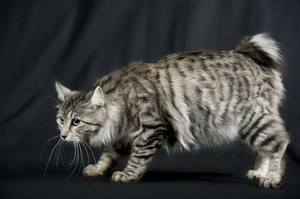 Unlike many of its relatives, the American Bobtail cat breed has an official ancestor. It is generally accepted that it is wild tabby kitten A kitten with a funny little tail, found on an Indian reservation in Arizona, USA, became the "founding father" of the breed.
American Bobtail cats are loving, good-natured, and lovable creatures. These animals get along well with other pets and are very loyal to children. They are also very cheerful and active, loving playtime and outdoor walks. They quickly become attached to their owners and crave reciprocal affection.
The American Bobtail does not tolerate loneliness, so you should not leave your pet alone for a long time.
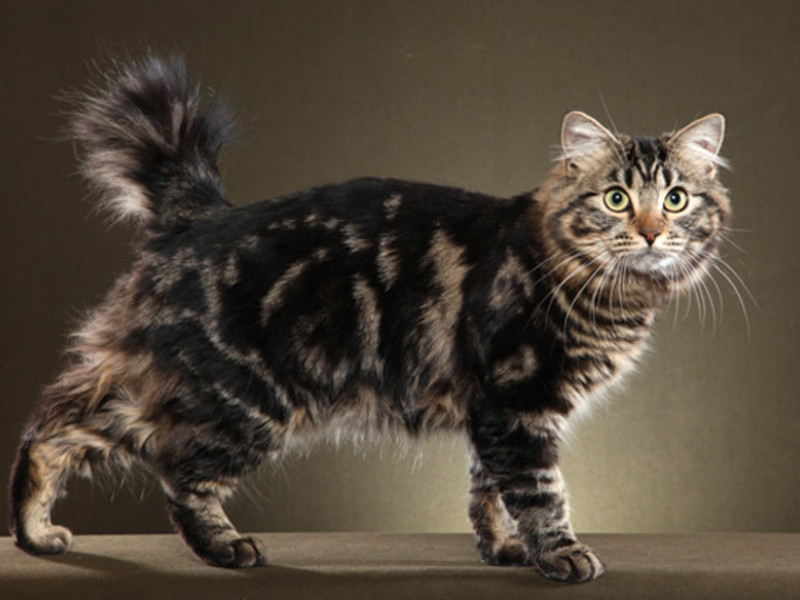
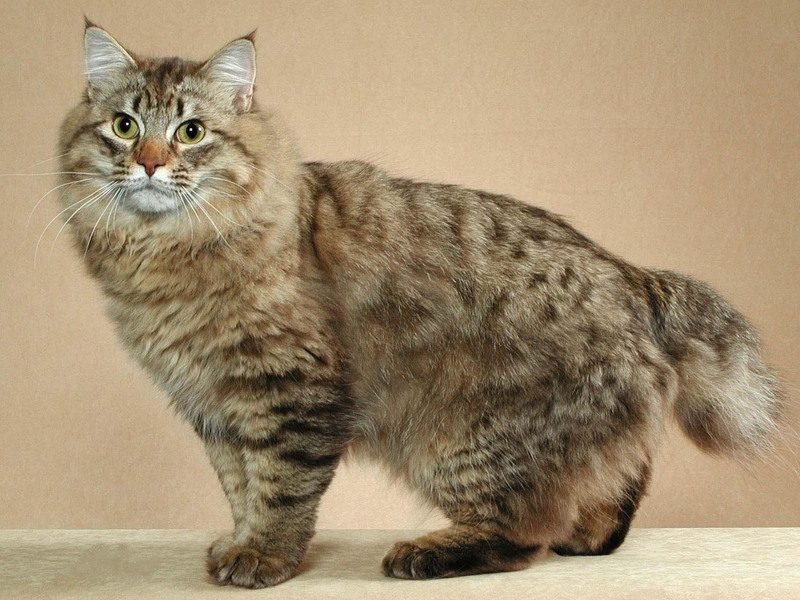
This is a fairly large cat, with a short, mobile tail and a well-developed, muscular body.
Breed characteristics:
- The body is moderately long, stocky, strong;
- the back is straight, with slightly protruding shoulder blades;
- chest is wide, deep;
- the head is wedge-shaped, the forehead is convex;
- The muzzle is wide, almost square, with slightly protruding cheekbones, the nose is of medium size; the chin is well developed, slightly rounded;
- the ears are set wide apart, tilted forward, and of medium length;
- eyes slightly slanted, almond or oval in shape, set wide apart;
- the neck is strong, of medium length, with sufficiently developed muscles;
- The limbs are heavy, short, and muscular. The front limbs are somewhat shorter than the hind limbs;
- paws are round, large with tufts of hair between the toes;
- The tail is very mobile, short, and resembles a brush or a shaving brush.
Animal has thick fur, which requires careful care, especially during the shedding period.
The American Bobtail comes in a variety of colors, the most popular being the hare color. They weigh between 3 and 8 kg.
The American Shorthair comes in two varieties: shorthair and semi-longhair. The former has short, springy fur with a moderately developed soft undercoat. Semi-longhairs have a sweaty, shaggy, medium-length coat with a soft undercoat. The feathering on the croup, hindquarters, chest, and neck is slightly longer than the main coat. The color can be any color.
Japanese Bobtail
In its homeland this cat is a symbol of friendshipIts images can often be found in Japanese paintings and prints dating back to various historical periods. The breed is considered indigenous to the Far East and is widespread in Korea and China, where it symbolizes success, prosperity, and well-being. The breed is quite popular in the United States, but has not achieved widespread popularity in the United Kingdom.
Breed characteristics:
- The Japanese Shorthair cat has a slender, well-built body of medium size;
- the body is muscular, strong, of equal width along the entire length, elongated;
- the lower back and back are slightly convex, the shoulders are broad;
- the limbs are slender, long, the front ones are shorter than the back ones, slightly bent when at rest;
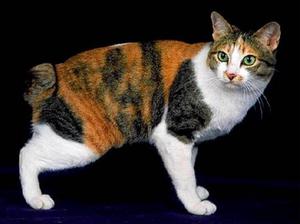
- The tail is vertical, short (5-7 cm, but can reach 12 cm), and looks like a pompom, similar to a hare's. There is a fur trim at the base of the tail;
- head shape - triangular;
- the eyes are oval, large, giving a charming expression to the animal’s face;
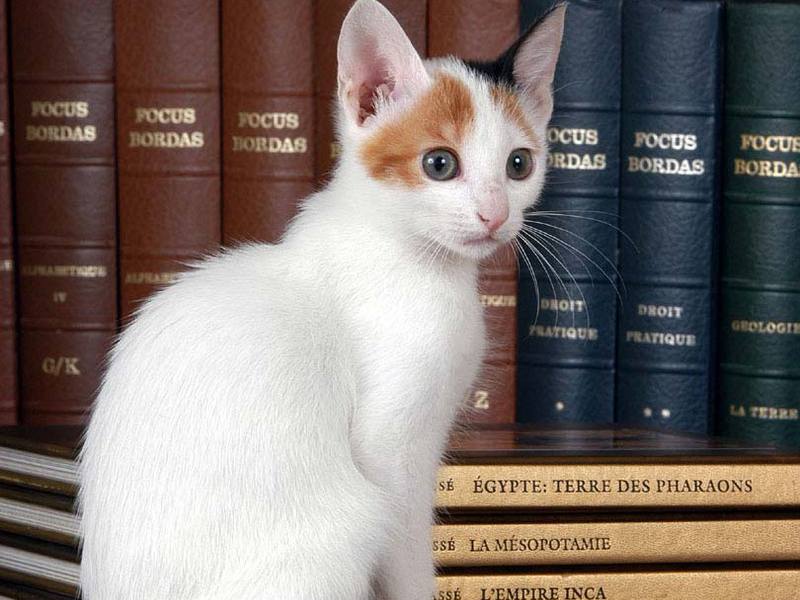
- The coat lies close to the body, short, and has almost no undercoat. The coat is typically tortoiseshell and white, but other shades are also found. Tricolor (white, red, and black, with the former predominating) is the most highly prized.
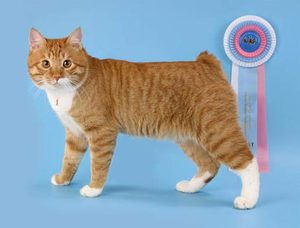 The Japanese Shorthair cat has a slender, well-built body of medium size;
Bobtail distinguished by good nature and calmnessThis cat enjoys company, is highly intelligent, curious, and intelligent, is incredibly devoted to its owner, and, according to breeders, can swim, hunt well, and even retrieve game. The breed is characterized by different eye colors: one is yellow, the other blue. Small kittens with this trait are especially prized.
The average weight of an adult cat is 3.5 kg, male cats – up to 5 kg.
Japanese Bobtails have a fairly long lifespan, are generally healthy, and are rarely susceptible to any illnesses.
Kurilian Bobtail - photo
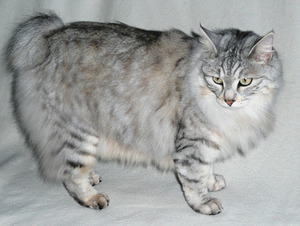 This is a breed of tailless cats, descended from the native short-tailed cats of the Kuril Islands. The Kurilian Bobtail is a relatively young Russian breed. similar in appearance to a lynxWhile its heroic character and independence resemble those of a wild animal, the bobtail is recognized as a domestic cat thanks to its loyalty, kindness, and endless affection.
Unlike the widely known and long-recognized Japanese Bobtail, the Kurilian cat breed emerged relatively recently—at the end of the 20th century. So, on the Kuril Islands, a cat with excellent qualities as a ratter and hunter lived, delighting local residents with his wonderful character and experiencing no troubles. It later turned out that this was not just a tailless animal, but a genuine Russian miracle, the sight of which has cat lovers around the world expressing genuine delight. Kurilian Bobtails have won successive cat shows across Europe: in Italy, Germany, Poland, and the Czech Republic.
The main difference between Kuril cats and Japanese cats is their special unique charm and a “purely Russian facial expression” that successfully combines canine devotion and the truly ferocious look of the “master of the taiga.”
Kurilian Bobtail - breed description:
- The coat is very beautiful and rich, of medium length;
- ears with tassels;
- the body is strong and powerful;
- the forelimbs are clearly lower than the hind limbs, which makes the gait playful and special;
- The tail is small and shortened: twisted and curled. It's virtually impossible to find identical pairs of tails; they are, so to speak, their "fingerprints," unique to each individual.
These inhabitants of the Kuril Islands are quite are successfully fighting rats, which is why they're known as excellent rat catchers. Bobtails have no trouble dealing with even large rodents, and they even dig up rat holes with their powerful forelimbs to retrieve their young. But even after killing the rodents, these cats don't rest easy and find an equally "fun" activity—chasing mosquitoes or flies, and cockroaches are a real treat for them.
Another distinctive feature of Kurilian Bobtails is their fishing ability. Their ears are slightly forward-tilted and can be folded to prevent water from entering, allowing them to dive underwater and catch fish with ease.
These adorable creatures have dog-like habits and are known for their trainability, courage, sociability, intelligence, and loyalty. They follow their owners everywhere, sleeping on their feet, laps, or even on their owners' beds.
As a rule, Kuril cats prefer to choose only one “object of adoration” from among family members, and they are simply friendly towards the rest.
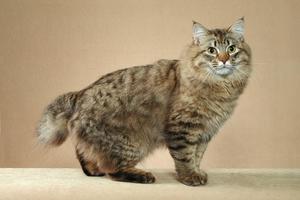 Features of Kurilian Bobtails:
- coexist quite peacefully with dogs;
- hypoallergenic;
- prefer constancy and do not change their location;
- get along great with children.
Even if your child constantly cuddles the Kurilian Bobtail, it will endure all the suffering gracefully and show no aggression. Since the Kurilian Bobtail is more dog-like in personality, it is very wary of strangers and will quickly warn of danger.
Today, the breed is quite popular and constantly evolving. You can purchase a Kurilian Bobtail kitten from one of the many catteries in Russia, Ukraine, and Belarus. The price depends on the Kurilian cat's pedigree, the prestige of the cattery, the color, and the class of the cat.
Breed diseases Kurilian Bobtail
Bobtails, including Kurilian Bobtails, have excellent health and strong immunity, but just like cats of other breeds, they can become ill with any of the diseases common to all felines.
Thai Bobtail
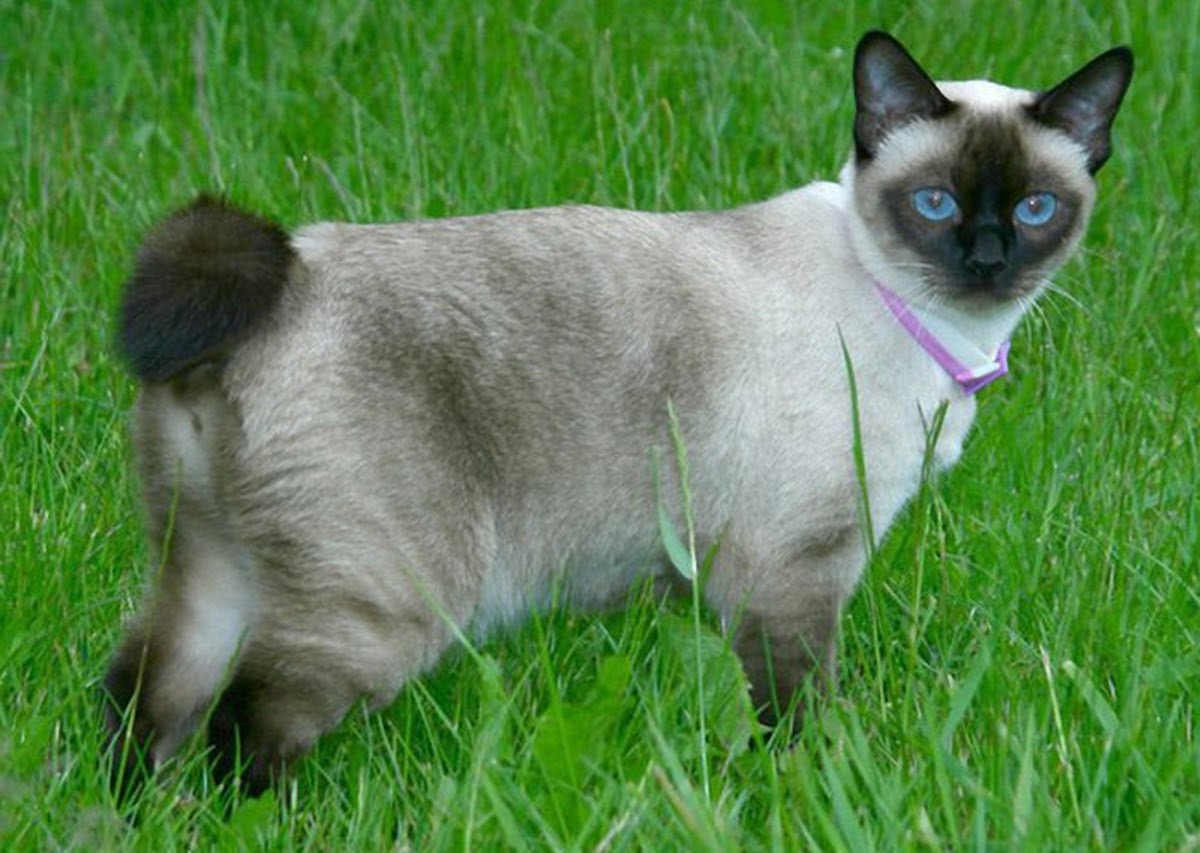
This breed is truly legendary in the cat world. According to legend, the Thai Bobtail's ancestors protected princesses. These cats have a dark, short tail, as well as paws and a face of the same color. The loops and lines on the tail are unique to each individual. Like all bobtails, Thai cats have dog-like habits and love to carry various objects in their mouths.
Fluffy creatures overly curious They are very attached to their owners. By nature, they are sweet and friendly animals who love to chat. However, "Thais" are very reserved in their emotions and try not to express them. Only males are responsible for raising their offspring. It is the "males" who lick their offspring and teach them etiquette and good manners.
The average female cat weighs 2.3 kg, while male cats are slightly larger – up to 4 kg.
Karelian Bobtail
These animals are of medium size, but due to their baggy figure, they look quite large. Signs:
- ears set high on the head, vertical;
- The eyes are lemon-yellow in color, quite expressive, and medium in size. Kittens with blue eyes are occasionally born;
- the tail is short and has the shape of a ball;
- the body of an animal of athletic build;
- the limbs are strong, slender, and in good harmony with the croup;
- the paws are small, graceful, giving an animal-like elegance;
- The coat is beautiful and lies close to the body. It can be either short or long.
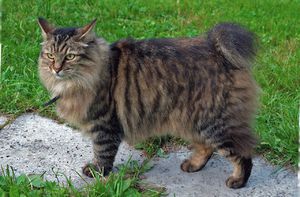 ears set high on the head, vertical;
The Karelian Bobtail has a pleasant and strikingly calm voice. By nature, animals of this breed are gentle and friendly, quite forgiving, but they do hold grudges, so beware of vengeance. Karelian Bobtails are gentle and warm-hearted, and they greatly value their home and their owner. love comfort and warmth.
Representatives of this breed will thrive in a dacha or country house, easily tolerating snowy winters and freezing temperatures. Females weigh 2.5 to 4 kg, while males weigh 4 to 6 kg.
So, Bobtails are good-natured, peaceful cats, but before acquiring a pet of this breed, it's still important to familiarize yourself with the animal's personality, habits, and food preferences. Only then will your furry friend delight you with its superb appearance, excellent stamina, and cheerful disposition.