Cats are among the most common pets worldwide, and they are especially beloved in Russia. Almost every second Russian has one at home, and some even have more than one. If you decide to get a pedigree cat, it's important to know how to distinguish it from an ordinary cat.
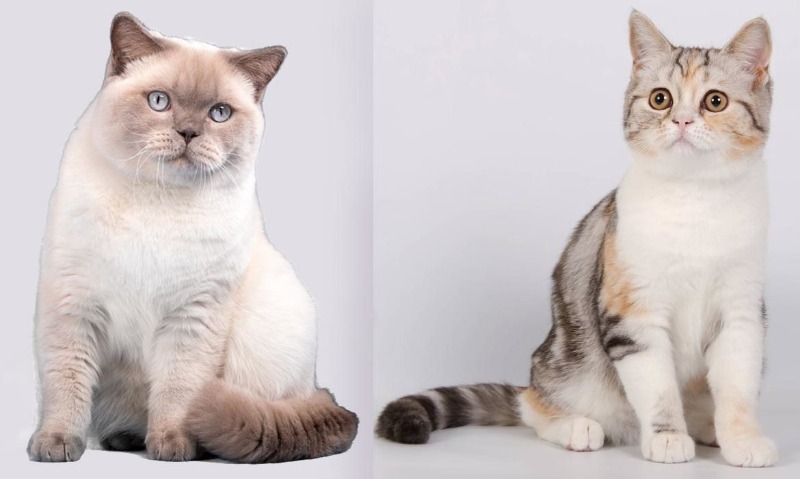
Pay attention to the body type
The structure of an animal's body will tell you not only about its health, but also about the breed to which it belongs.
The following factors should be taken into account:
- A large, round head, a stocky build, and short legs. These include bobtails, Scottish Folds, and American Shorthairs.
- Maine Coons and American Curls have a muscular body, medium-length limbs and a round head.
- Lithe, slender felines with long, thin legs are the hallmarks of the Siamese, Thai, Balinese, and Angora breeds.
- Exotics or Persians have a large head and a flat nose.
- The wedge-shaped skull, long body and paws are characteristic of Oriental Shorthair cats.
Pets are divided into three subgroups according to body type:
- lungs;
- average;
- heavy.
Lightly built cats have a slender, graceful body, high paws, a long tail, and an elongated neck. These breeds include:
- Eastern-Oriental;
- Siamese;
- Bollines;
- Javanese.
Medium-sized breeds:
- Russian Blue;
- Tonkinese;
- American Shorthair;
- British Shorthair.
Representatives of the heavy subgroup have a strong, stocky body, short muscular legs, large feet, and a large tail. Representatives of the following cat breeds:
- Manx;
- exotics.
Inspect the wool
Among the feline family, you can find breeds with long hair, as well as completely hairless breeds and even those with luxurious, curly fur.
Long-haired cats include:
- Burmese. Pets with long, fluffy fur, characterized by easy brushing.
- Himalayan cats are a cross between Persians and Siamese. They have the large, strong build of Persian cats and the coloring of Siamese cats.
- Maine Coons have long, wiry fur and a fluffy tail.
- Napoleons are medium-sized animals with a small but very fluffy tail.
- The Norwegian Forest Cat. It has a unique furry ruff and paws with fur that resembles pants.
- Persian. The most famous long-haired breed.
- Turkish Angora. A cat with extraordinary snow-white fur.
Climbing breeds include:
- The La Perm's coloring resembles that of a common yard cat, but this breed's fur is very curly.
- Rex. An unusual, curly-haired Czech cat.
There are animals that have no hair at all, or very little. These are:
- Don Sphinx;
- bambino;
- Ukrainian Levkoy.
When choosing a kitten from a breeder, the first thing to consider is the condition of the coat. A healthy animal's coat is dense and shiny.
Look where the ears are pointing
This is another trait that identifies a purebred cat. For example, common stray cats have pointed ears that point upward. Purebred cats often have unique ears, as well as a different direction or placement relative to each other.
Forward-curving ears are a characteristic feature of:
- British fold-eared cats;
- Scots;
- Highland Fold;
- Scottish Fold.
In the American Curl, they are curved backwards.
Unusually shaped ears:
- Pudelket. Has large, drooping ears.
- Ukrainian Levkoy. The ears are almost invisible, as they curl into a tight tube.
Some breeds are distinguished by the size of their ears. The largest ears are found in:
- Siamese cats;
- oriental;
- sphinxes;
- Peterbalds.
Maine Coons have tufts on their ears, while Siamese cats have dark fur on their ears.
When choosing a leopard, pay attention to the condition of the auricle. A healthy animal's auricle should be clean and free of purulent deposits.
Be sure to take into account the coat color.
A cat's color can also reveal a lot about itself. Some breeds (such as the Bengal or St. Petersburg Masquerade) have a distinctive shade or pattern. A distinctive blue color is a distinctive feature of breeds such as:
- Russian Blue;
- British Fold;
- Korat.
Siamese breeds have dark markings on their faces, paws, and tails. Bengal cats have a vibrant, unusual pattern. Chocolate-colored fur is typical for breeds such as the Brown or Chantilly-Tiffany. Abyssinian and Somali cats have a sandy color.