 The elephant is one of the largest mammals on the planet. An adult elephant can reach a length of 7.5 meters and a height of almost 4 meters. Females weigh an average of 5 tons, while larger males average 7 tons. Elephants are predominantly dark gray in color. Young elephants are covered in fur, which wears off as the animal matures. The only remaining fur on an adult elephant is a tuft on the tail.
Despite their impressive thickness (2–4 centimeters), elephant skin is very sensitive to various injuries and insect bites. To protect it, the animals often bathe or take mud baths.
The ears, which reach up to one and a half meters in length, deserve special attention. They are the result of evolution. In hot climates Due to its large area, this organ serves to remove excess heat, and elephants can also fan themselves with them.
All elephant species possess a long, flexible organ called the trunk. It consists of the nose and upper lip fused together. Typically, this organ reaches one and a half meters in length and weighs over a ton. The trunk possesses tremendous mobility and strength. It can easily hold up to 7 liters of water and can carry up to 2.5 quintals.
Male and female elephants differ not only in body weight, but also in the size of their tusks. Males have longer and heavier tusks.Elephants' tusks grow throughout their lives. These animals are also either right-handed or left-handed. Individuals use either the right or left tusk more frequently. This is reflected in the wear on the tusks.
Elephants also have 4 to 6 molars, in addition to their tusks. It's worth noting that elephants' teeth are replaced as they wear down. Interestingly, unlike humans, elephants grow new teeth not under worn ones, but next to themAs they grow, new teeth displace the old ones. Molars are quite impressive: at 30 cm long, they can weigh almost 4 kilograms. Unlike humans, elephants replace their teeth three times during their lives.
Features of reproduction
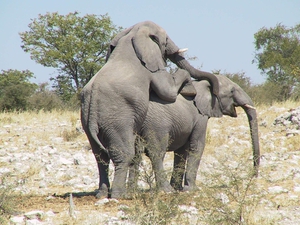 Elephant reproduction is not very seasonal, but in most cases births occur during the rainy season. Adults usually Males lead a solitary life, while females join together in herdsUpon reaching sexual maturity, males become aggressive and very dangerous. They approach a herd of females if at least one of the females is in the rare period suitable for pregnancy and bearing a calf. Violent fights between males are often observed during this period.
When does an elephant reach sexual maturity?
Only adults and the strongest individuals who have reached sexual maturity participate in reproduction, but elephants are remarkable animals. They exhibit reproductive flexibility, which means they can reproduce depending on their environment. the onset of puberty and the interval between births may increaseThe minimum reproductive age for females is 7 years. However, under unfavorable conditions, this age can double or even triple.
How long does an elephant's pregnancy last?
Elephants have the longest gestation period on the planet. How long is it? The female elephant carries the calf for 20–22 months.The exact gestational age depends on factors such as:
- time of year,
- age of the elephant,
- how much feed does the animal receive,
- other factors.
 Recent studies have established that this long pregnancy period is due to a unique ovulation cycle and hormonal mechanism.
At the same time the fetus is fully formed already at 19 months, but remains inside the mother. During the remaining time, the baby grows in size, its bones strengthen, and its skin grows. This is a kind of protective mechanism.
Elephants give birth very rarely, approximately once every three to nine years. This is also due to a special hormonal mechanism.
Elephant growth and lifespan
In almost 100% of cases, only one calf is born. Childbirth occurs differently in different elephant species:
- A pregnant elephant leaves the herd to give birth, sometimes accompanied by another female from the herd.
- The entire herd forms a dense wall around the female who is about to give birth, protecting her and her baby from enemies until the baby elephant can stand on its own two feet.
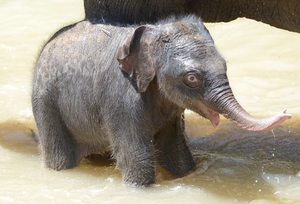 At birth The baby elephant weighs about 100 kilogramsNewborns reach a height of one meter. They have small tusks that fall out at about two years of age.
A baby elephant is born almost independent. It can stand on its own within half an hour. Until it can stand, its mother sprinkles dust and soil on it, masking its scent and thus protecting it from predators. After that, it follows its mother closely, clinging to her tail with its trunkAn elephant only becomes independent at age four. Until then, the cubs are protected by their mother and other young females in the herd.
The mother nurses her baby. Surprisingly, all the females in the herd who have milk nurse the calf. This period can last from six months to five years. However, As early as 6 months, baby elephants begin to eat solid foodIt is a well-known fact that baby elephants eat the feces of adults.
At about 10 years of age, an adult elephant leaves the herd, while young females remain in the herd for the rest of their lives. The lifespan of elephants reaches approximately 70 years.


 Nikita
1 comment