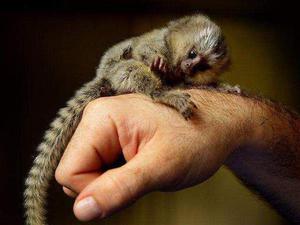
 The smallest monkey is the pygmy marmoset, also known as the marmoset.
The body length of these miniature animals does not exceed 15 centimeters, while the tail can reach 22 cm. Despite this length, marmosets' tails are non-prehensile. They also weigh lightly: 100–190 grams.
Marmosets have very interesting coloring. Their paws and belly covered with dark yellow furThe tail has black stripes, and the face has white stripes. The pattern on the face resembles whiskers. The fur on the back is a mixed color: gray, brown, gold, and black.
The fur on the head is much longer than on the body, making the little monkeys appear to have a mane.
The skull is very small, but the brain is quite large relative to the marmoset's body. This animal's head can rotate 180 degrees. Unlike other monkey species, marmosets have only two teeth. The incisors are turned forward.
The front legs of these animals are shorter than the back legs. All toes have claws. The big toe on the hind feet has a flat claw. Small monkeys capable of jumping 5 meters in height, but in trees they move vertically, firmly attached to the trunk or branches with their claws.
Nutrition
The food that marmosets eat includes:
- berry juice;
- tree resins;
- insects.
To obtain sap, marmosets chew large holes in plants, where they accumulate various resins over the course of a day to feed on. This type of food forms the basis of their diet. Pygmy monkeys spend more than half their time extracting sap.
These animals also like to feed on insects:
- grasshoppers,
- butterflies,
- beetles.
They find them among the leaves in the treetopsMarmosets may even descend to the ground to forage for grasshoppers or butterflies, although they typically remain in the trees. In captivity, pygmy marmosets' diet also includes eggs, yogurt, fish, and meat.
Marmosets also find fresh water on leaves and flowers.
Social structure
 These animals are diurnal. They typically form family packs, with up to nine individuals living in a single group. A group always includes one dominant male, a female of reproductive age, and several generations of young.
One such group needs territory. approximately half a hectareAs the trees become depleted, the group moves on. If another group appears on the territory, the male defends the boundaries.
Members of a group constantly communicate using auditory and visual signals. The sounds monkeys can produce are extremely varied, ranging from whistles to grinding sounds. Different sounds convey specific information:
- a trill with an open mouth can indicate alarm or a challenge;
- a trill with a closed mouth is a call for contact and interaction,
- chirping signifies submission.
In addition, marmosets can produce a supersonic cry that is not detectable by the human ear.
Reproduction
There are some in the pack one reproductive female and one maleThe dominant female suppresses ovulation in other females using a special hormone. A female can give birth no more than twice a year.
A female's pregnancy lasts approximately four months. A litter typically contains two to three cubs, but typically only one survives. The entire pack is responsible for raising and protecting the cub. The female nurses the cub, while the male and other members of the group carry it on their backs.
Newborn marmosets stay on their mother for the first 24 hours, and then move on to other members of the group, although the mother continues to nurse them. This practice allows the reproductive female to rest and replenish lost energy and strength. The babies become independent three weeks after birth.
The mature individuals remain with the group for two subsequent birth cycles, with females reaching sexual maturity within six months of birth. Adult marmosets begin to participate in reproduction only after reaching two years of age.
Newborn marmosets are lemon-colored with black spots. Their heads are dark gray. After about a month, the babies begin to molt and change color.
Habitats
 These small monkeys live mainly in Central and South America: in Brazil, Ecuador, Peru.
They prefer lowland rainforests for their habitat. Marmosets rarely rise above 20 meters, even though their light weight allows for this.
In the wild, the lifespan of these animals is approximately 10 years; in captivity, there are known cases of marmosets living up to 18 years.
Life-threatening
Due to their small size, pygmy marmosets are susceptible to attacks from predators and tree snakes. Birds of prey pose a particular threat to their lives. Marmosets are also common. demonstrate group resistanceThe entire group slowly moves toward the predator, shouting loudly and lunging, forcing it to retreat. Another situation occurs when the enemy is superior. In this case, the group freezes until the threat passes.
Habitat destruction is a major lesson for marmoset populations, even though they readily adapt to changing conditions. It should be noted that capture for the pet trade also poses a significant threat.